Asymptotes: Vertical, Horizontal and Slant (Oblique)
An asymptote is a line that a graph approaches more and more closely. For a rational function N(x) ⁄ D(x) in lowest terms, vertical asymptotes are at the zeros of D. The horizontal asymptote is y = 0 if deg N < deg D, the ratio of leading coefficients if the degrees are equal, and none if deg N > deg D. If deg N = deg D + 1 there is a slant asymptote found by division.
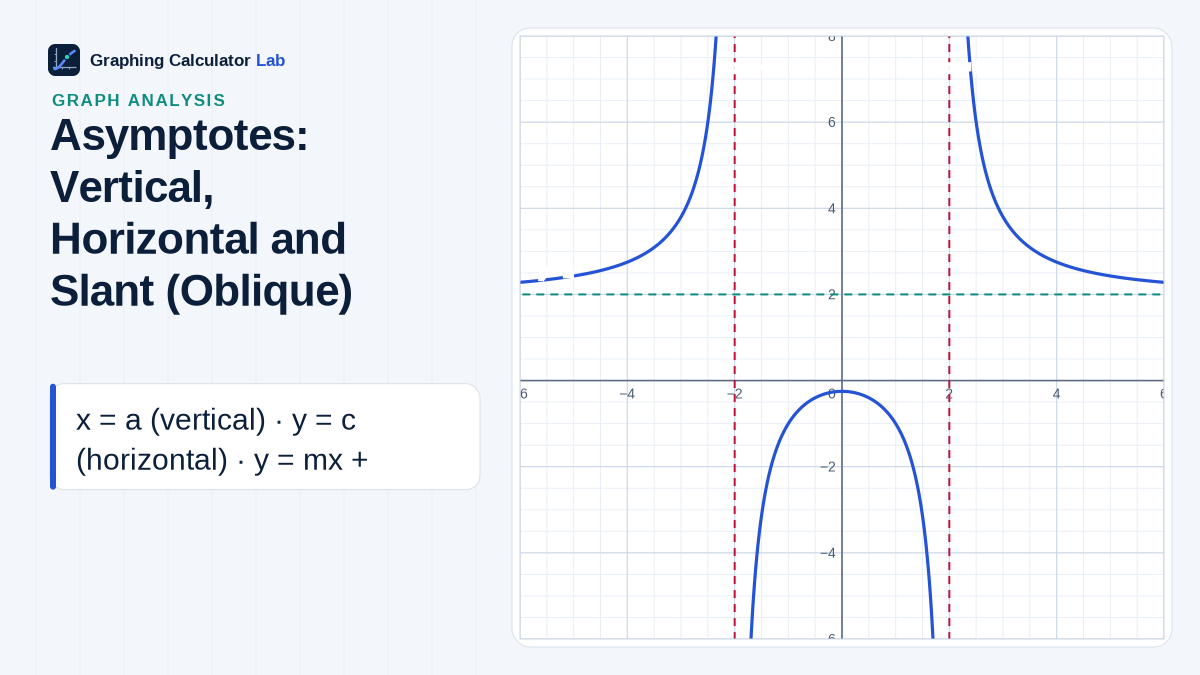
Check it yourself: every example here can be loaded into the Asymptote Calculator.
Open the Asymptote CalculatorWhat an asymptote is
An asymptote is a line the graph gets closer and closer to without settling on it. There are three types:
| Type | Equation | Describes |
|---|---|---|
| Vertical | x = a | the graph shoots up or down near x = a |
| Horizontal | y = c | the graph levels off as x → ±∞ |
| Slant (oblique) | y = mx + b | the graph approaches a tilted line as x → ±∞ |
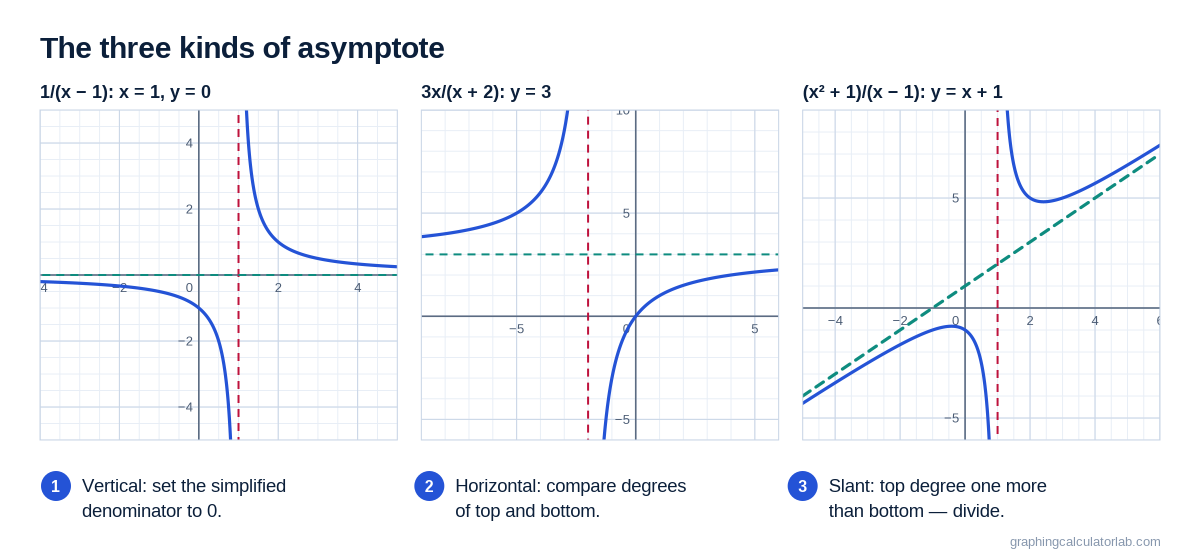
Text description of this figure
Three panels: y = 1/(x − 1) with vertical asymptote x = 1 and horizontal asymptote y = 0; y = 3x/(x + 2) with horizontal asymptote y = 3; y = (x² + 1)/(x − 1) with vertical asymptote x = 1 and slant asymptote y = x + 1.
- Vertical: set the simplified denominator to 0.
- Horizontal: compare degrees of top and bottom.
- Slant: top degree one more than bottom — divide.
Vertical asymptotes
For a rational function, simplify first, then set the denominator to zero.
- f(x) = 1⁄(x − 1): x − 1 = 0 → x = 1.
- f(x) = (2x² + 1)⁄(x² − 4) = (2x² + 1)⁄((x − 2)(x + 2)): x = −2 and x = 2.
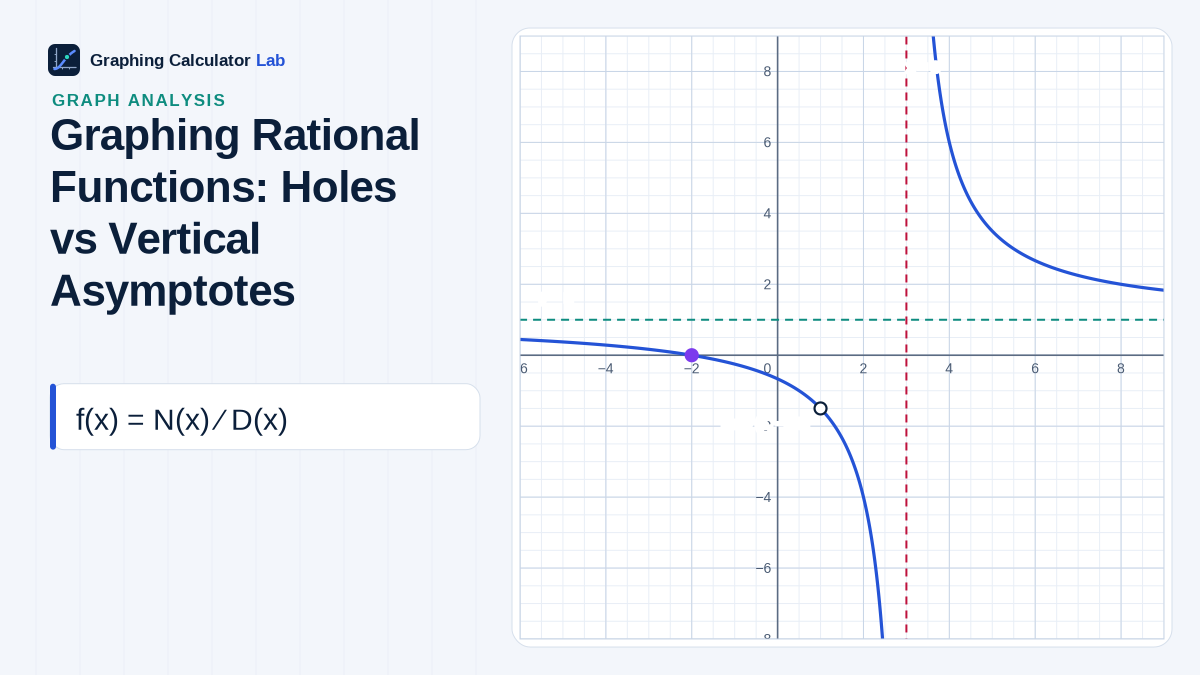
- f(x) = (x² − 1)⁄(x − 1) = x + 1 (for x ≠ 1): no vertical asymptote — the cancelled factor leaves a hole at (1, 2). See holes vs vertical asymptotes.
Near a vertical asymptote the function grows without bound. If the factor appears an odd number of times, the two sides go in opposite directions (+∞ and −∞); if even, they go the same way.
- Asymptotes of (2x² + 1)/(x² − 4) — opens the Asymptote Calculator
Horizontal asymptote rules
Compare the degree of the numerator (n) with the degree of the denominator (d):
| Case | Horizontal asymptote | Example |
|---|---|---|
| n < d | y = 0 | (x + 3)⁄(x² + 1) → y = 0 |
| n = d | y = (leading coef. of N) ⁄ (leading coef. of D) | 3x⁄(x + 2) → y = 3 |
| n > d | none | x²⁄(x + 1) has a slant one instead |
Why it works: for large |x| the highest powers dominate. In (2x² + 1)⁄(x² − 4), both top and bottom behave like 2x² and x², so the ratio approaches 2.
- Horizontal asymptote of 3x/(x + 2) — opens the Asymptote Calculator
Slant (oblique) asymptotes
When the numerator’s degree is exactly one more than the denominator’s, divide. The quotient (a linear expression) is the slant asymptote; the remainder fades away.
For (x² + 1)⁄(x − 1): long division gives x + 1 with remainder 2, so
As x → ±∞, 2⁄(x − 1) → 0, so the graph approaches y = x + 1.
If the numerator is two or more degrees higher, there is no straight-line asymptote: the graph follows a polynomial curve. For x³⁄(x − 1), the end behaviour is like x², not a line.
- Slant asymptote of (x² + 1)/(x − 1) — opens the Asymptote Calculator
Asymptotes outside rational functions
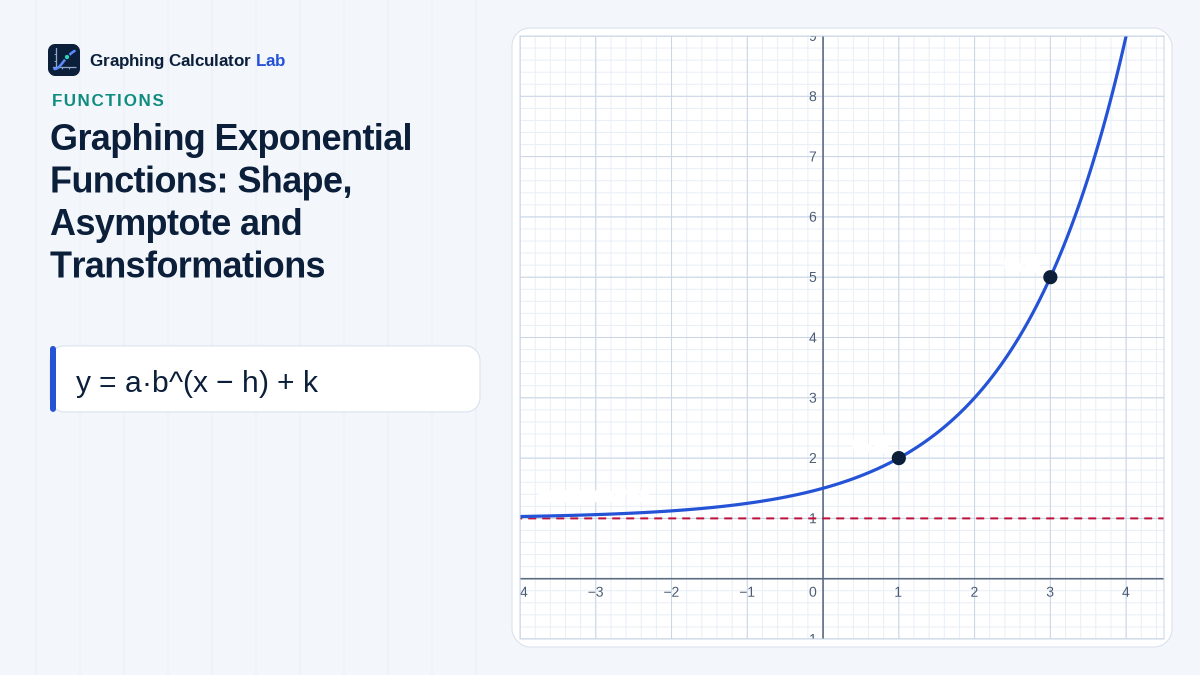
- Exponentials: y = a·bˣ + k has the horizontal asymptote y = k. See graphing exponential functions.
- Logarithms: y = log_b(x − h) has the vertical asymptote x = h.
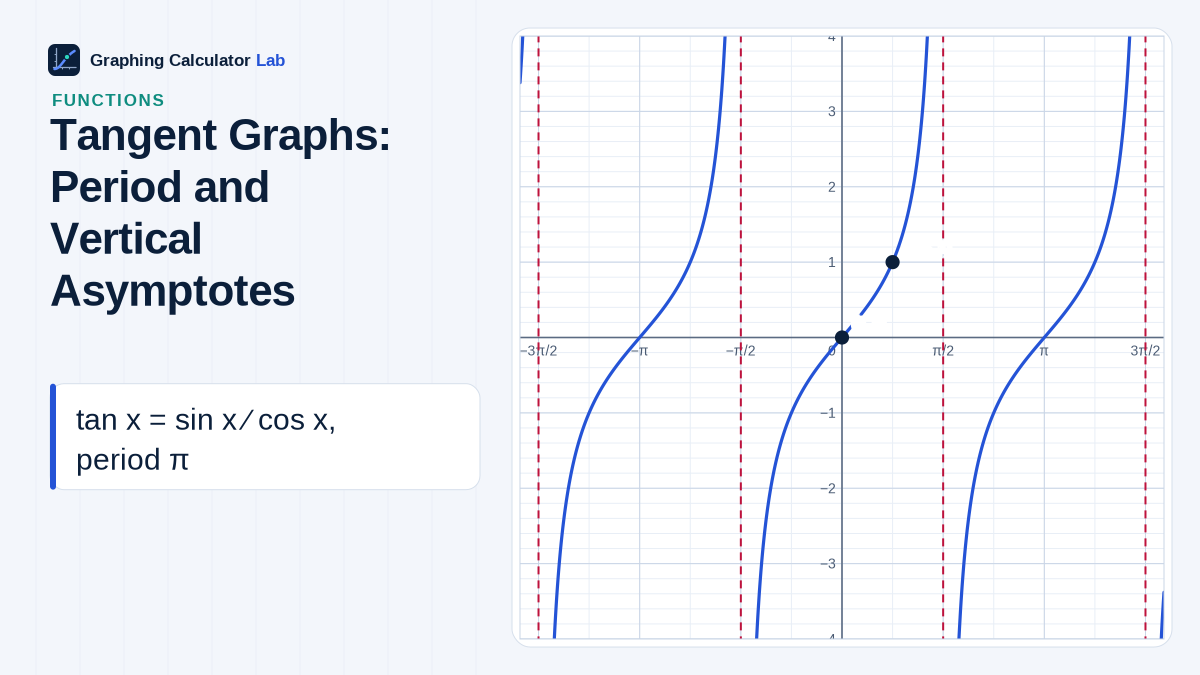
- Tangent: vertical asymptotes at x = π/2 + kπ. See tangent graphs.
Common mistakes
- Not cancelling common factors first — this turns holes into false asymptotes.
- Using degrees on unsimplified expressions like (x² − 1)⁄(x − 1); the result is right here, but the vertical asymptote is not.
- Claiming a graph never crosses a horizontal asymptote. It can.
- Drawing the curve across a vertical asymptote. Each side is a separate branch; the calculator never connects them.
Questions
Can a graph cross an asymptote?
It can cross a horizontal or slant asymptote (those describe behaviour far away), but never a vertical asymptote, where the function is undefined.
Can a function have two horizontal asymptotes?
Rational functions cannot, but other functions can — for example arctan x approaches π/2 on the right and −π/2 on the left.
Do exponential and log functions have asymptotes?
Yes. y = bˣ has the horizontal asymptote y = 0, and y = log_b x has the vertical asymptote x = 0.
Graph your own example with the Asymptote Calculator — free, in your browser.
Try it nowSources and further reading
- OpenStax, College Algebra 2e — 5.6 Rational Functions
- OpenStax, Calculus Volume 1 — 4.6 Limits at Infinity and Asymptotes
Worked examples and figures were produced and checked with the Graphing Calculator Lab engine. See the editorial policy.