Functions
Absolute Value Functions: Graph, Vertex and Transformations
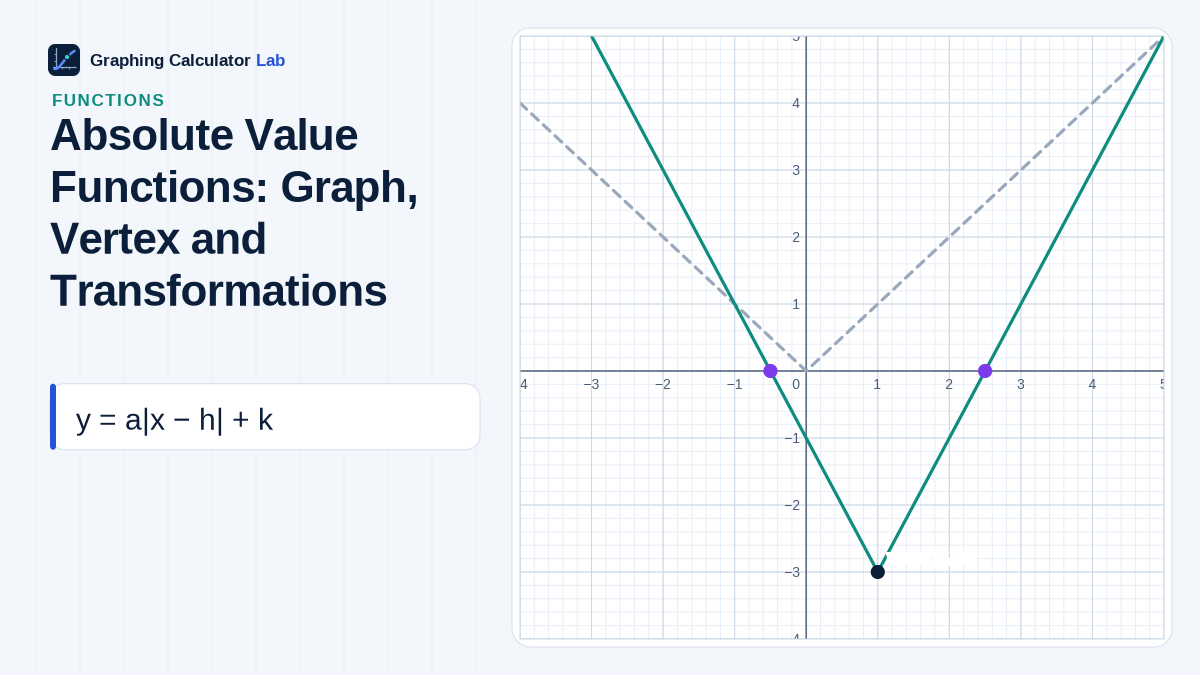
Graph y = a|x − h| + k: find the vertex, the direction of the V, the slopes of each side, the intercepts and the domain and range, with worked examples.
Graph y = a|x − h| + k and get the vertex, the direction it opens, the slope of each side, the intercepts, the domain and range, and the equivalent piecewise form.
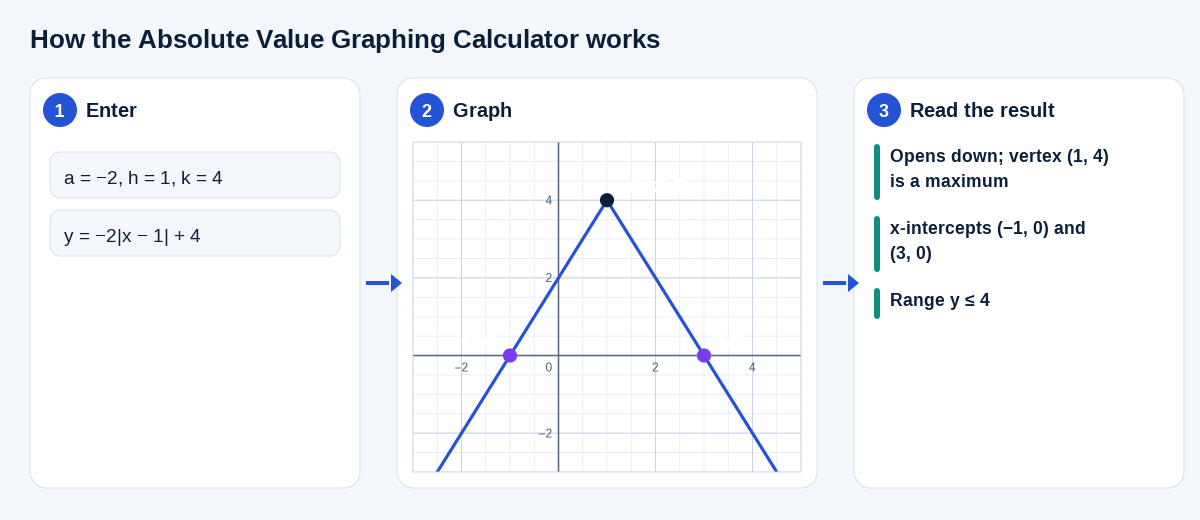
y = a|x − h| + k. Fractions such as 1/2 are fine.
Guides: absolute value functions, function transformations and piecewise functions.
At (h, k). It is the lowest point when a > 0 and the highest point when a < 0.
The right side has slope a and the left side has slope −a. For y = 2|x| the sides rise with slope 2 to the right and fall with slope −2 to the left.
Split at the vertex: y = −a(x − h) + k for x < h, and y = a(x − h) + k for x ≥ h. The calculator shows this form for your values.
If the V opens upward and the vertex is above the x-axis (a > 0, k > 0), the graph never reaches y = 0. The same happens for a downward V whose vertex is below the axis.
Graph y = a|x − h| + k: find the vertex, the direction of the V, the slopes of each side, the intercepts and the domain and range, with worked examples.
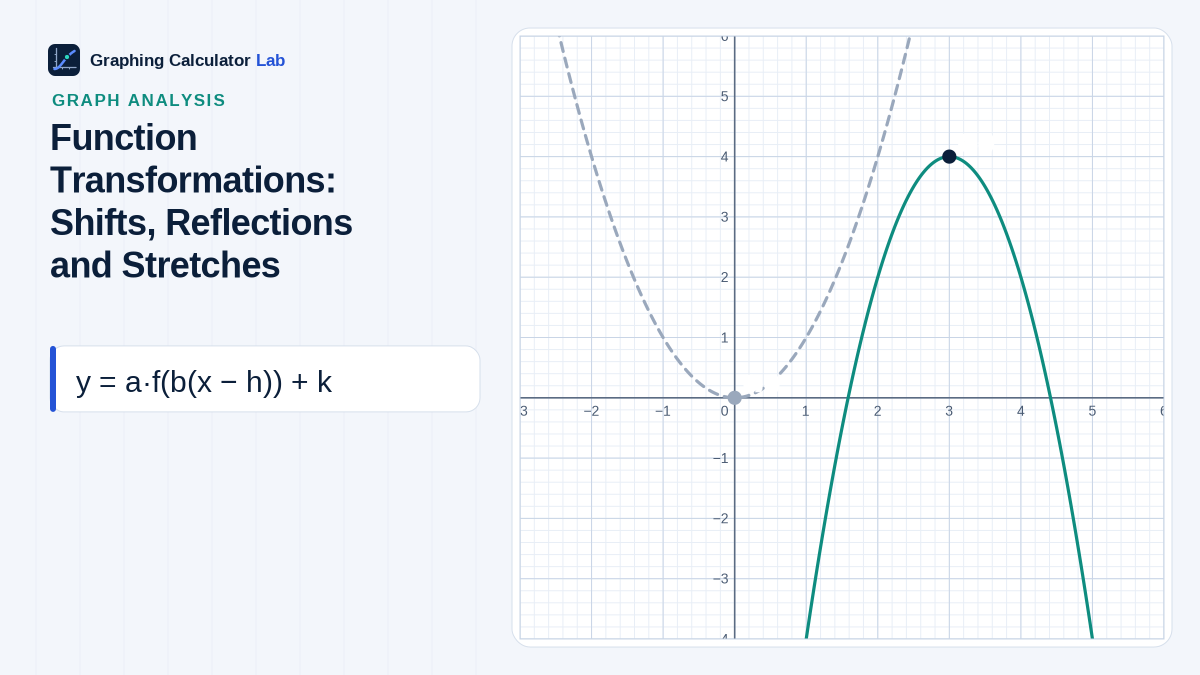
How f(x) + k, f(x − h), −f(x), f(−x), a·f(x) and f(bx) move a graph — with a summary table, worked examples and the order to apply them.
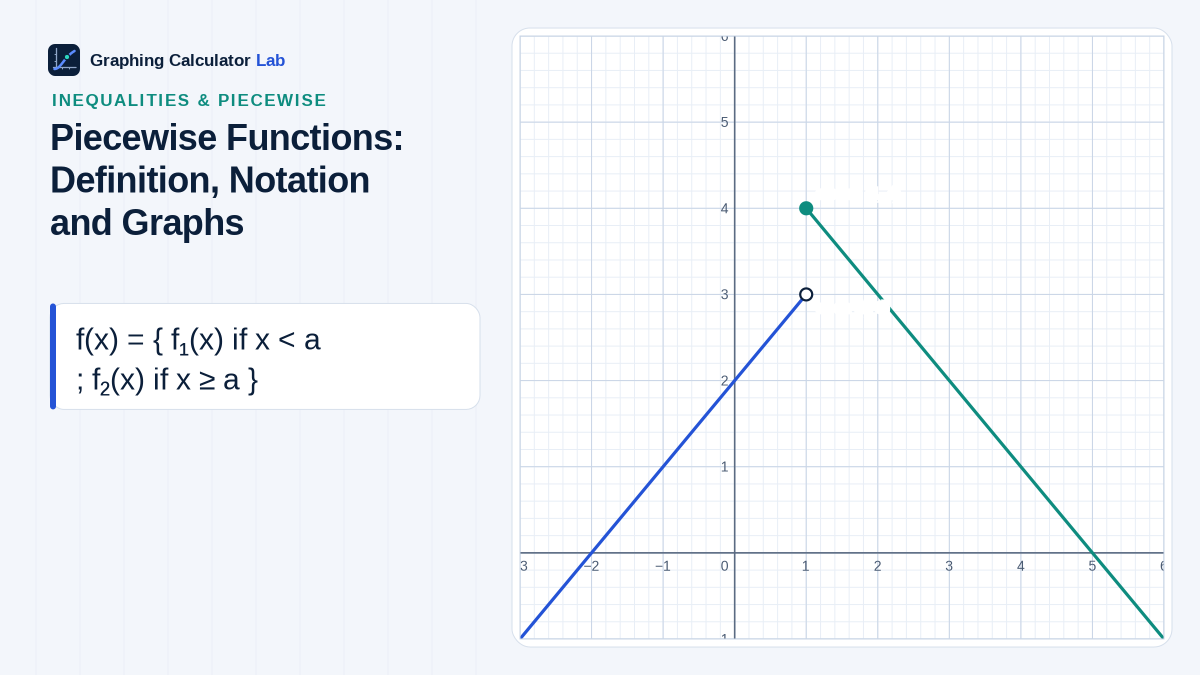
What a piecewise function is, how to read its notation, and how to graph each branch with the correct open and closed circles at the endpoints.
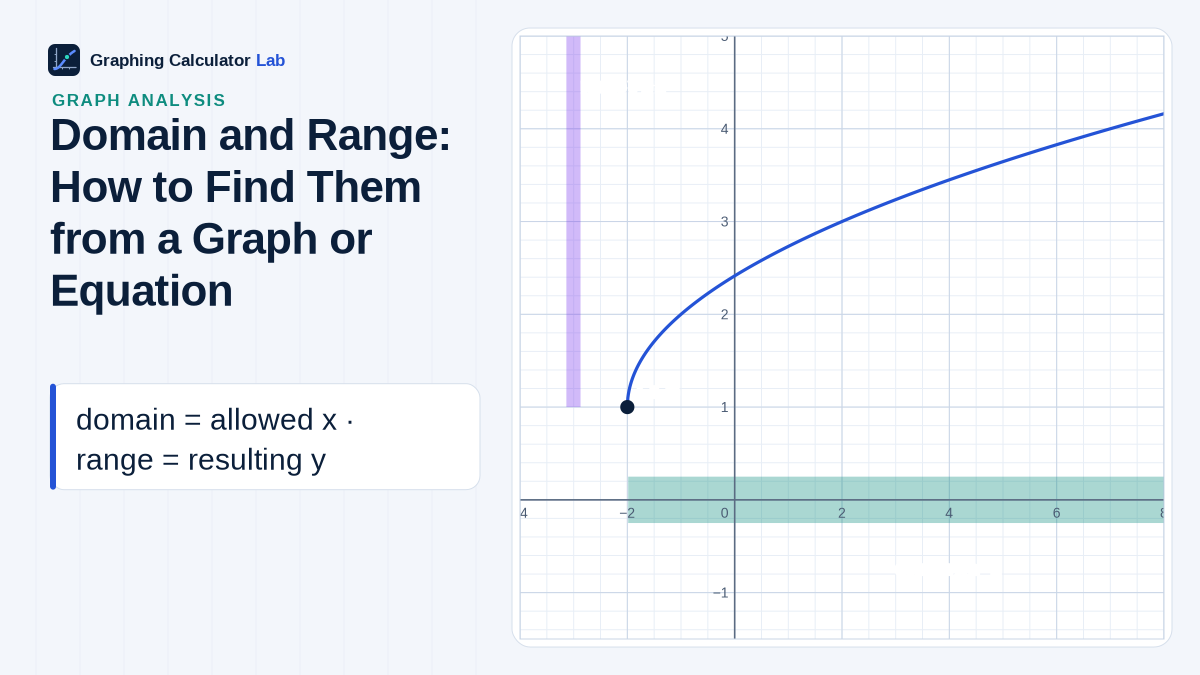
What domain and range mean, how to read them from a graph by projecting onto the axes, how to find them from an equation, and how to write them in interval notation.
Branch editor with open/closed endpoints, overlap checks and evaluation.
Standard ↔ vertex form with steps, vertex, axis, roots, max/min and graph.
Plot several functions, points and inequalities; find roots, intersections and turning points.