Square Root vs Cube Root Functions: Graphs and Domains
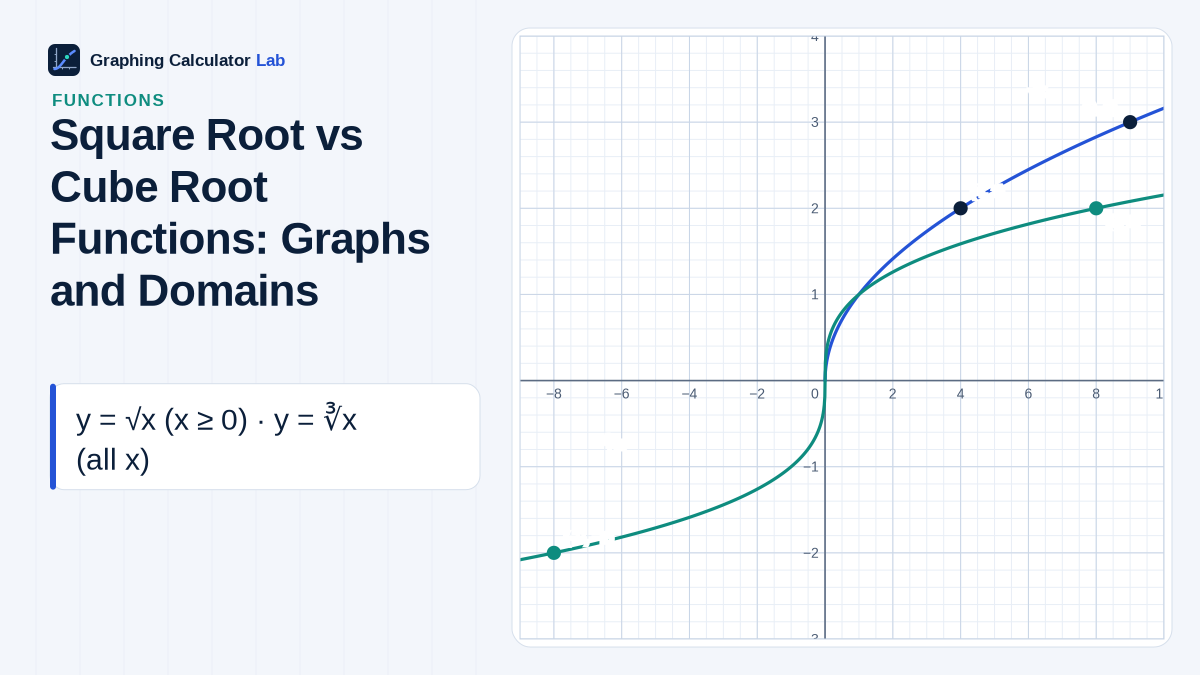
The square root function y = √x is defined only for x ≥ 0: its graph starts at (0, 0) and rises slowly to the right. The cube root function y = ∛x is defined for every real x, because negative numbers have real cube roots: its graph passes through (−8, −2), (0, 0) and (8, 2) and is symmetric about the origin.
Check it yourself: every example here can be loaded into the Graphing Calculator.
Open the Graphing CalculatorThe two parent functions
| y = √x | y = ∛x | |
|---|---|---|
| Domain | x ≥ 0 | all real numbers |
| Range | y ≥ 0 | all real numbers |
| Key points | (0, 0), (1, 1), (4, 2), (9, 3) | (−8, −2), (−1, −1), (0, 0), (1, 1), (8, 2) |
| Shape | half of a sideways parabola | an S lying on its side |
| Symmetry | none | odd: ∛(−x) = −∛x |
| Inverse of | x² for x ≥ 0 | x³ |
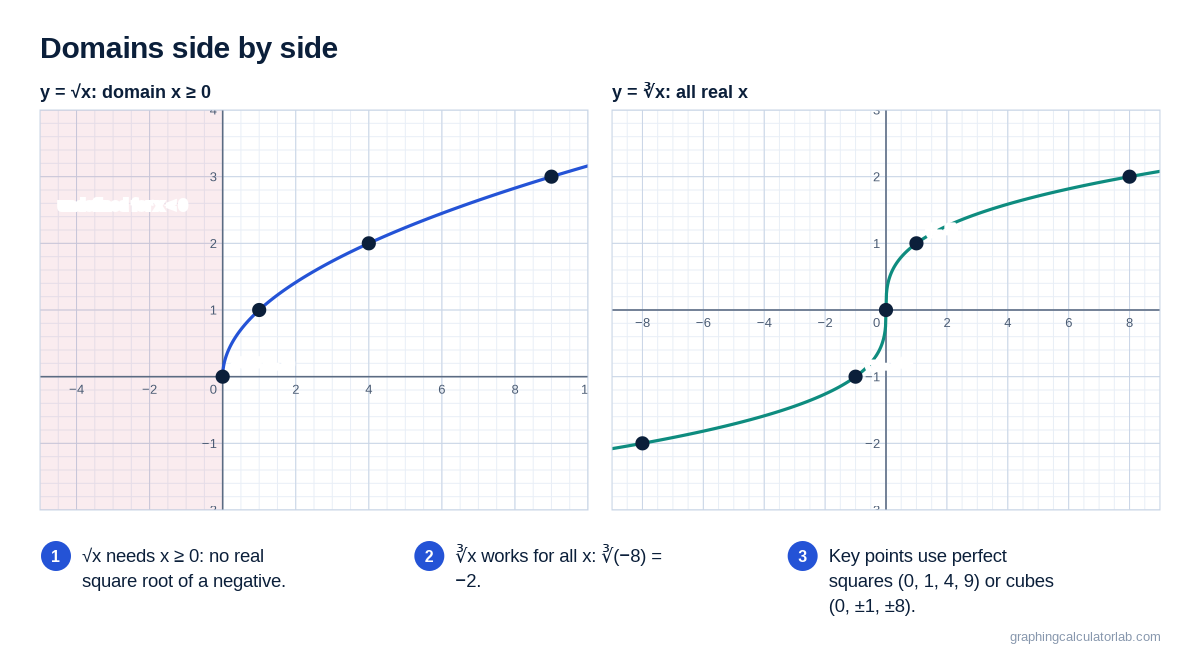
Text description of this figure
Two panels. Left: y = √x with the region x < 0 shaded as excluded and the starting point (0, 0). Right: y = ∛x defined for all x with points (−1, −1), (0, 0) and (1, 1).
- √x needs x ≥ 0: no real square root of a negative.
- ∛x works for all x: ∛(−8) = −2.
- Key points use perfect squares (0, 1, 4, 9) or cubes (0, ±1, ±8).
Why the domains differ
A square root asks “what non-negative number squared gives x?”. Squares are never negative, so there is no real answer for x < 0 — the graph simply does not exist there.
A cube root asks “what number cubed gives x?”. Cubes can be negative: (−2)³ = −8. So every real x has exactly one real cube root, and the graph continues to the left as a mirror image (through the origin) of the right half.
- Compare √x and ∛x — opens the Graphing Calculator
Shapes up close
- Both curves are steepest near the origin and flatten as |x| grows.
- √x starts with a vertical tangent at (0, 0) and turns right.
- ∛x passes through the origin with a vertical tangent, bending one way on the right and the opposite way on the left.
Transformations
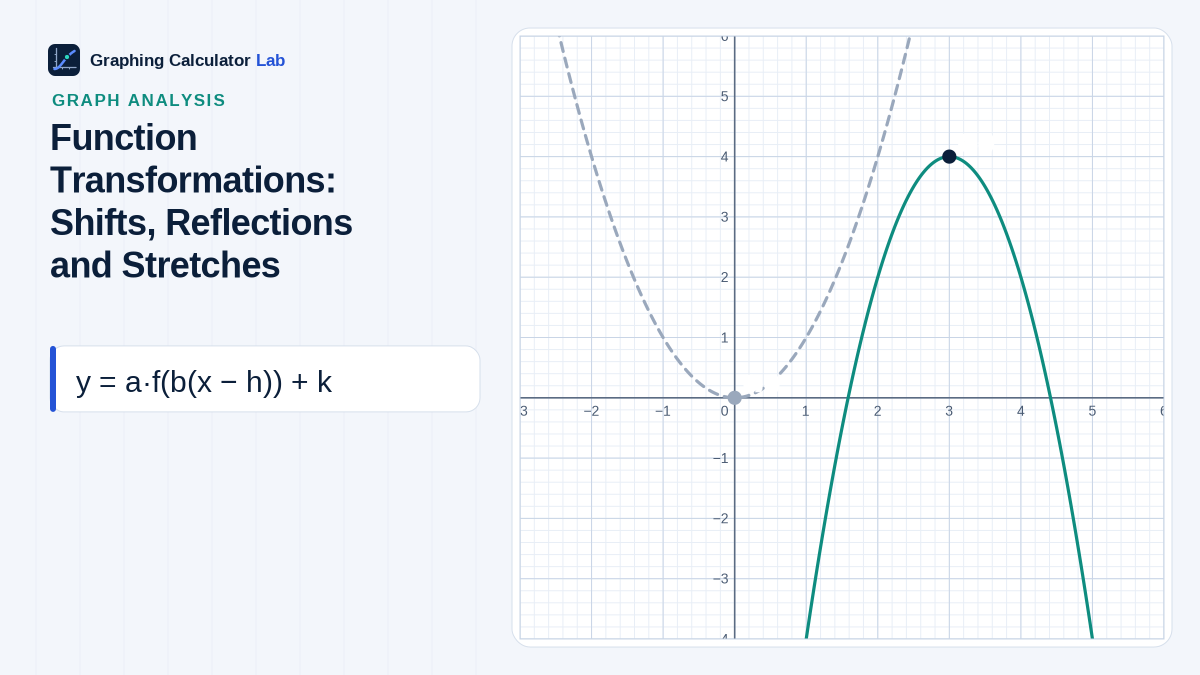
The usual rules apply (see function transformations):
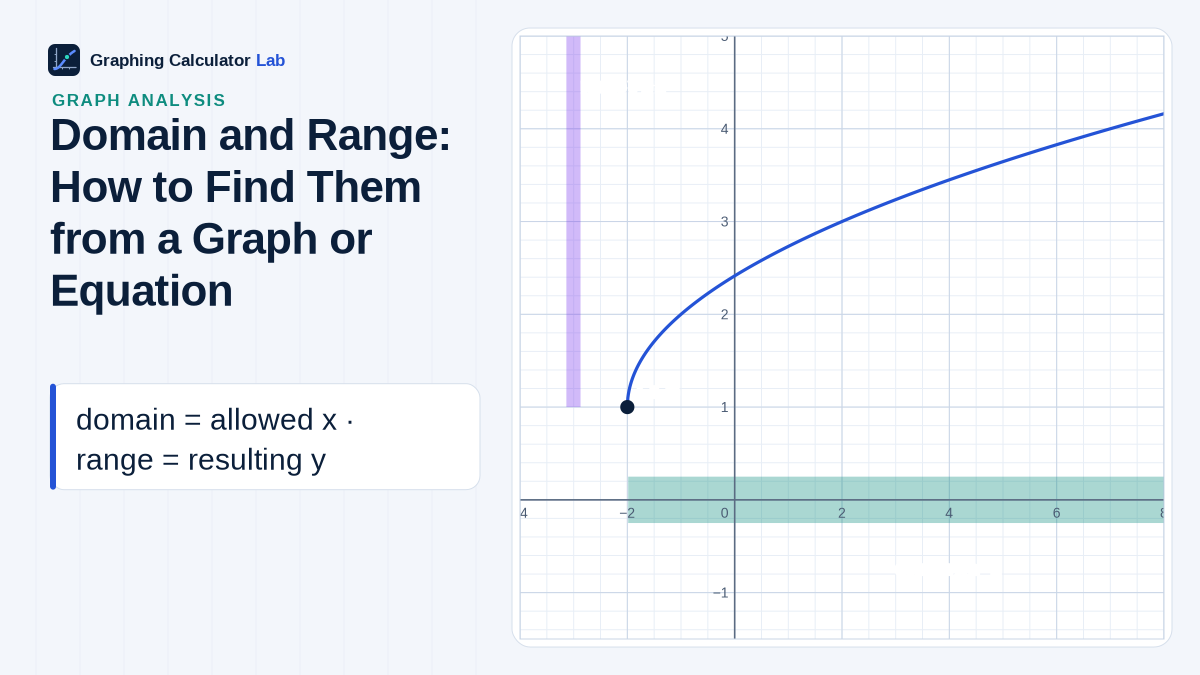
- y = √(x − 2) + 1 — start point moves from (0, 0) to (2, 1); domain x ≥ 2; range y ≥ 1.
- y = −∛(x + 1) — centre moves to (−1, 0) and the graph is flipped vertically.
- y = √(−x) — reflected in the y-axis; domain x ≤ 0.
- y = 2√x — stretched vertically: (4, 4) instead of (4, 2).
For a transformed square root a√(b(x − h)) + k, the domain comes from b(x − h) ≥ 0.
- Transformations: √(x − 2) + 1 and −∛(x + 1) — opens the Graphing Calculator
Finding the domain of a square-root expression
Set the expression under the root ≥ 0 and solve:
- √(2x − 6): 2x − 6 ≥ 0 → x ≥ 3.
- √(5 − x): 5 − x ≥ 0 → x ≤ 5.
- √(x² − 4): x² ≥ 4 → x ≤ −2 or x ≥ 2.
Cube roots never restrict the domain. See domain and range for more.
Common mistakes
- Plotting √x for negative x. There is nothing there.
- Leaving out the negative half of ∛x.
- Writing √x as x^(1/3). Square root is the power ½; cube root is ⅓.
- Choosing awkward x-values. Use perfect squares for √ and perfect cubes for ∛ to get exact points.
Questions
Why does √(−4) not exist but ∛(−8) does?
No real number squared is negative, but (−2)³ = −8. Odd roots of negatives are real; even roots are not.
Is x^(1/3) the same as cbrt(x)?
Mathematically yes for real numbers. Some software returns an error for negative x with x^(1/3); this site returns the real cube root for both.
Does √x have a maximum?
No. It keeps increasing without bound, although more and more slowly.
Graph your own example with the Graphing Calculator — free, in your browser.
Try it nowSources and further reading
- OpenStax, College Algebra 2e — 5.7 Inverses and Radical Functions
- OpenStax, College Algebra 2e — 3.5 Transformation of Functions
Worked examples and figures were produced and checked with the Graphing Calculator Lab engine. See the editorial policy.