Absolute Value Functions: Graph, Vertex and Transformations
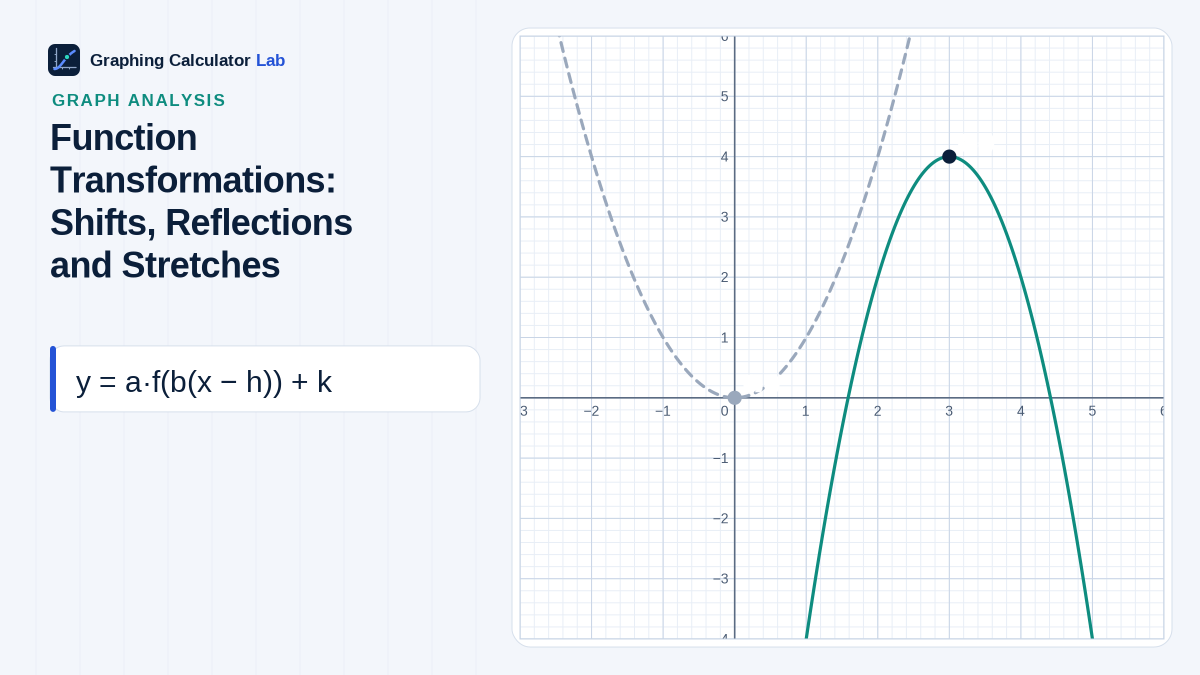
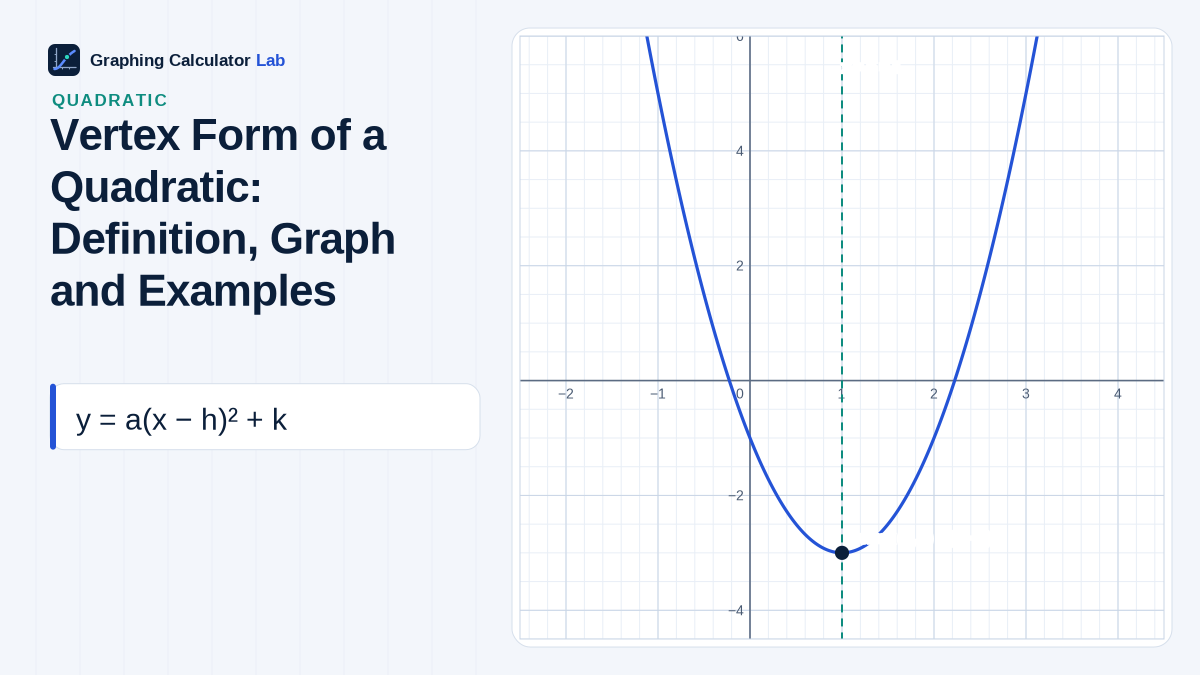
The absolute value function f(x) = |x| gives the distance of x from 0, so its graph is a V with vertex at the origin and sides of slope 1 and −1. For y = a|x − h| + k the vertex is (h, k), the V opens up if a > 0 and down if a < 0, and the two sides have slopes a and −a.
Check it yourself: every example here can be loaded into the Absolute Value Graphing Calculator.
Open the Absolute Value Graphing CalculatorThe parent function y = |x|
The absolute value of a number is its distance from 0, so it is never negative: |3| = 3 and |−3| = 3.
| x | −3 | −2 | −1 | 0 | 1 | 2 | 3 |
|---|---|---|---|---|---|---|---|
| |x| | 3 | 2 | 1 | 0 | 1 | 2 | 3 |
The graph is a V with:
- vertex (0, 0), the minimum point,
- right side y = x (slope 1) and left side y = −x (slope −1),
- symmetry about the y-axis,
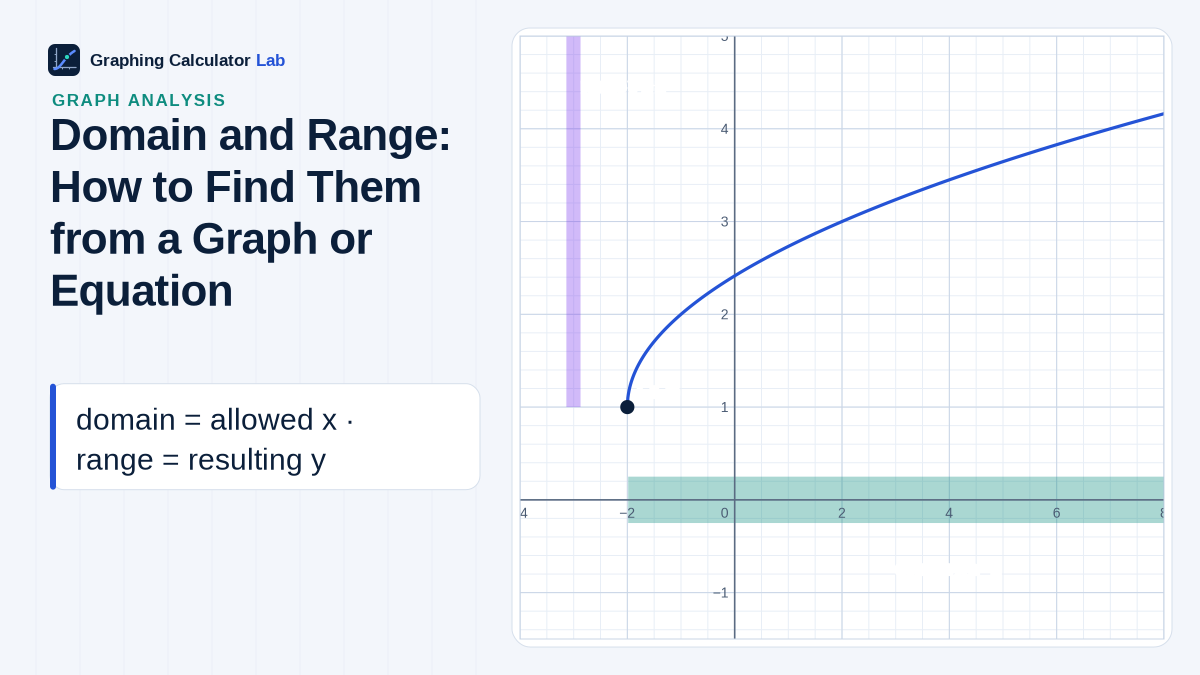
- domain all real numbers and range y ≥ 0.
The general form
| Parameter | Effect |
|---|---|
| (h, k) | vertex |
| sign of a | opens up (a > 0) or down (a < 0) |
| |a| | steepness: slopes are a and −a |
| x = h | axis of symmetry |
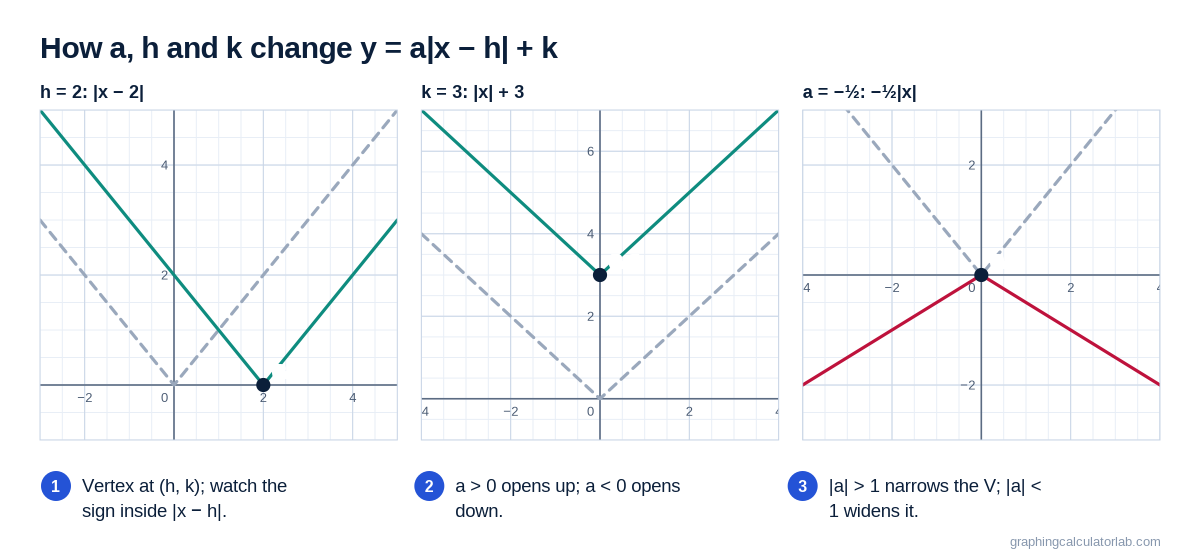
Text description of this figure
Three panels: y = |x − 2| moved right 2; y = |x| + 3 moved up 3; y = −0.5|x| flipped and widened.
- Vertex at (h, k); watch the sign inside |x − h|.
- a > 0 opens up; a < 0 opens down.
- |a| > 1 narrows the V; |a| < 1 widens it.
Worked example: y = 2|x − 1| − 3
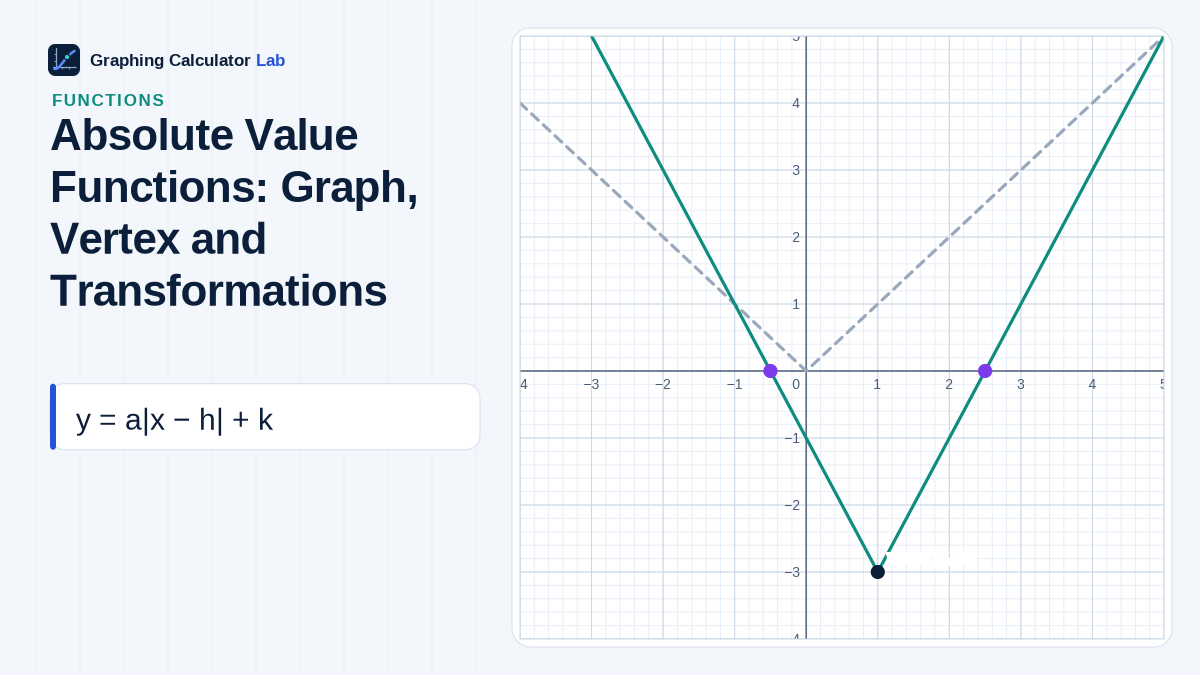
- Vertex: (1, −3). a = 2 > 0, so it is a minimum and the V opens up.
- Slopes: right side 2, left side −2.
- Points: from the vertex, 1 right and 2 up gives (2, −1); 1 left and 2 up gives (0, −1).
- y-intercept: y = 2|0 − 1| − 3 = −1, matching (0, −1).
- x-intercepts: 2|x − 1| = 3 → |x − 1| = 1.5 → x = −0.5 or x = 2.5.
- Range: y ≥ −3.
- Graph y = 2|x − 1| − 3 — opens the Absolute Value Graphing Calculator
Worked example: y = −½|x + 2| + 4
- Rewrite the bracket: x + 2 = x − (−2), so h = −2. Vertex (−2, 4), a maximum because a < 0.
- Slopes −½ to the right and +½ to the left — a wide, upside-down V.
- x-intercepts: ½|x + 2| = 4 → |x + 2| = 8 → x = 6 or x = −10.
- Range: y ≤ 4.
- Graph y = −½|x + 2| + 4 — opens the Absolute Value Graphing Calculator
Writing it as a piecewise function
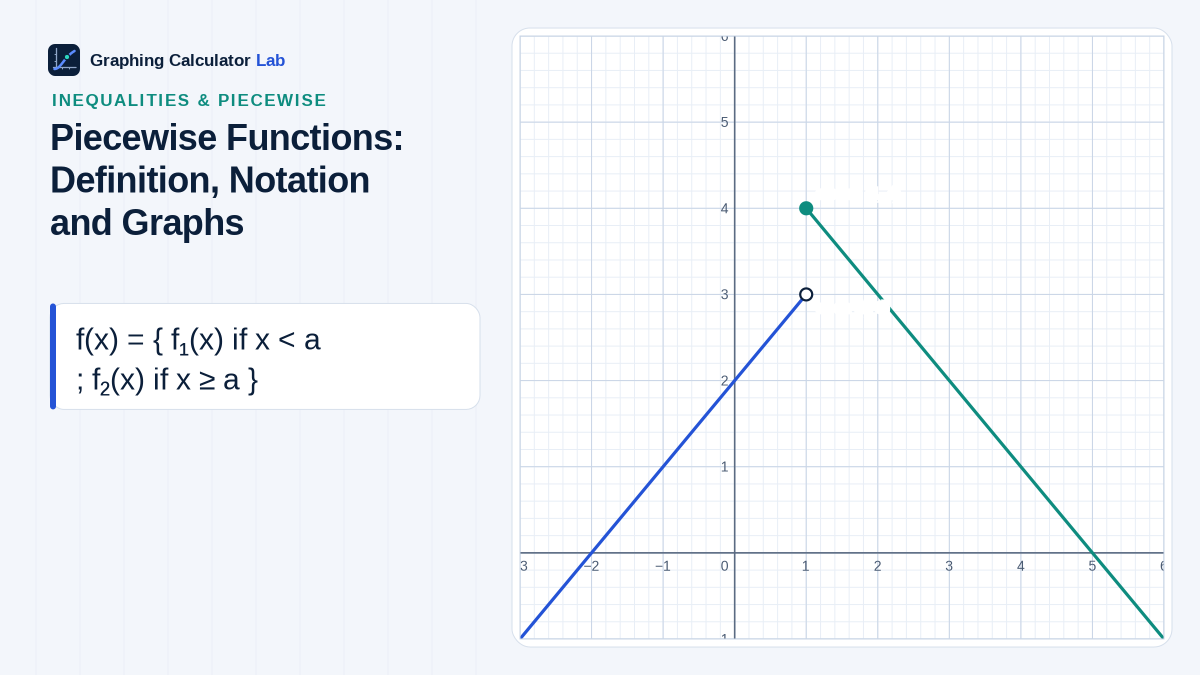
Split at the vertex x = h:
For y = 2|x − 1| − 3: y = −2x − 1 for x < 1 and y = 2x − 5 for x ≥ 1. See piecewise functions.
Solving absolute value equations graphically
To solve |x − 1| = 3, graph y = |x − 1| and y = 3: they meet at x = −2 and x = 4. An equation like |x − 1| = −2 has no solution — the horizontal line y = −2 never meets the V.
Common mistakes
- Wrong direction for h. |x + 4| has its vertex at x = −4.
- Drawing a rounded bottom. The vertex is a sharp corner.
- Thinking a negative a gives negative slopes on both sides. One side is always positive and one negative.
- Typing |x| in a calculator. Use abs(x) — see how to enter equations.
Questions
Why is the graph a V and not a curve?
|x| equals x for x ≥ 0 and −x for x < 0. Both pieces are straight lines, so the graph is two rays meeting at a corner.
How do I find the x-intercepts?
Set y = 0 and solve |x − h| = −k/a. If −k/a is positive there are two answers, h ± (−k/a); if it is zero there is one; if negative, none.
Is the absolute value function piecewise?
Yes. y = |x| can be written as y = −x for x < 0 and y = x for x ≥ 0. The absolute value calculator shows the piecewise form for any a, h and k.
Graph your own example with the Absolute Value Graphing Calculator — free, in your browser.
Try it nowSources and further reading
- OpenStax, College Algebra 2e — 3.6 Absolute Value Functions
- OpenStax, College Algebra 2e — 3.5 Transformation of Functions
Worked examples and figures were produced and checked with the Graphing Calculator Lab engine. See the editorial policy.