Vertex Form of a Quadratic: Definition, Graph and Examples
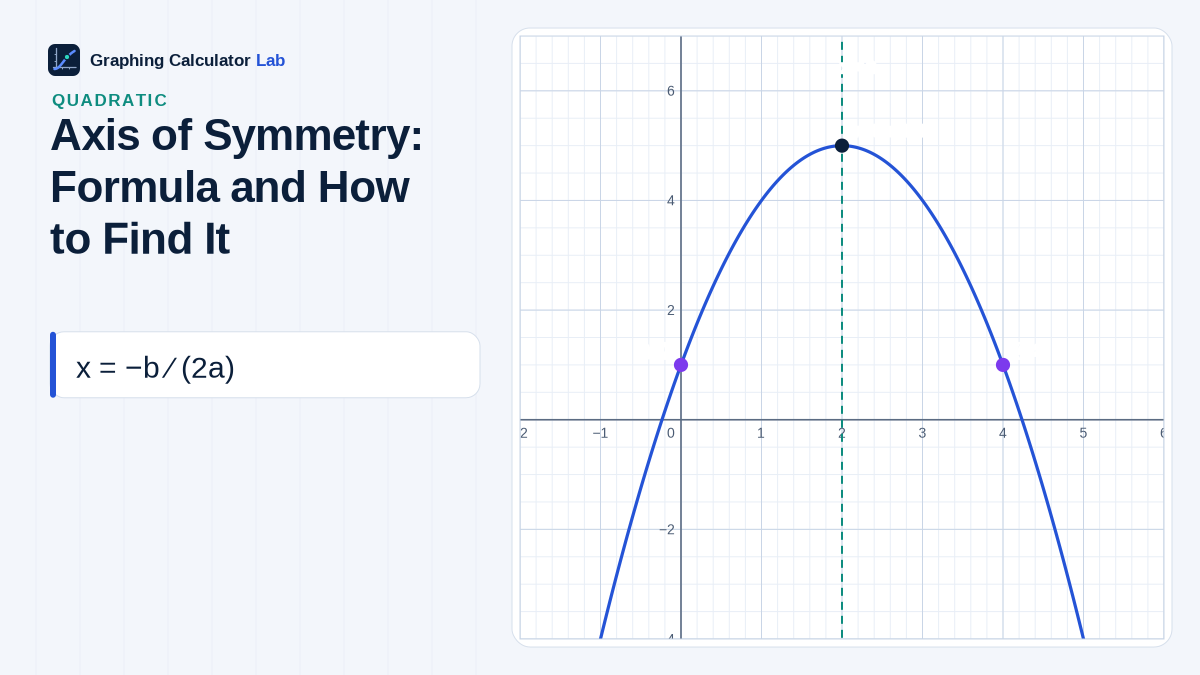
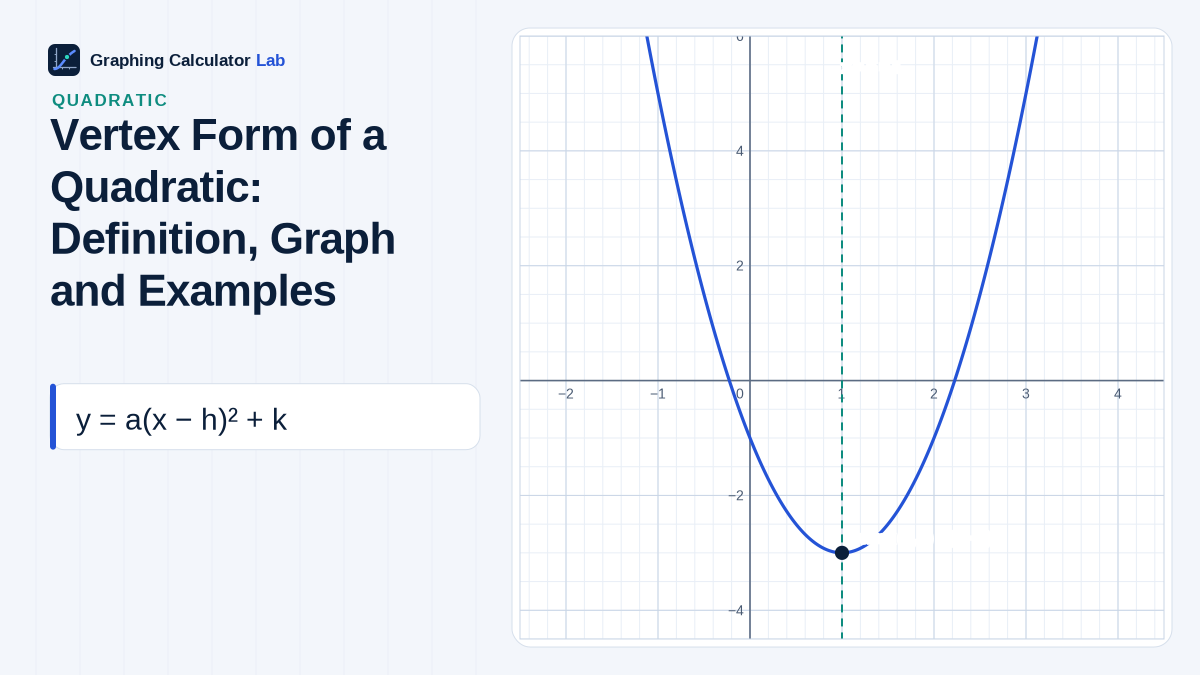
Vertex form is a way of writing a quadratic function as y = a(x − h)² + k. The point (h, k) is the vertex — the turning point of the parabola — and x = h is its axis of symmetry. The number a decides whether the parabola opens up (a > 0) or down (a < 0) and how narrow it is.
Check it yourself: every example here can be loaded into the Vertex Form Calculator.
Open the Vertex Form CalculatorWhat vertex form tells you
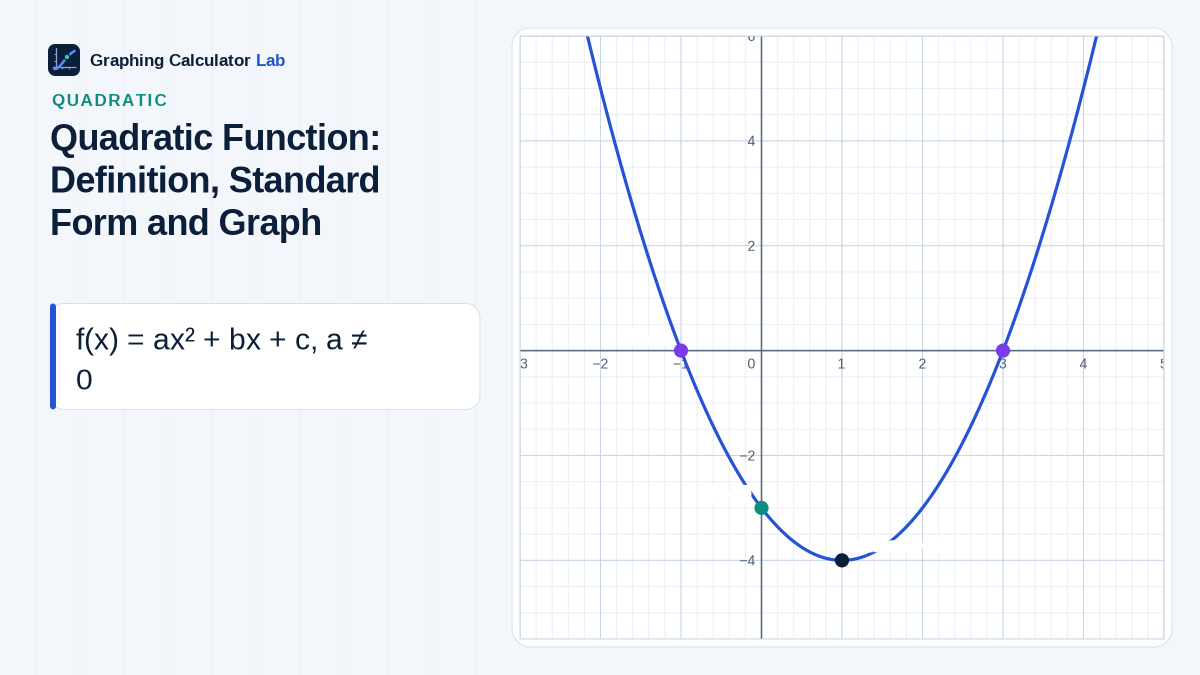
Every quadratic function graphs as a parabola, a U-shaped curve with one turning point called the vertex. Vertex form is the version of the equation that puts that turning point on display:
| Part | Meaning | Example: y = 2(x − 1)² − 3 |
|---|---|---|
| a | Direction and width. a > 0 opens up; a < 0 opens down; larger |a| is narrower | a = 2, opens up, narrower than y = x² |
| h | x-coordinate of the vertex (note the minus sign in the bracket) | h = 1 |
| k | y-coordinate of the vertex — the minimum or maximum value | k = −3 |
| x = h | Axis of symmetry, the vertical line through the vertex | x = 1 |
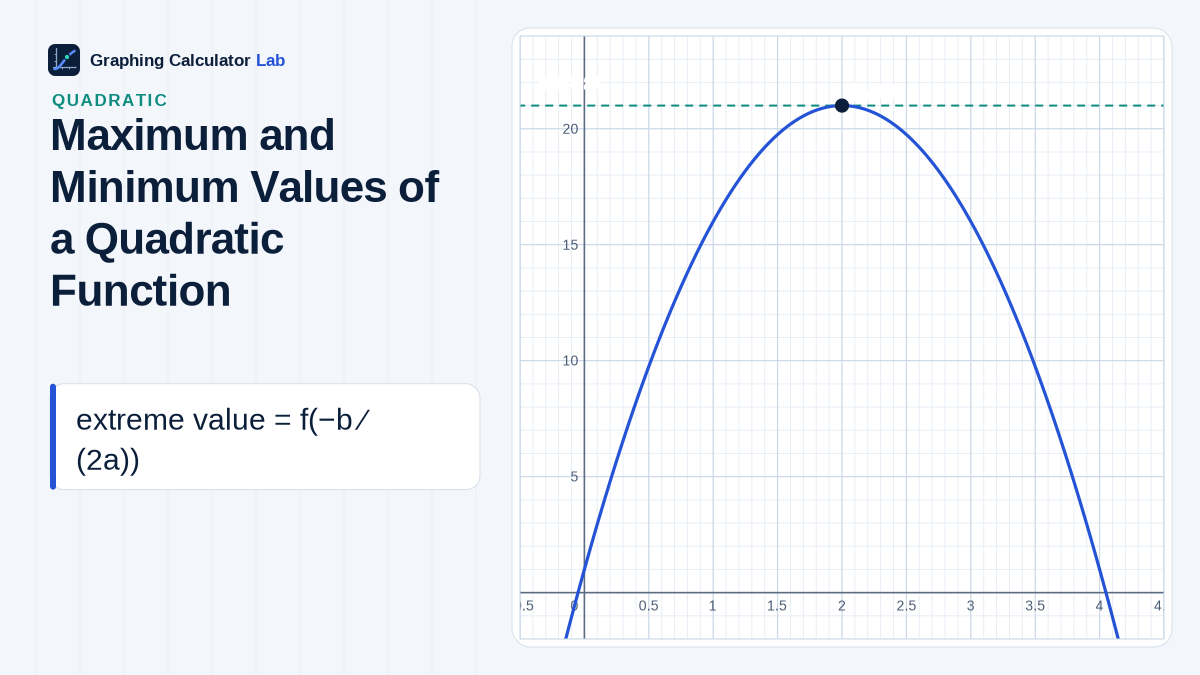
The reason it works is simple: (x − h)² is never negative and equals 0 only when x = h. So when a > 0 the smallest value of a(x − h)² is 0, reached at x = h, and the smallest value of y is k. When a < 0 the same point becomes the largest value.
How to read h correctly
The bracket is written as (x − h), so the number you see inside has the opposite sign of h:
- y = (x − 4)² + 1 → h = 4, vertex (4, 1)
- y = (x + 4)² + 1 = (x − (−4))² + 1 → h = −4, vertex (−4, 1)
- y = 3x² − 5 → there is no bracket shift, so h = 0 and the vertex is (0, −5)
This is the most common slip with vertex form. A quick check: substitute x = h. The bracket must become zero.
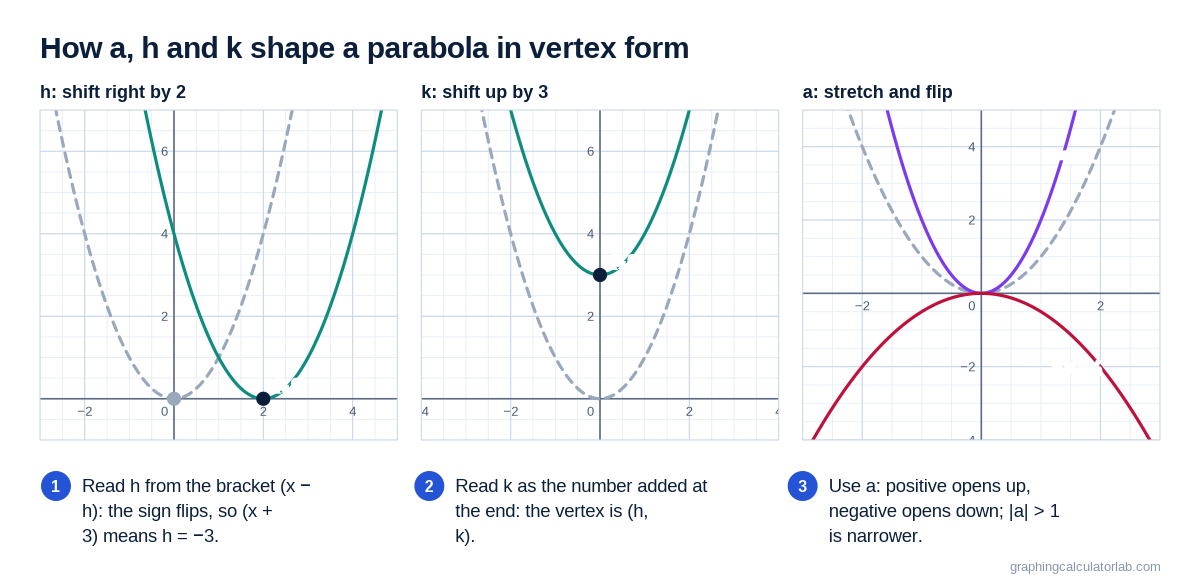
Text description of this figure
Three panels. Left: y = x² and y = (x − 2)² showing a shift right by h = 2. Middle: y = x² and y = x² + 3 showing a shift up by k = 3. Right: y = x², y = 2x² and y = −0.5x² showing how a stretches and flips the graph.
- Read h from the bracket (x − h): the sign flips, so (x + 3) means h = −3.
- Read k as the number added at the end: the vertex is (h, k).
- Use a: positive opens up, negative opens down; |a| > 1 is narrower.
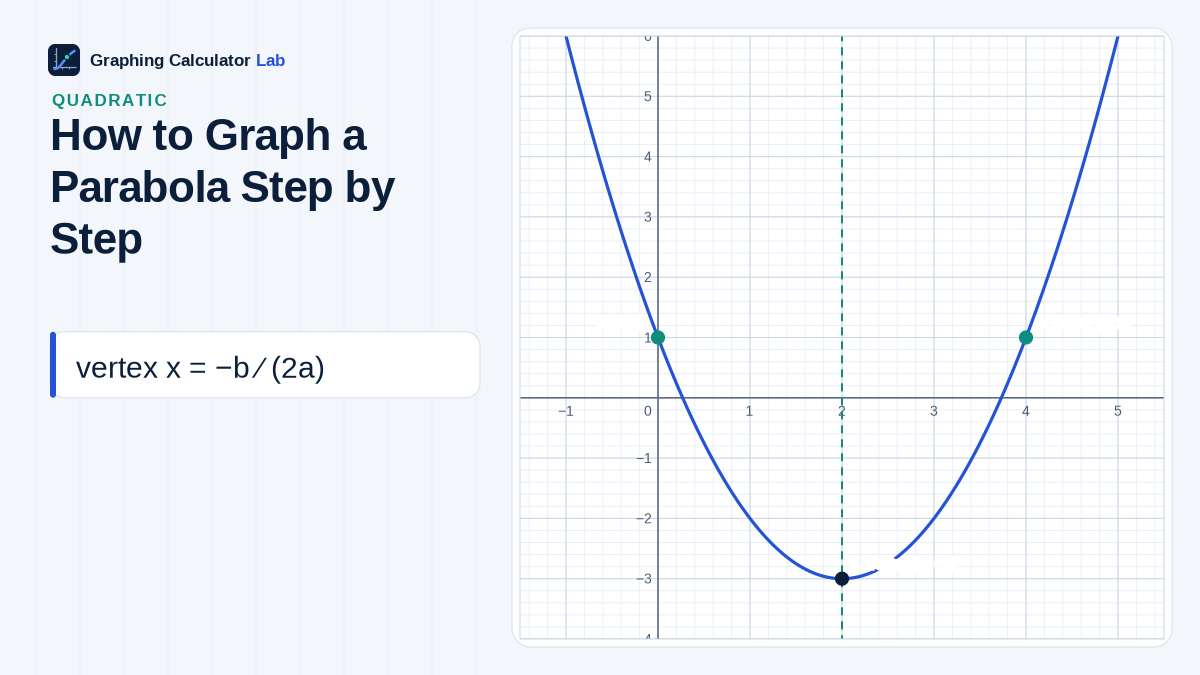
How to graph a parabola from vertex form
Take y = 2(x − 1)² − 3.
- Plot the vertex (h, k) = (1, −3) and draw the dashed axis of symmetry x = 1.
- Decide the direction. a = 2 is positive, so the parabola opens upward and (1, −3) is the minimum.
- Step out one unit each way. At x = 0 and x = 2 the bracket is ±1, so y = 2(1) − 3 = −1. Plot (0, −1) and (2, −1).
- Step out two units. At x = −1 and x = 3, y = 2(4) − 3 = 5. Plot (−1, 5) and (3, 5).
- Join the points with a smooth U shape that is symmetric about x = 1.
Notice the pattern from the vertex: one step across, up 2·1 = 2; two steps across, up 2·4 = 8. For y = x² the rises would be 1 and 4, so a = 2 doubles every rise. That is what “narrower” means.
- Compare y = x², y = (x − 2)² and y = x² + 3 — opens the Graphing Calculator
Converting standard form to vertex form
Most textbook problems start in standard form, y = ax² + bx + c. There are two reliable routes.
Route 1 — the vertex formula. Use h = −b ⁄ (2a), then substitute to get k.
For y = 2x² − 8x + 3: h = −(−8) ⁄ (2·2) = 2, and k = 2(2)² − 8(2) + 3 = −5. So y = 2(x − 2)² − 5.
Route 2 — completing the square. This shows why the formula works:
- Factor a out of the x-terms: y = 2(x² − 4x) + 3.
- Take half of −4, which is −2, and square it: 4. Add and subtract 4 inside: y = 2(x² − 4x + 4 − 4) + 3.
- The first three terms form (x − 2)². The −4 leaves the bracket as −4·2 = −8: y = 2(x − 2)² − 8 + 3.
- Simplify: y = 2(x − 2)² − 5.
- Convert 2x² − 8x + 3 to vertex form — opens the Vertex Form Calculator
Converting vertex form to standard form
Go the other way by expanding. For y = −(x + 1)² + 4:
- Square the bracket: (x + 1)² = x² + 2x + 1.
- Multiply by a = −1: −x² − 2x − 1.
- Add k = 4: y = −x² − 2x + 3.
The y-intercept of the standard form, 3, is a handy check: substituting x = 0 in the vertex form gives −(1)² + 4 = 3 as well.
- Expand −(x + 1)² + 4 to standard form — opens the Vertex Form Calculator
Common mistakes
- Wrong sign for h. (x + 5)² puts the vertex at x = −5.
- Forgetting to multiply by a when completing the square. The number you add inside the bracket is multiplied by a when it comes out.
- Thinking a only flips the graph. Its size also changes the width: y = 0.5x² is wider than y = x².
- Reading k as the y-intercept. k is the height of the vertex. The y-intercept is the value at x = 0, which is a·h² + k.
Where vertex form is used
Vertex form is the quickest way to answer “what is the highest or lowest value?” — the height of a thrown ball, the minimum cost on a quadratic cost curve, or the best price in a revenue model. It is also the natural language of function transformations: y = a(x − h)² + k is the parent graph y = x² stretched by a, moved h units across and k units up. To find the turning point’s role in the bigger picture, see quadratic maximum and minimum values and the axis of symmetry.
Questions
Why is vertex form useful?
It shows the vertex immediately, so you can sketch the graph, find a maximum or minimum, or describe a transformation without any extra algebra.
Is vertex form the same as standard form?
They describe the same parabola. Standard form y = ax² + bx + c shows the y-intercept c; vertex form shows the vertex (h, k). The value of a is identical in both.
Can every quadratic be written in vertex form?
Yes. Completing the square turns any quadratic with a ≠ 0 into vertex form, even when it has no real roots.
Graph your own example with the Vertex Form Calculator — free, in your browser.
Try it nowSources and further reading
- OpenStax, College Algebra 2e — 5.1 Quadratic Functions
- LibreTexts — Graphing Quadratic Functions Using Properties
Worked examples and figures were produced and checked with the Graphing Calculator Lab engine. See the editorial policy.