Inequalities and Piecewise Functions
Check Continuity at a Piecewise Boundary
A piecewise function is continuous at a boundary x = c when three things agree: the left piece approaches some value L as x → c, the right piece approaches the same L, and f(c) = L. If the two sides approach different values it is a jump discontinuity; if they agree but f(c) is missing or different, it is a removable discontinuity.
Check it yourself: every example here can be loaded into the Piecewise Function Calculator.
Open the Piecewise Function CalculatorThe three-part test
At a boundary x = c, a function is continuous when:
- f(c) is defined,
- the left-hand limit and the right-hand limit both exist and are equal, and
- that common limit equals f(c).
Informally: you can draw through x = c without lifting your pencil.
For a piecewise function made of polynomials, the one-sided limits are found by substituting c into the neighbouring pieces.
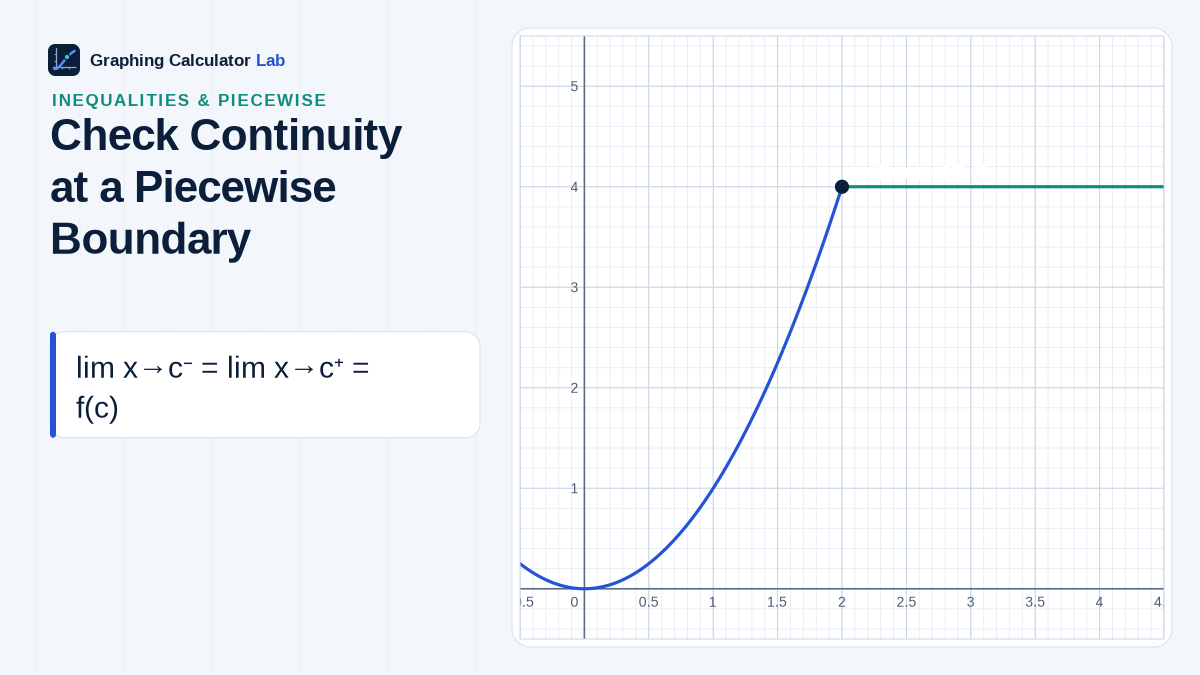
Worked example: x² (x < 2), 4 (x ≥ 2)
- Left limit: 2² = 4.
- Right limit: 4.
- f(2) = 4 (the second piece includes 2).
All three agree → continuous at x = 2.
- Continuous join: x² (x < 2), 4 (x ≥ 2) — opens the Piecewise Function Calculator
Text description of this figure
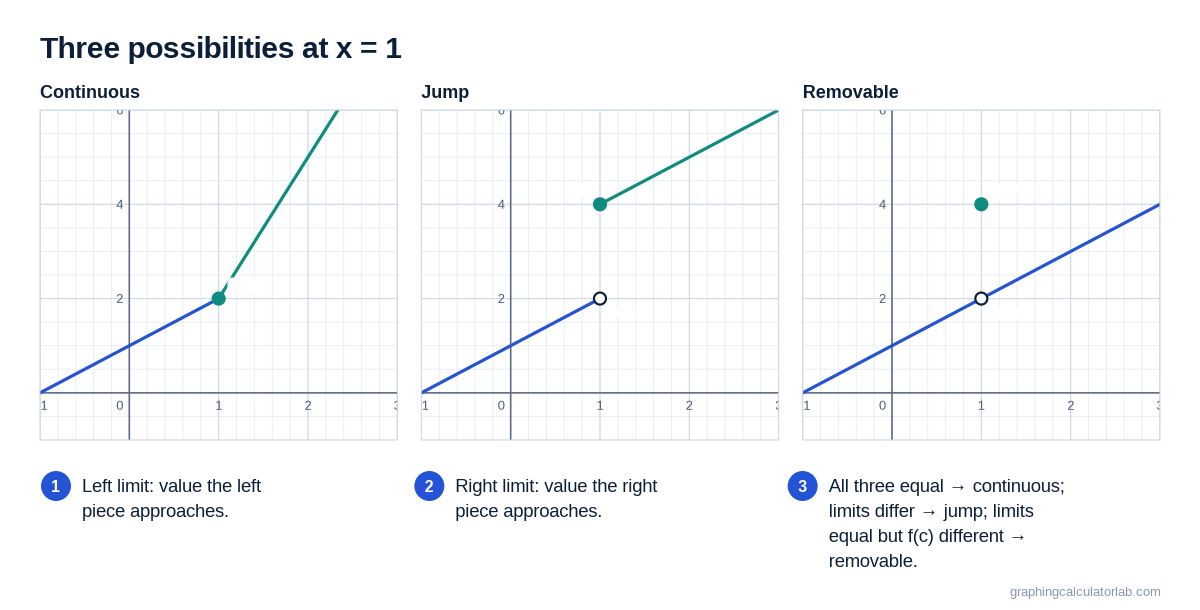
Three panels: continuous where x + 1 and 3x − 1 meet at (1, 2); a jump where x + 1 for x < 1 ends at 2 and x + 3 for x ≥ 1 starts at 4; a removable discontinuity where both sides approach 2 but f(1) = 4.
- Left limit: value the left piece approaches.
- Right limit: value the right piece approaches.
- All three equal → continuous; limits differ → jump; limits equal but f(c) different → removable.
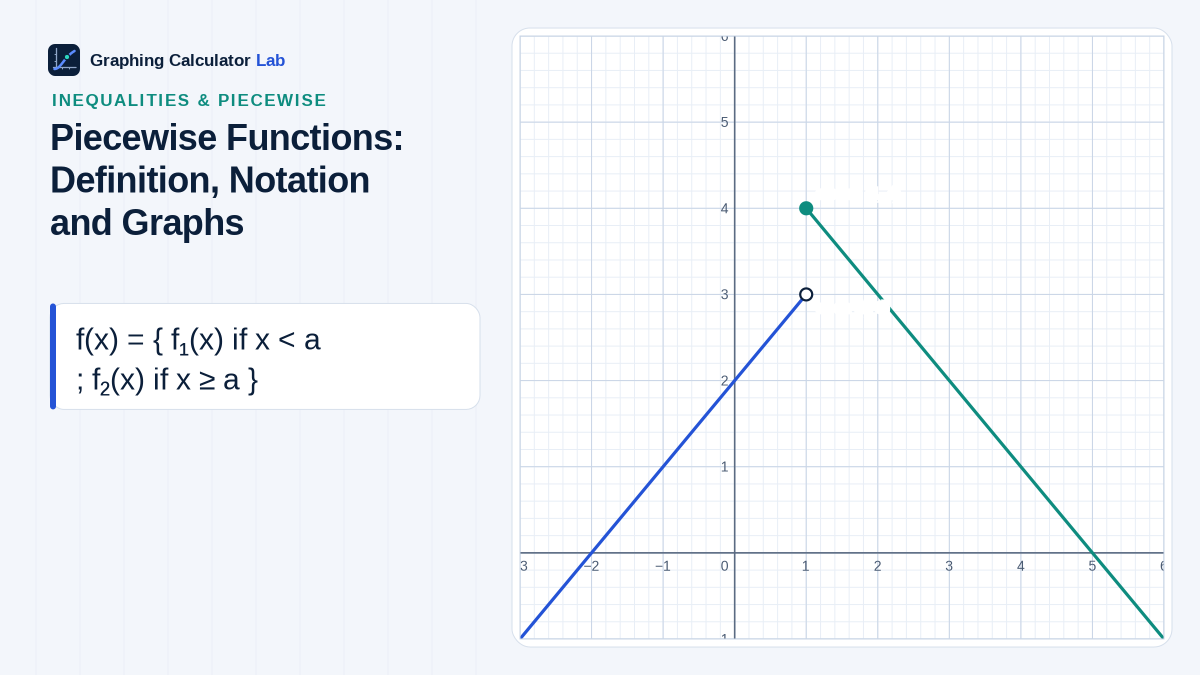
Jump discontinuity
f(x) = x + 1 for x < 1 and x + 3 for x ≥ 1.
- Left limit: 1 + 1 = 2.
- Right limit: 1 + 3 = 4.
The limits differ, so the graph jumps from 2 to 4. f(1) = 4 exists, but that does not fix the jump.
- Jump: x + 1 (x < 1), x + 3 (x ≥ 1) — opens the Piecewise Function Calculator
Removable discontinuity
f(x) = x + 1 except f(1) = 4.
- Left and right limits are both 2.
- But f(1) = 4 ≠ 2.
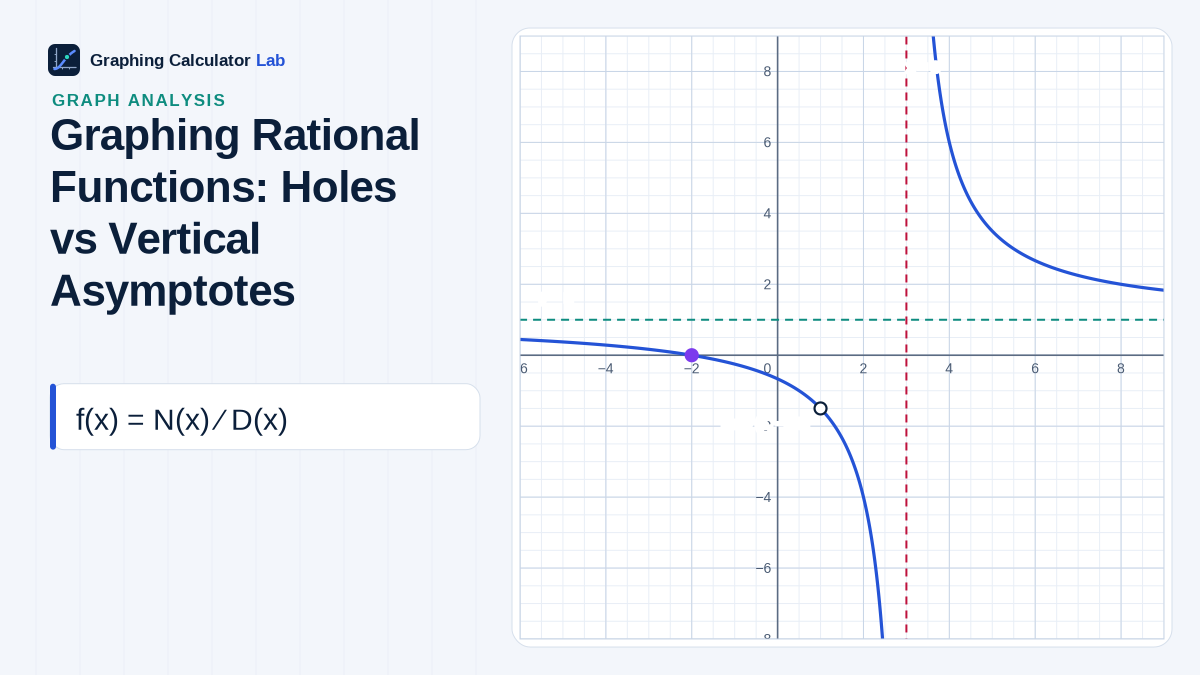
The curve has a hole at (1, 2) and an isolated point at (1, 4). Redefining f(1) = 2 would “remove” the discontinuity — hence the name. The same kind of hole appears in rational functions after a factor cancels; see rational function graphs.
- Removable: x + 1 except f(1) = 4 — opens the Piecewise Function Calculator
Making a function continuous
Find k so that f(x) = kx + 1 for x < 3 and x² − 2 for x ≥ 3 is continuous.
- Right side at 3: 9 − 2 = 7.
- Left side at 3: 3k + 1.
- Set equal: 3k + 1 = 7 → k = 2.
Summary
| Left limit | Right limit | f(c) | Verdict |
|---|---|---|---|
| L | L | L | continuous |
| L | M (≠ L) | any | jump |
| L | L | ≠ L or undefined | removable |
| ±∞ on a side | infinite (asymptote) |
Common mistakes
- Checking only f(c). A defined value does not mean the pieces meet.
- Using the wrong piece for a one-sided limit. The left limit uses the formula valid just to the left.
- Calling a jump “removable”. Removable means the two sides agree.
- Forgetting points not at boundaries. Each piece can also have its own discontinuities, such as 1⁄x inside an interval.
Questions
Do I need limits to check continuity?
For piecewise polynomials, substituting the boundary value into each neighbouring formula gives the one-sided limits directly.
How do I make a piecewise function continuous?
Choose constants so the pieces meet. For f(x) = kx for x < 2 and x² for x ≥ 2, set 2k = 4, so k = 2.
Is a function with a hole continuous elsewhere?
Yes. Continuity is checked point by point; a single removable discontinuity does not affect other points.
Graph your own example with the Piecewise Function Calculator — free, in your browser.
Try it nowSources and further reading
Worked examples and figures were produced and checked with the Graphing Calculator Lab engine. See the editorial policy.