Parallel and Perpendicular Lines: Slopes and Equations
Two non-vertical lines are parallel when their slopes are equal (and their y-intercepts differ). They are perpendicular when their slopes are negative reciprocals: m₂ = −1 ⁄ m₁, so m₁ · m₂ = −1. A horizontal and a vertical line are always perpendicular, and two vertical lines are parallel.
Check it yourself: every example here can be loaded into the Slope Intercept Form Calculator.
Open the Slope Intercept Form CalculatorThe two slope rules
| Relationship | Slope rule | Example slopes |
|---|---|---|
| Parallel | m₁ = m₂ | 3 and 3 |
| Perpendicular | m₁ · m₂ = −1 (m₂ = −1 ⁄ m₁) | 3 and −1⁄3 |
| Neither | anything else | 3 and 2 |
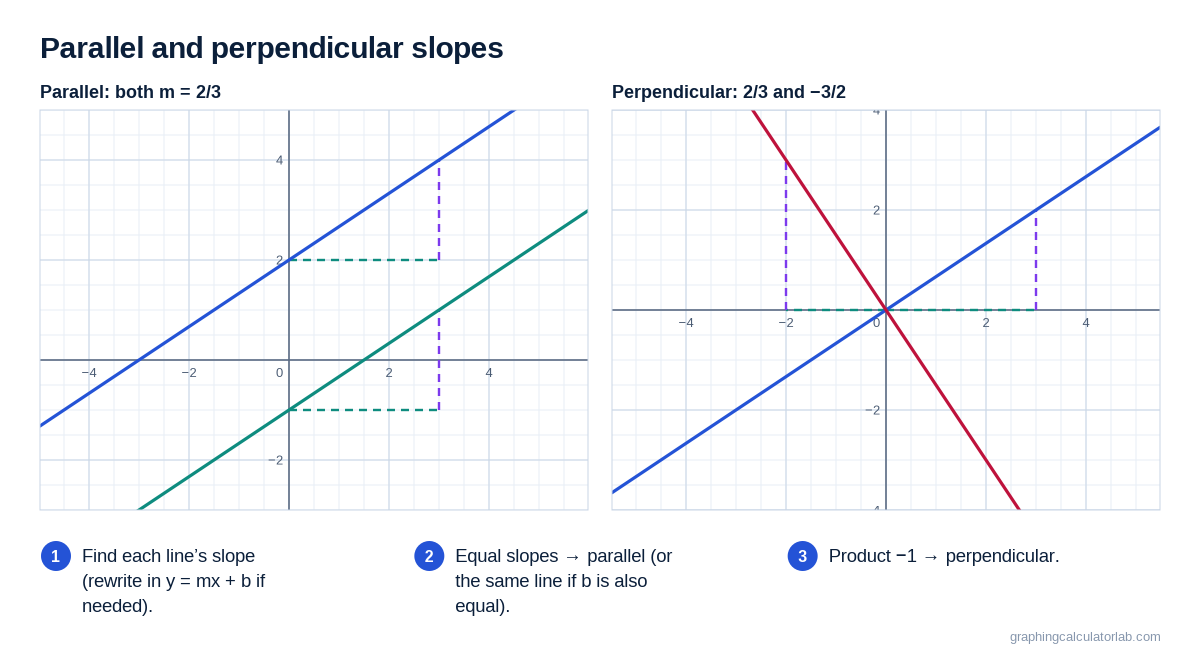
Parallel lines rise at the same rate, so they never meet. Perpendicular lines meet at a right angle (90°). Turning a line through 90° swaps its rise and run and flips the direction of one of them, which is why the slope becomes the negative reciprocal.
Text description of this figure
Two panels. Left: parallel lines y = (2/3)x + 2 and y = (2/3)x − 1 with identical rise and run triangles. Right: perpendicular lines y = (2/3)x and y = −(3/2)x with their rise and run swapped and one sign changed.
- Find each line’s slope (rewrite in y = mx + b if needed).
- Equal slopes → parallel (or the same line if b is also equal).
- Product −1 → perpendicular.
Identifying the relationship
Decide whether the lines are parallel, perpendicular or neither.
(a) y = 4x − 1 and 8x − 2y = 6. Rewrite the second: −2y = −8x + 6, so y = 4x − 3. Both slopes are 4 and the intercepts differ, so they are parallel.
(b) y = −(2⁄5)x + 3 and y = (5⁄2)x − 1. The product is −(2⁄5)(5⁄2) = −1, so they are perpendicular.
(c) y = 3x + 1 and y = −3x + 4. The product is −9, not −1; the slopes are not equal. Neither.
- Check y = 2x + 1 against y = −½x + 2 — opens the Slope Intercept Form Calculator
Writing the equation of a parallel line
Find the line through (4, −1) parallel to y = (1⁄2)x + 5.
- A parallel line has the same slope: m = 1⁄2.
- Use point-slope form: y + 1 = (1⁄2)(x − 4).
- Simplify: y = (1⁄2)x − 3.
Writing the equation of a perpendicular line
Find the line through (2, 3) perpendicular to 3x + 4y = 8.
- Slope of the given line: m = −A⁄B = −3⁄4.
- Perpendicular slope: the negative reciprocal, m = 4⁄3.
- Point-slope form: y − 3 = (4⁄3)(x − 2).
- Simplify: y = (4⁄3)x + 1⁄3.
Check: (−3⁄4)(4⁄3) = −1 ✓.
- Graph two parallel lines — opens the Graphing Calculator
Horizontal and vertical cases
The product rule needs two defined slopes, so treat these separately:
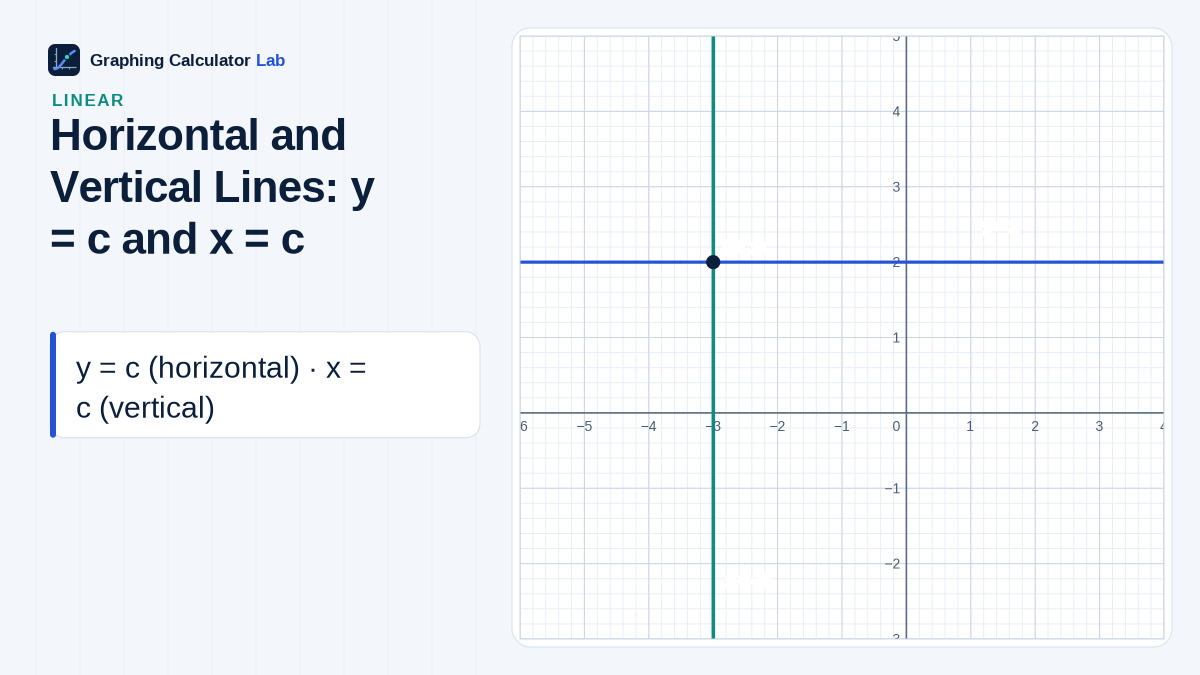
- Two horizontal lines (y = a, y = b) are parallel.
- Two vertical lines (x = a, x = b) are parallel.
- A horizontal and a vertical line are always perpendicular.
So the line perpendicular to y = 6 through (1, 2) is the vertical line x = 1. See horizontal and vertical lines.
Connection to systems of equations
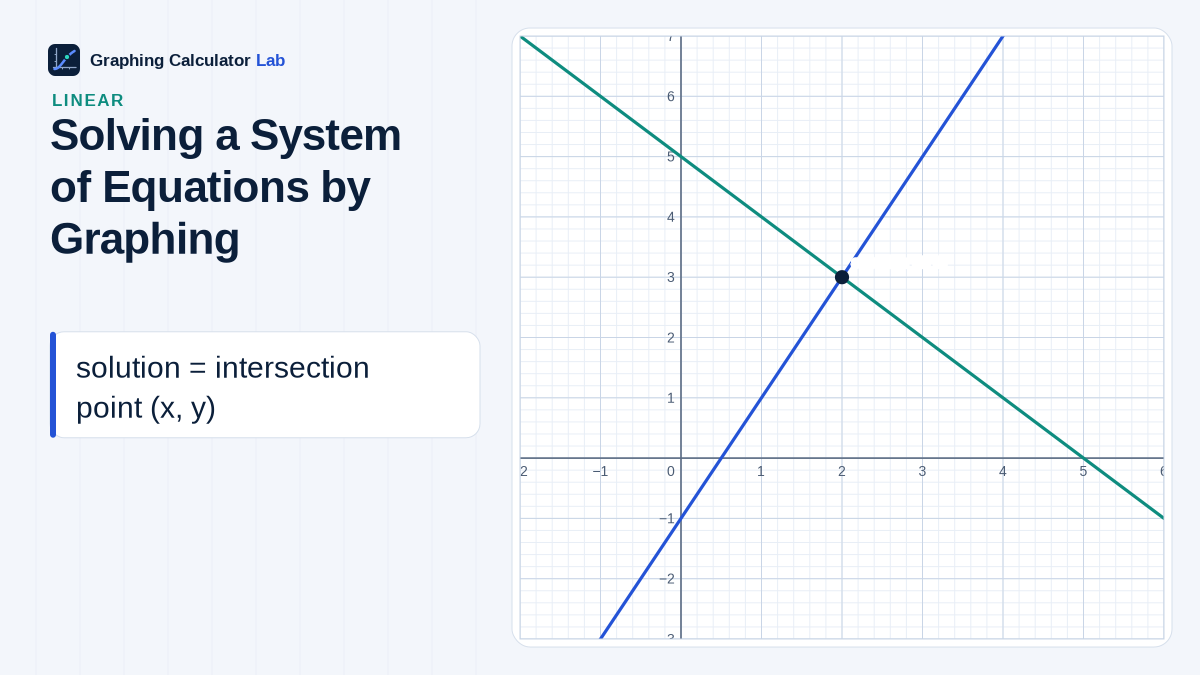
Two parallel lines never intersect, so a system of equations made of them has no solution. Two lines with the same slope and the same intercept are the same line, giving infinitely many solutions. Lines with different slopes cross at exactly one point.
Common mistakes
- Using the reciprocal without changing the sign (3 → 1⁄3 instead of −1⁄3).
- Changing the sign without taking the reciprocal (3 → −3).
- Comparing slopes before solving for y. In 6x + 2y = 4, the slope is −3, not 6.
- Calling identical lines parallel. y = 2x + 1 and 2y = 4x + 2 are the same line.
Questions
How do I find the negative reciprocal?
Flip the fraction and change its sign. The negative reciprocal of 3/4 is −4/3; of −5 (= −5/1) it is 1/5; of 1 it is −1.
Can I check perpendicularity without slopes?
Yes. Lines Ax + By = C and Dx + Ey = F are perpendicular exactly when AD + BE = 0. This also works when one line is vertical.
Why do the lines in the graph not look perpendicular?
If the x- and y-axes use different scales, right angles look stretched. Use an equal-scale window to see true angles.
Graph your own example with the Slope Intercept Form Calculator — free, in your browser.
Try it nowSources and further reading
- OpenStax, Elementary Algebra 2e — 4.6 Find the Equation of a Line
- OpenStax, College Algebra 2e — 4.1 Linear Functions
Worked examples and figures were produced and checked with the Graphing Calculator Lab engine. See the editorial policy.