Point-Slope Form: Formula, Graph and Examples
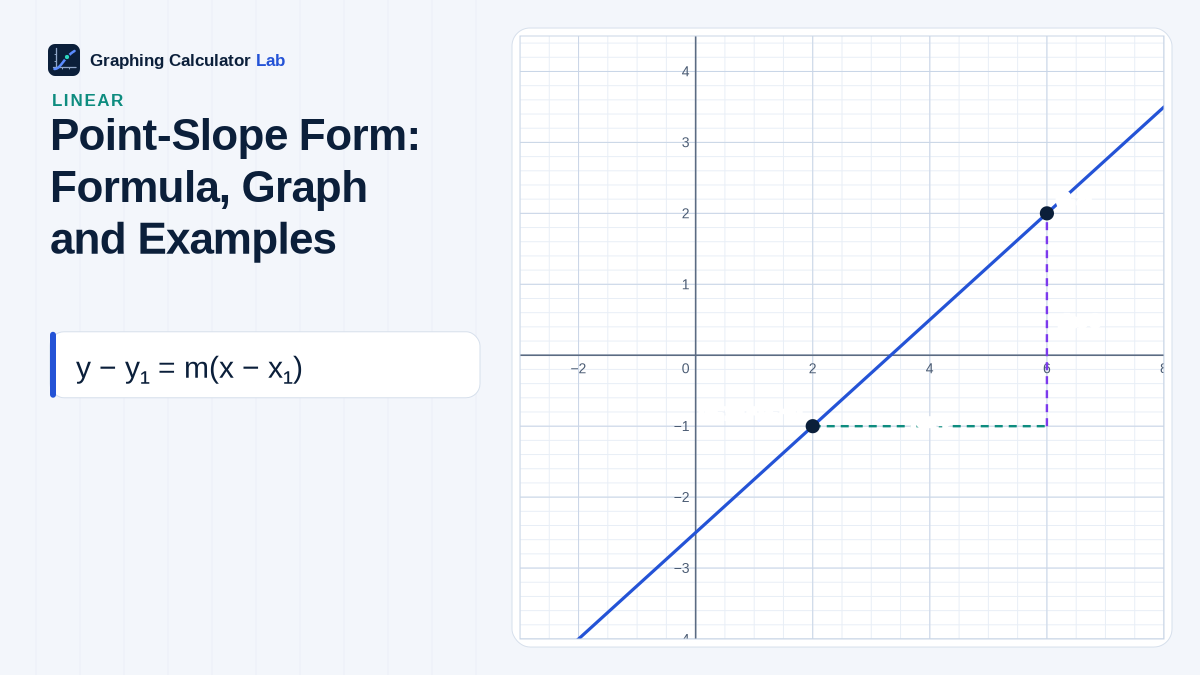
Point-slope form is y − y₁ = m(x − x₁). It describes the straight line with slope m that passes through the point (x₁, y₁). It is the quickest way to write a line’s equation when you know one point and the slope, or two points (find m first, then use either point).
Check it yourself: every example here can be loaded into the Slope Intercept Form Calculator.
Open the Slope Intercept Form CalculatorThe formula
Here (x₁, y₁) is a known point on the line and m is the slope. The x and y without subscripts stay as variables — they stand for any point on the line.
The formula is just the slope definition rearranged. For any point (x, y) on the line, the slope between it and (x₁, y₁) must be m:
Writing an equation from a point and a slope
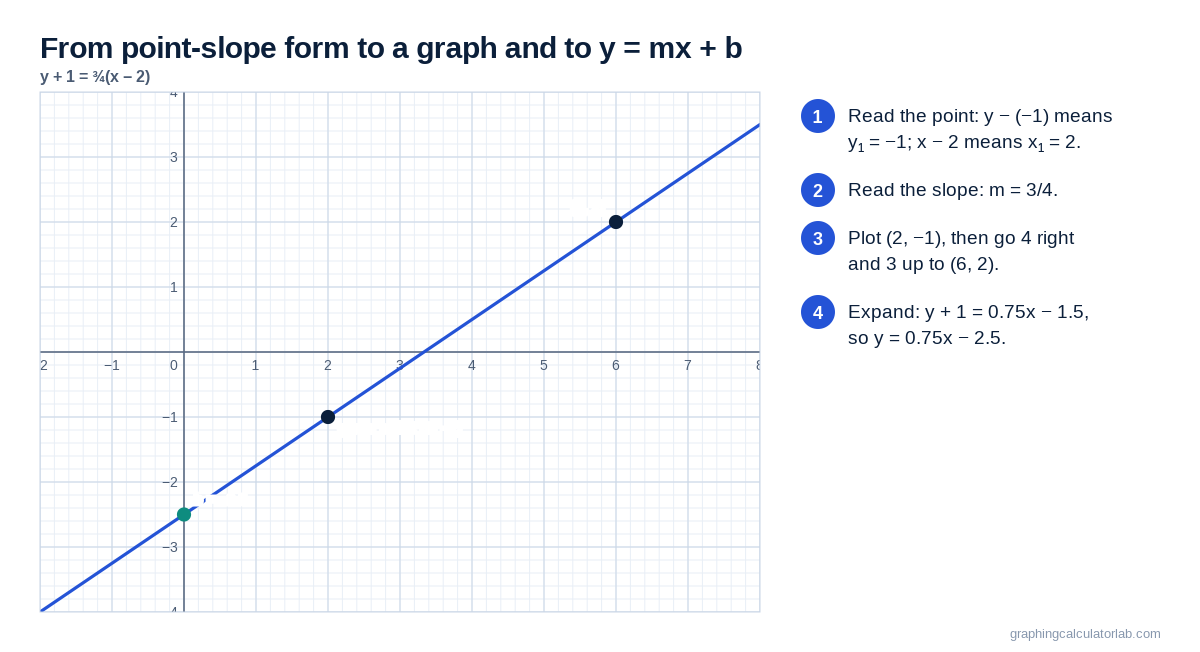
Write the line through (2, −1) with slope 3⁄4.
- Substitute x₁ = 2, y₁ = −1, m = 3⁄4: y − (−1) = (3⁄4)(x − 2).
- Simplify the double negative: y + 1 = (3⁄4)(x − 2).
That is a complete answer in point-slope form. No need to find b unless you are asked for slope-intercept form.
- Line through (2, −1) with slope 3/4 — opens the Slope Intercept Form Calculator
Text description of this figure
Line y + 1 = (3/4)(x − 2) through (2, −1), with its y-intercept (0, −2.5) found by converting to y = 0.75x − 2.5.
- Read the point: y − (−1) means y₁ = −1; x − 2 means x₁ = 2.
- Read the slope: m = 3/4.
- Plot (2, −1), then go 4 right and 3 up to (6, 2).
- Expand: y + 1 = 0.75x − 1.5, so y = 0.75x − 2.5.
Reading the point from the equation
The signs inside the brackets are opposite to the coordinates:
| Equation | Point (x₁, y₁) | Slope m |
|---|---|---|
| y − 5 = 2(x − 3) | (3, 5) | 2 |
| y + 4 = −(x − 1) | (1, −4) | −1 |
| y = 6(x + 2) | (−2, 0) | 6 |
| y − 3 = ½(x + 7) | (−7, 3) | ½ |
Writing an equation from two points
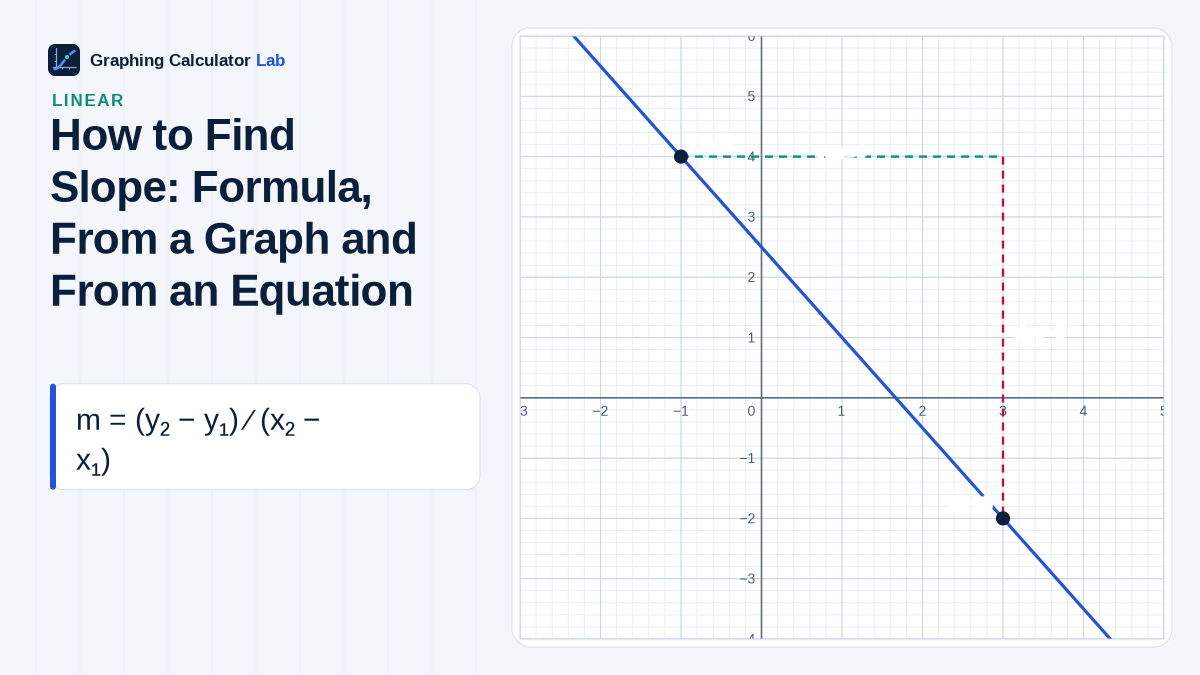
Find the line through (−3, 4) and (1, −2).
- Slope: m = (−2 − 4) ⁄ (1 − (−3)) = −6 ⁄ 4 = −3⁄2.
- Pick either point, say (−3, 4): y − 4 = −(3⁄2)(x + 3).
- Optional — slope-intercept form: y − 4 = −1.5x − 4.5, so y = −1.5x − 0.5.
Using (1, −2) instead gives y + 2 = −1.5(x − 1), which also simplifies to y = −1.5x − 0.5. Same line.
- Line through (−3, 4) and (1, −2) — opens the Slope Intercept Form Calculator
Converting to slope-intercept or standard form
- To y = mx + b: distribute m and add y₁ to both sides. y + 1 = (3⁄4)(x − 2) → y + 1 = 0.75x − 1.5 → y = 0.75x − 2.5.
- To Ax + By = C: clear fractions, then collect x and y on one side. Multiply by 4: 4y + 4 = 3x − 6 → 3x − 4y = 10.
See slope-intercept form and standard form of a line for more on each.
When to choose point-slope form
- You know the slope and any point, not necessarily the y-intercept.
- You are finding a tangent line or a line parallel or perpendicular to another through a given point — see parallel and perpendicular lines.
- You want to avoid fractions in b until the last step.
Common mistakes
- Sign errors with negative coordinates. For the point (−2, 5): y − 5 = m(x − (−2)) = m(x + 2).
- Substituting the point into x and y instead of x₁ and y₁. The answer must still contain x and y.
- Using a slope from the wrong pair of points. Compute m from the two given points before writing the equation.
- Mixing up the order in the slope. (y₂ − y₁) ⁄ (x₂ − x₁) — subtract in the same order on top and bottom.
Questions
Why is it called point-slope form?
Because the two things you substitute are a point on the line, (x₁, y₁), and the slope m. Nothing else is needed.
Do I get the same line if I use the other point?
Yes. The equations look different — y − 4 = −1.5(x + 3) versus y + 2 = −1.5(x − 1) — but both simplify to y = −1.5x − 0.5.
Can point-slope form describe a vertical line?
No. A vertical line has no defined slope. Its equation is x = x₁.
Graph your own example with the Slope Intercept Form Calculator — free, in your browser.
Try it nowSources and further reading
- OpenStax, Elementary Algebra 2e — 4.6 Find the Equation of a Line
- OpenStax, College Algebra 2e — 4.1 Linear Functions
Worked examples and figures were produced and checked with the Graphing Calculator Lab engine. See the editorial policy.