Radians vs Degrees When Graphing Functions
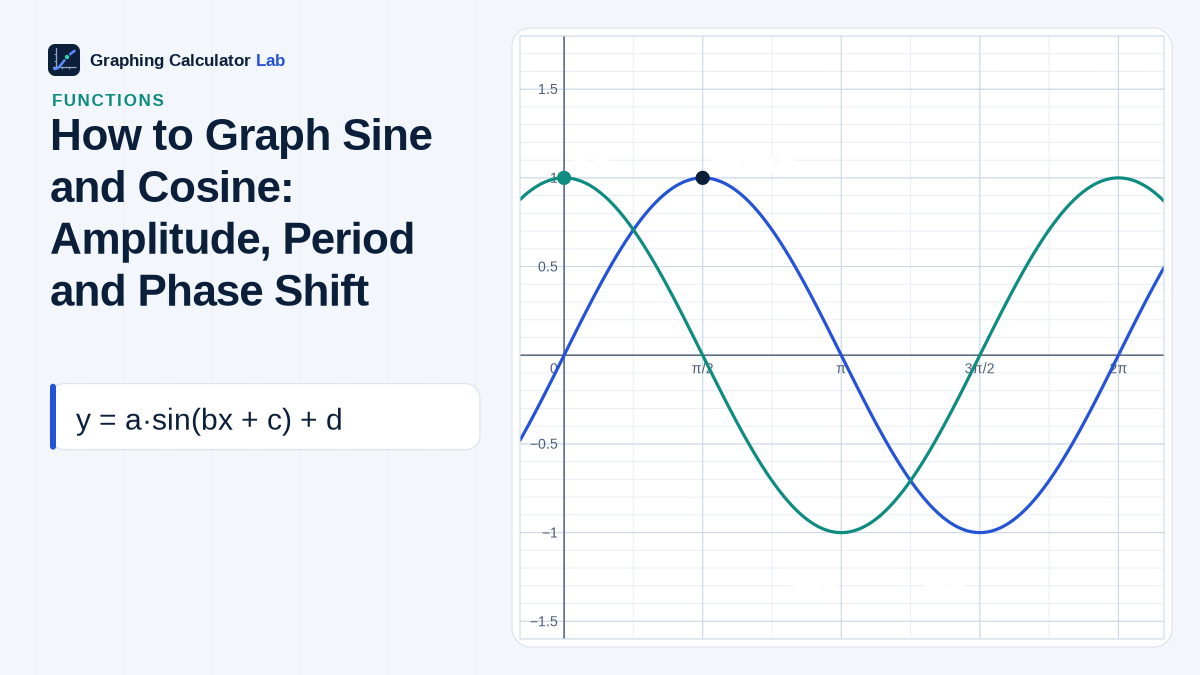
Radians and degrees are two units for angles: a full turn is 360° or 2π radians, so 180° = π radians. Multiply degrees by π⁄180 to get radians and radians by 180⁄π to get degrees. When graphing trig functions, radian mode makes one cycle of sin x about 6.28 units wide; degree mode makes it 360 units wide, so the same window can look completely different.
Check it yourself: every example here can be loaded into the Trigonometric Graphing Calculator.
Open the Trigonometric Graphing CalculatorWhat a radian is
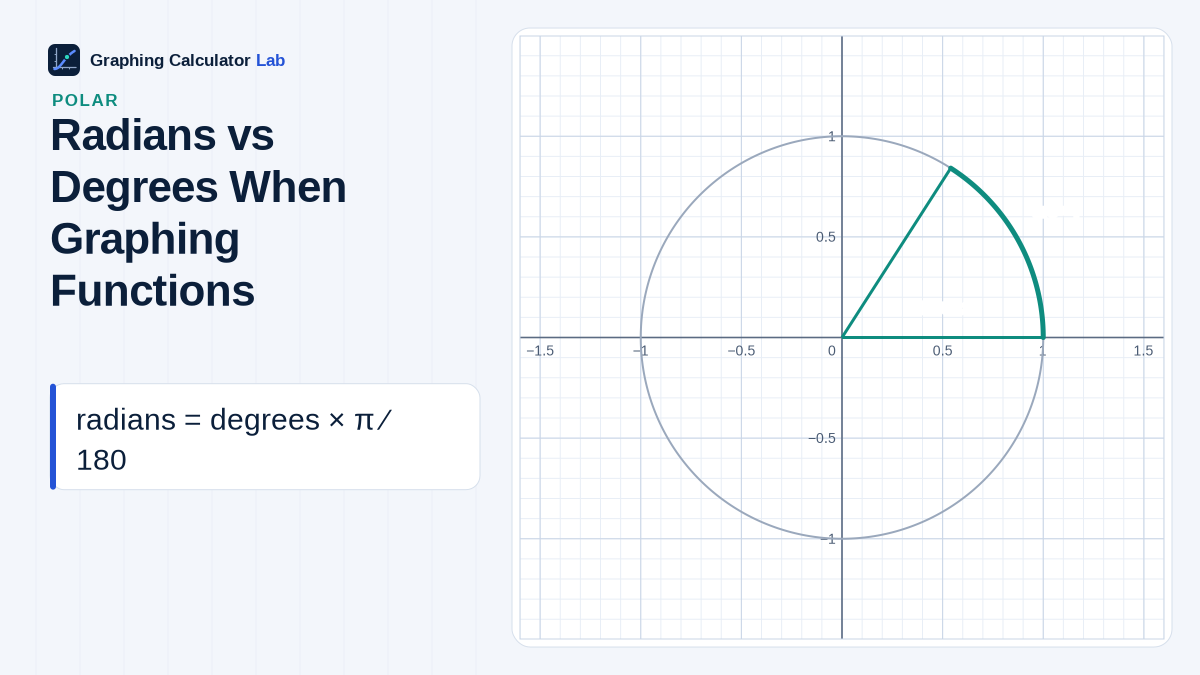
One radian is the angle at the centre of a circle that cuts off an arc equal in length to the radius. A full circle has circumference 2πr, so it contains 2π radians:
One radian is about 57.3°.
Converting
- Degrees → radians: multiply by π⁄180. 45° = 45π⁄180 = π⁄4.
- Radians → degrees: multiply by 180⁄π. 2π⁄3 = (2π⁄3)(180⁄π) = 120°.
| Degrees | 0° | 30° | 45° | 60° | 90° | 180° | 270° | 360° |
|---|---|---|---|---|---|---|---|---|
| Radians | 0 | π⁄6 | π⁄4 | π⁄3 | π⁄2 | π | 3π⁄2 | 2π |
| Decimal | 0 | 0.524 | 0.785 | 1.047 | 1.571 | 3.142 | 4.712 | 6.283 |
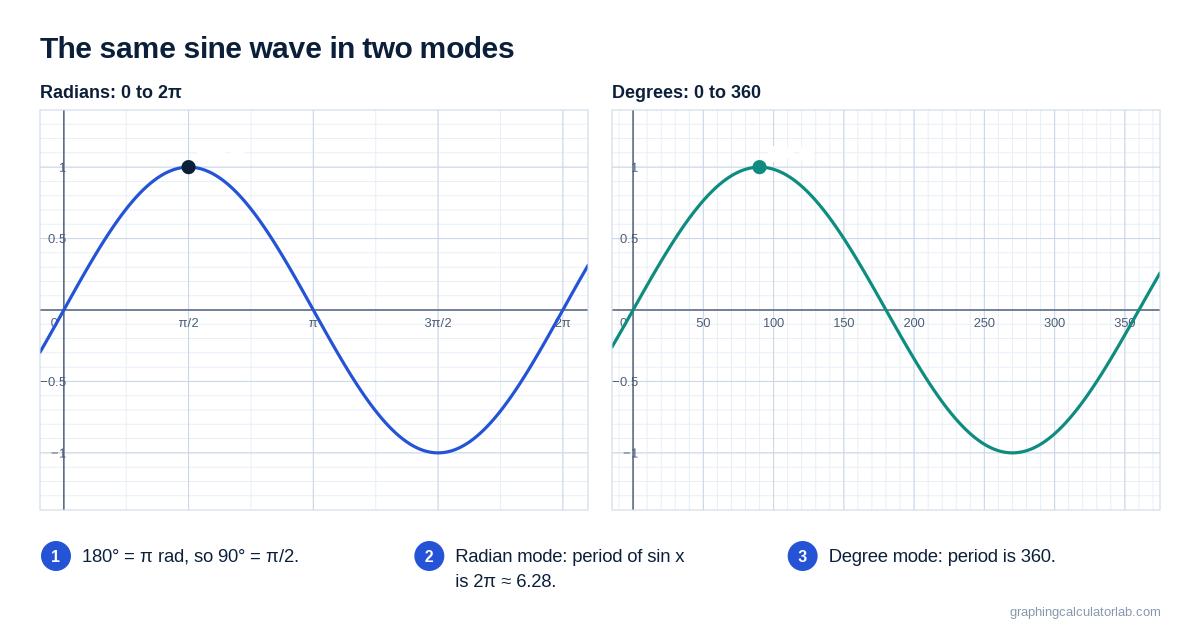
Text description of this figure
Two panels: y = sin x in radian mode over 0 to 2π shows one full cycle; y = sin x in degree mode over 0 to 360 also shows one full cycle; the x-axis scales differ by a factor of about 57.3.
- 180° = π rad, so 90° = π/2.
- Radian mode: period of sin x is 2π ≈ 6.28.
- Degree mode: period is 360.
Why the mode changes your graph
The calculator needs to know what number to feed into sin, cos or tan:
- In radian mode, sin(90) means the sine of 90 radians ≈ 0.894.
- In degree mode, sin(90) means sin 90° = 1.
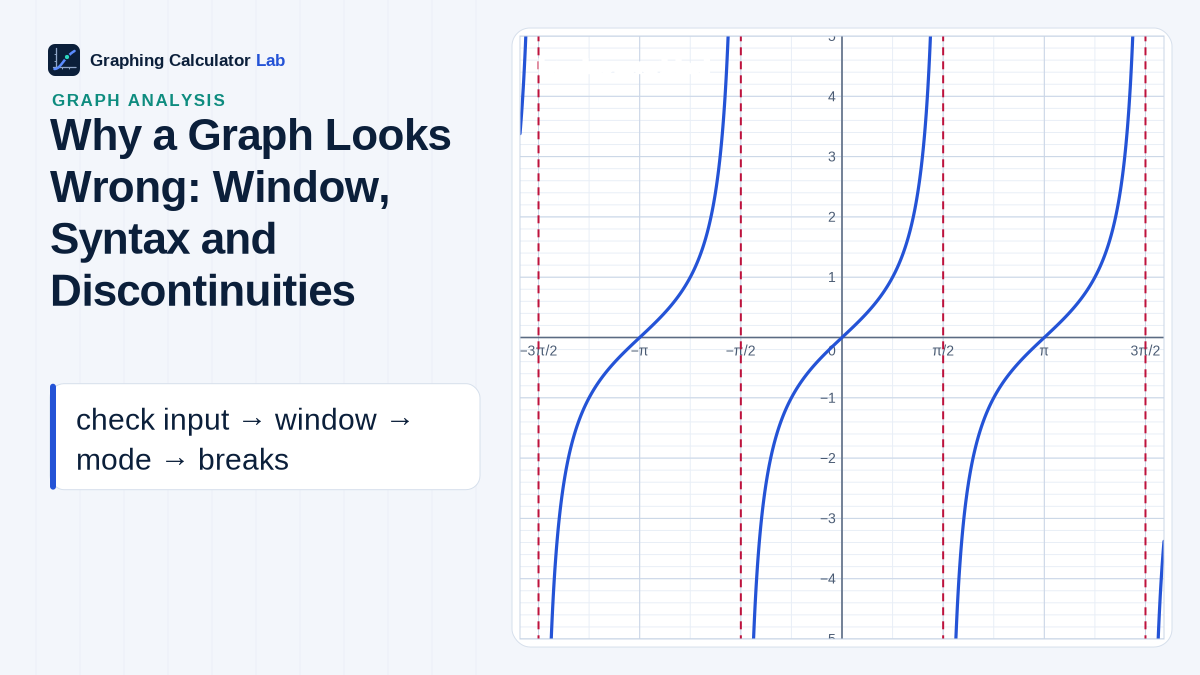
For graphs, the x-axis is the angle. In radian mode one cycle of sin x spans 2π ≈ 6.28 units, so a −10 to 10 window shows about three cycles. In degree mode one cycle spans 360 units, so the same window shows a tiny piece that looks almost like a straight line.
- sin x in radians — opens the Trigonometric Graphing Calculator
- sin x in degrees — opens the Trigonometric Graphing Calculator
Choosing the right mode
| Situation | Mode |
|---|---|
| Angles written with π (π⁄3, 2π) | radians |
| Calculus, derivatives, integrals | radians |
| Polar equations like r = sin(3θ) | usually radians |
| Geometry, bearings, triangle problems | degrees |
| Angles like 30, 45, 120 without π | degrees |
The graphing, trigonometric and polar calculators on this site all have a radians/degrees switch next to their inputs.
Polar graphs and angle units
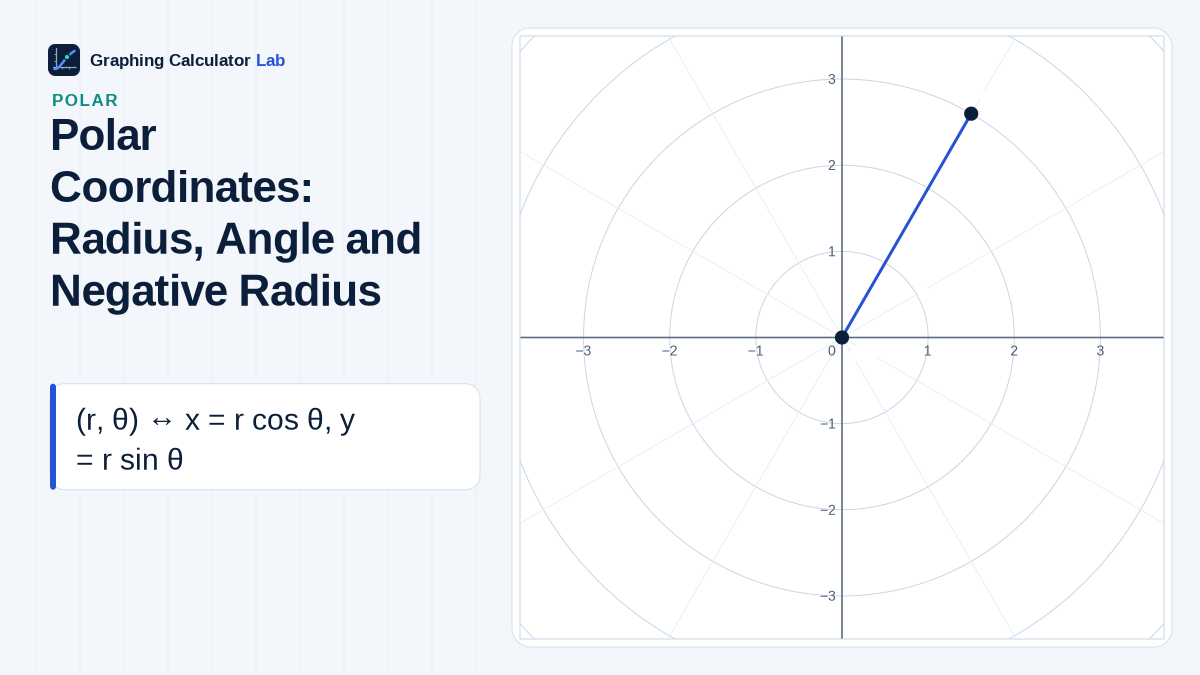
In the polar graphing calculator, the θ range must match the mode: 0 to 2π in radians or 0 to 360 in degrees for one full turn. A rose r = 2 sin(3θ) looks identical either way as long as the range covers a full turn in the chosen unit.
Common mistakes
- Forgetting the mode was changed in an earlier problem.
- Typing 90 for a right angle in radian mode. Use pi/2.
- Mixing units in one expression, such as sin(x + 30) with x in radians.
- Reading a period of 2π on a degree-mode graph — there it is 360.
Questions
Why do mathematicians prefer radians?
Radians make calculus formulas simple: the derivative of sin x is cos x only when x is in radians. They also connect angle directly to arc length: s = rθ.
How many degrees is one radian?
180⁄π ≈ 57.2958 degrees.
How do I know which mode my problem uses?
If angles involve π or are small decimals like 1.2, use radians. If they are like 30, 45 or 90 without π, they are probably degrees.
Graph your own example with the Trigonometric Graphing Calculator — free, in your browser.
Try it nowSources and further reading
Worked examples and figures were produced and checked with the Graphing Calculator Lab engine. See the editorial policy.