Polar Coordinates: Radius, Angle and Negative Radius
Polar coordinates describe a point by its distance r from the origin (the pole) and the angle θ measured counterclockwise from the positive x-axis, written (r, θ). The same point has many names: adding 2π to θ, or using −r with θ + π, gives the same location. A negative r means move in the direction opposite to the angle.
Check it yourself: every example here can be loaded into the Polar Graphing Calculator.
Open the Polar Graphing CalculatorThe two coordinates
- r (radius): how far the point is from the origin, called the pole.
- θ (theta, angle): the direction, measured from the positive x-axis (the polar axis). Counterclockwise is positive.
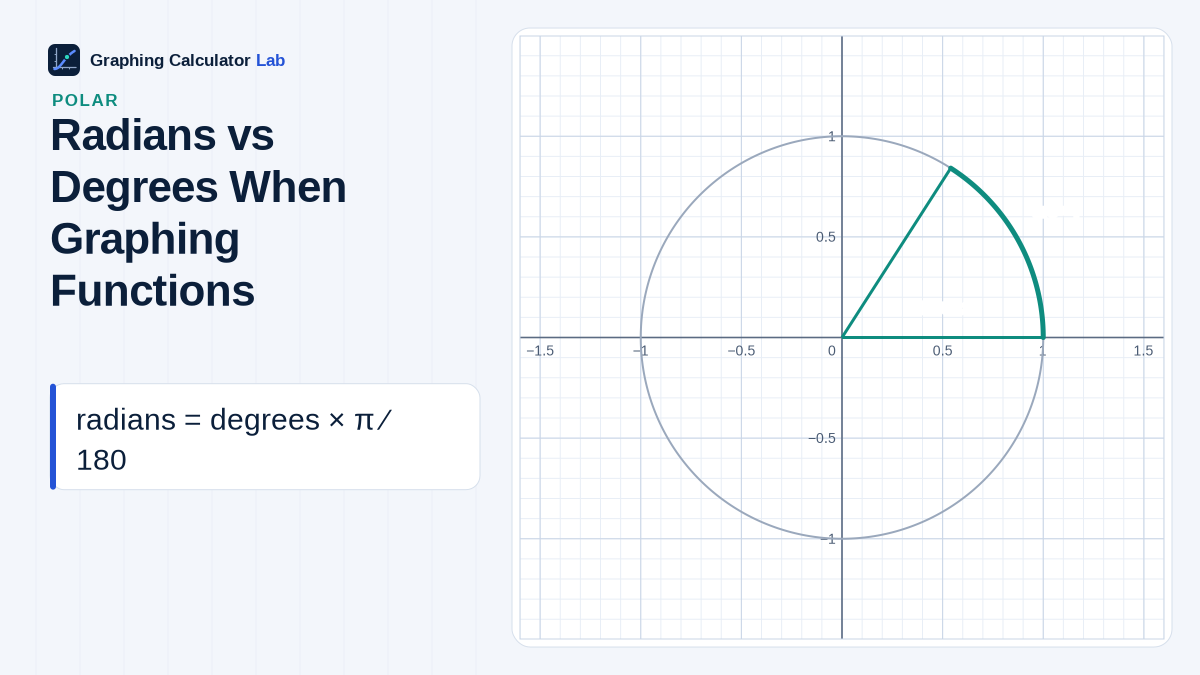
A point is written (r, θ). Angles are usually in radians; see radians vs degrees.
Plotting a polar point
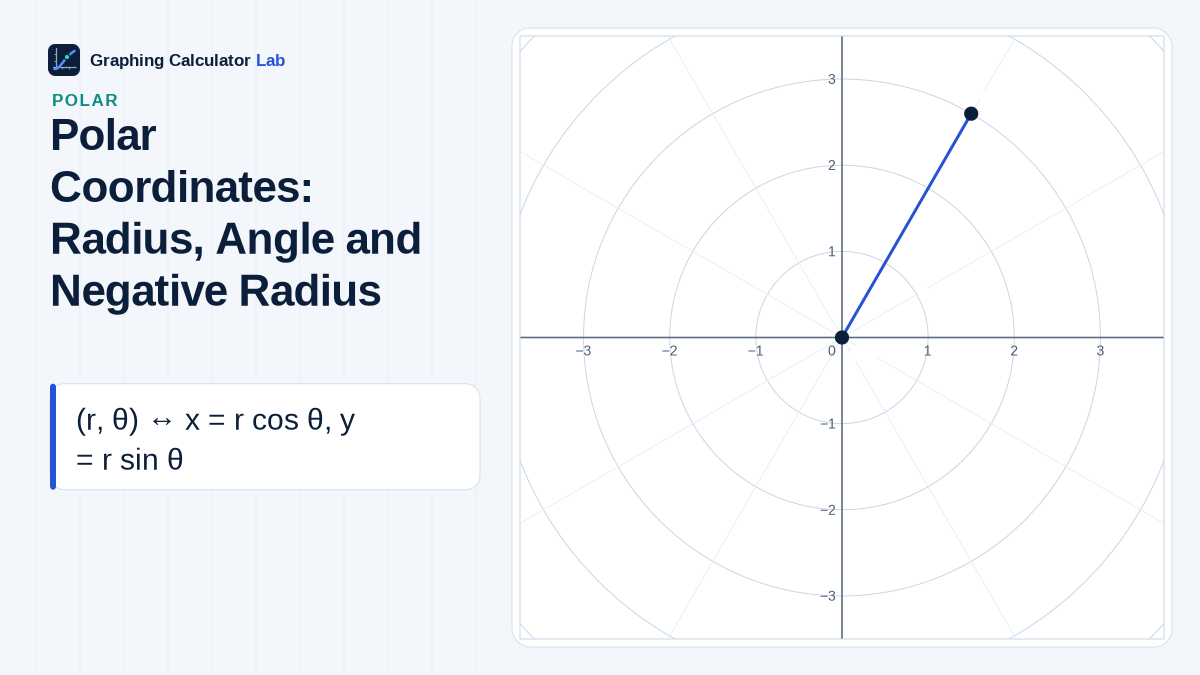
To plot (3, π/3):
- Start at the pole.
- Turn to face the angle π/3 (60°) from the positive x-axis.
- Walk 3 units in that direction.
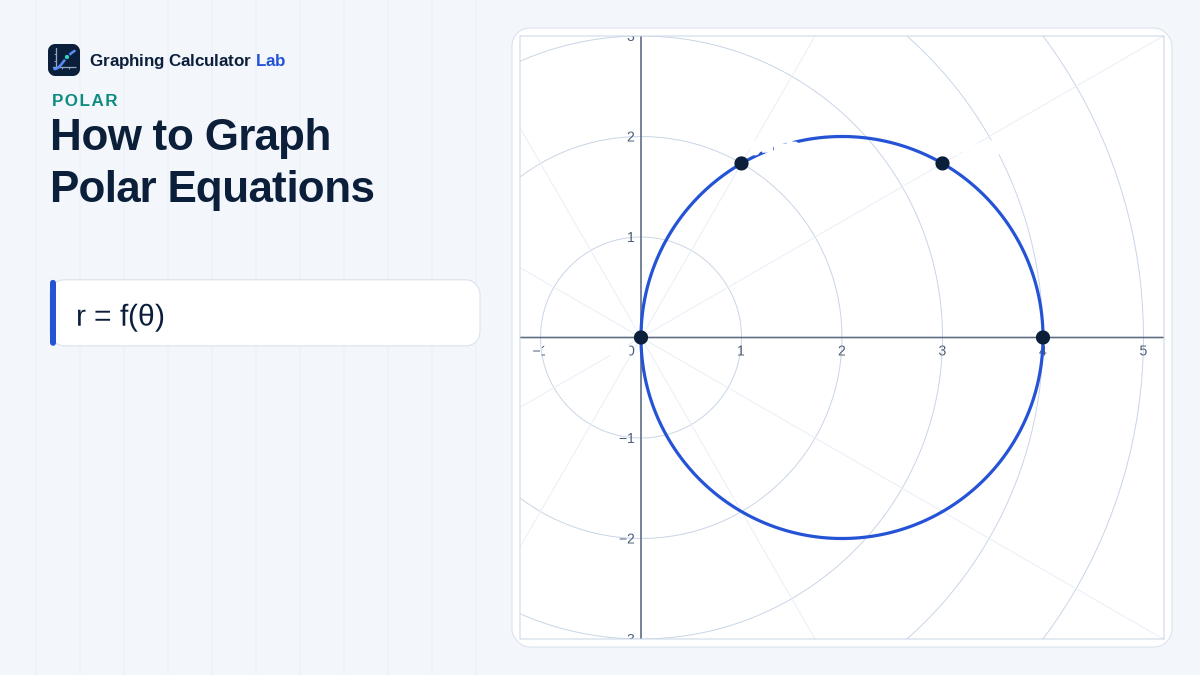
A polar grid — circles for r and rays for θ — makes this quick. The polar graphing calculator uses one.
Many names for one point
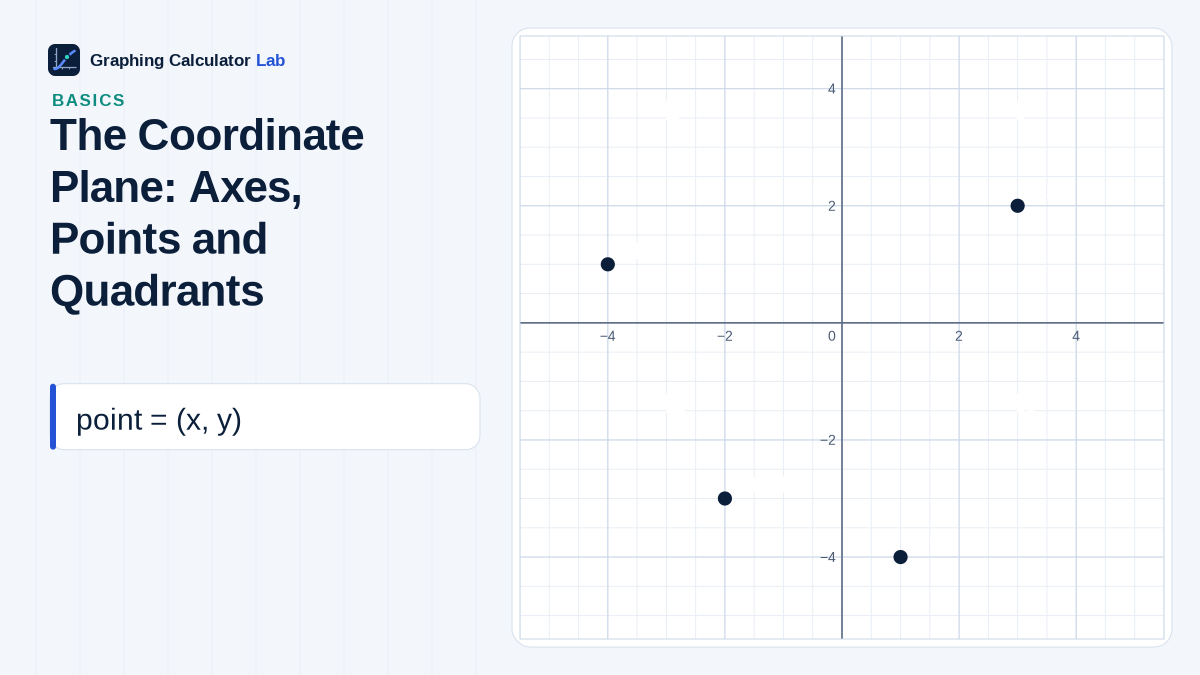
In rectangular coordinates each point has exactly one name. In polar coordinates it has infinitely many:
- (r, θ + 2πk) for any integer k — going all the way around returns to the same direction.
- (−r, θ + π) — reversing both the direction and the sign.
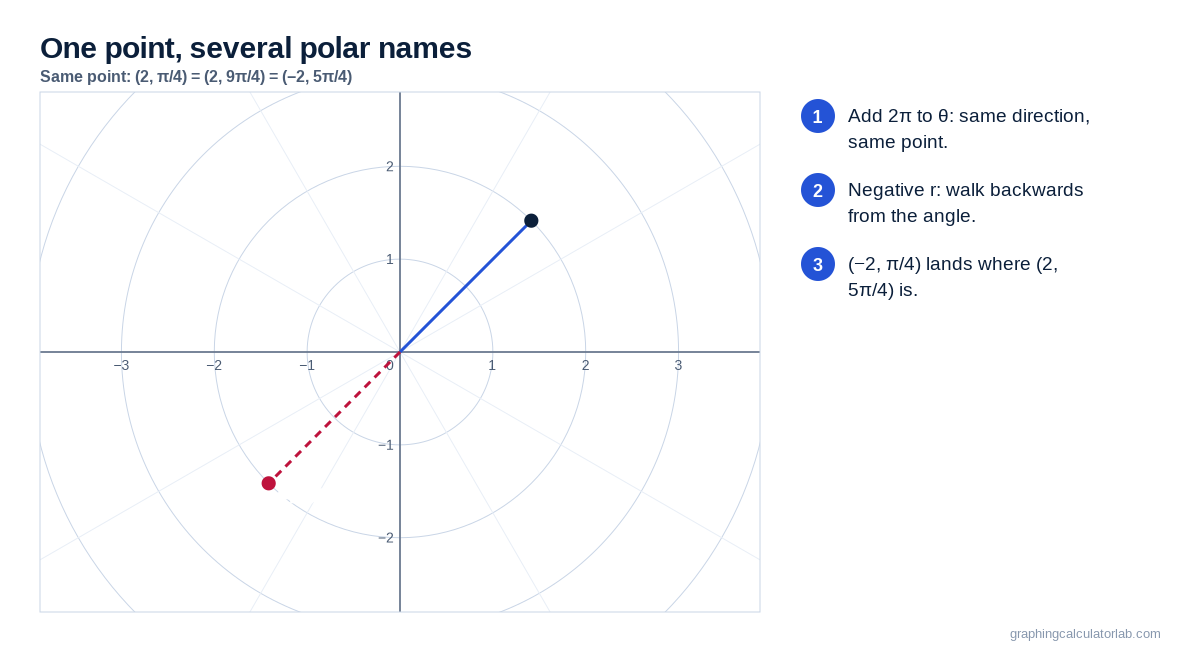
So (2, π/4), (2, 9π/4), (2, −7π/4) and (−2, 5π/4) are all the same point.
Text description of this figure
Polar grid showing that (2, π/4), (2, 9π/4) and (−2, 5π/4) all name the same point, and that (−2, π/4) is the opposite point (2, 5π/4).
- Add 2π to θ: same direction, same point.
- Negative r: walk backwards from the angle.
- (−2, π/4) lands where (2, 5π/4) is.
Negative r
When r is negative, face the angle θ and walk backwards. (−2, π/4) is 2 units from the pole in the direction 5π/4. This rule is what creates the inner loops of limaçons and the extra petals of some rose curves.
- Graph r = 2 (a circle) — opens the Polar Graphing Calculator
Polar vs rectangular
| Rectangular (x, y) | Polar (r, θ) | |
|---|---|---|
| Describes | left/right and up/down | distance and direction |
| Unique names? | yes | no |
| Natural for | lines, parabolas | circles, spirals, roses |
| Circle of radius 3 | x² + y² = 9 | r = 3 |
| Line y = x | y = x | θ = π/4 |
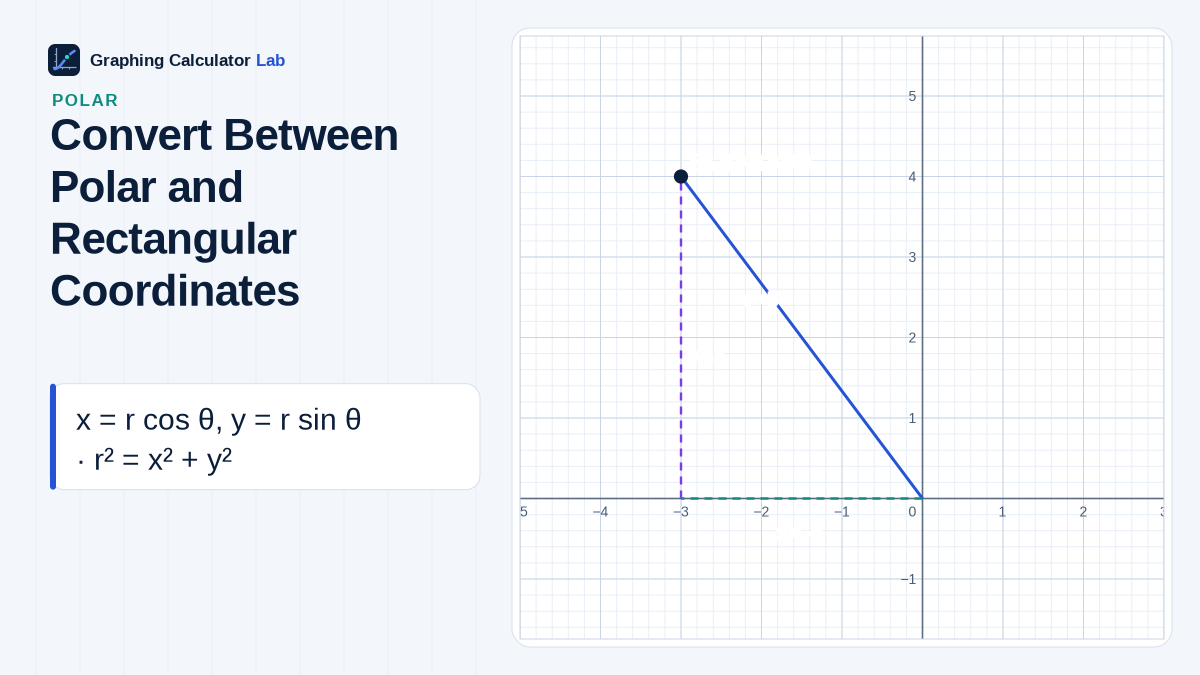
To switch between them use x = r cos θ, y = r sin θ and r = √(x² + y²), θ = atan2(y, x). See converting polar and rectangular coordinates.
- Circle r = 3 — then use the conversion panel for (3, π/3) — opens the Polar Graphing Calculator
Common mistakes
- Measuring θ from the y-axis — it is measured from the positive x-axis.
- Measuring clockwise for positive angles.
- Treating a negative r as an error. It is allowed and means the opposite direction.
- Mixing degree and radian angles. π/3 and 60° are the same angle; 60 radians is not.
Questions
Why use polar coordinates?
They make circles, spirals and rotating motion simple to describe. A circle of radius 4 is just r = 4.
Can θ be negative?
Yes. A negative angle is measured clockwise. (2, −π/2) is the point (0, −2).
What are the polar coordinates of the origin?
(0, θ) for any θ. The origin has no unique angle.
Graph your own example with the Polar Graphing Calculator — free, in your browser.
Try it nowSources and further reading
Worked examples and figures were produced and checked with the Graphing Calculator Lab engine. See the editorial policy.