Polar Rose Curves and Petal Counts
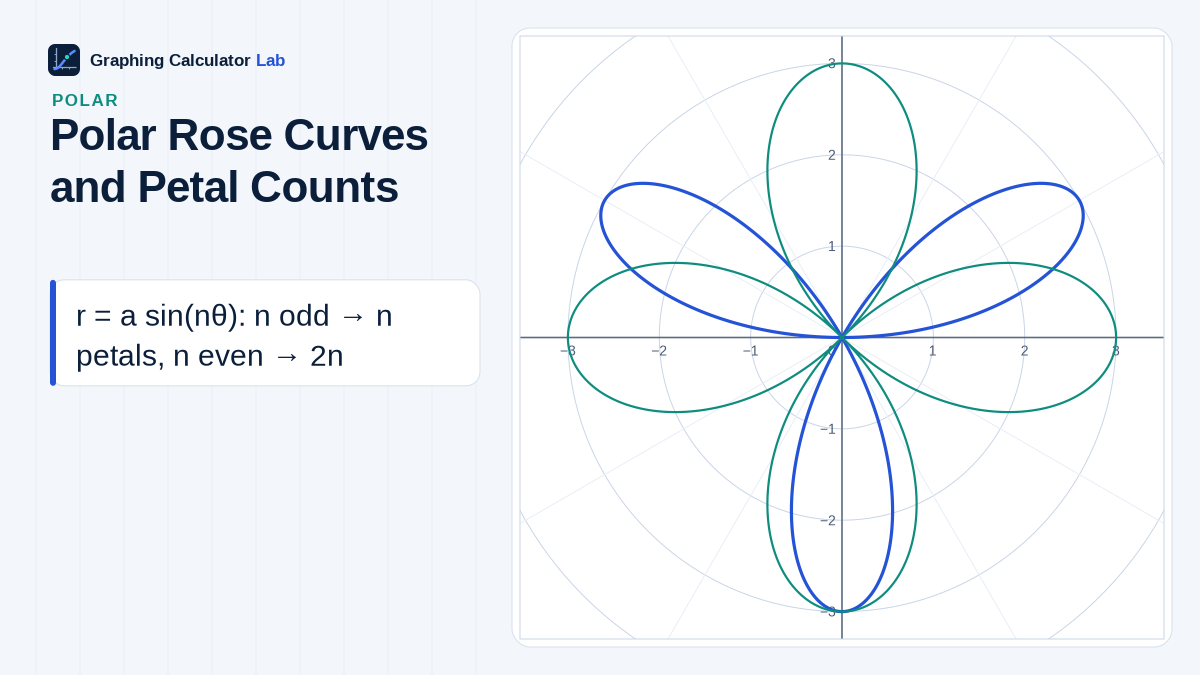
A rose curve has the polar equation r = a sin(nθ) or r = a cos(nθ), with n a positive integer. If n is odd the rose has n petals; if n is even it has 2n petals. Each petal has length |a|. An odd-n rose is traced completely for 0 ≤ θ ≤ π; an even-n rose needs 0 ≤ θ ≤ 2π.
Check it yourself: every example here can be loaded into the Polar Graphing Calculator.
Open the Polar Graphing CalculatorThe rose equations
| n odd | n even | |
|---|---|---|
| Number of petals | n | 2n |
| θ range to draw once | 0 to π | 0 to 2π |
| Petal length | |a| | |a| |
| Angle between petal tips | 2π⁄n | π⁄n |
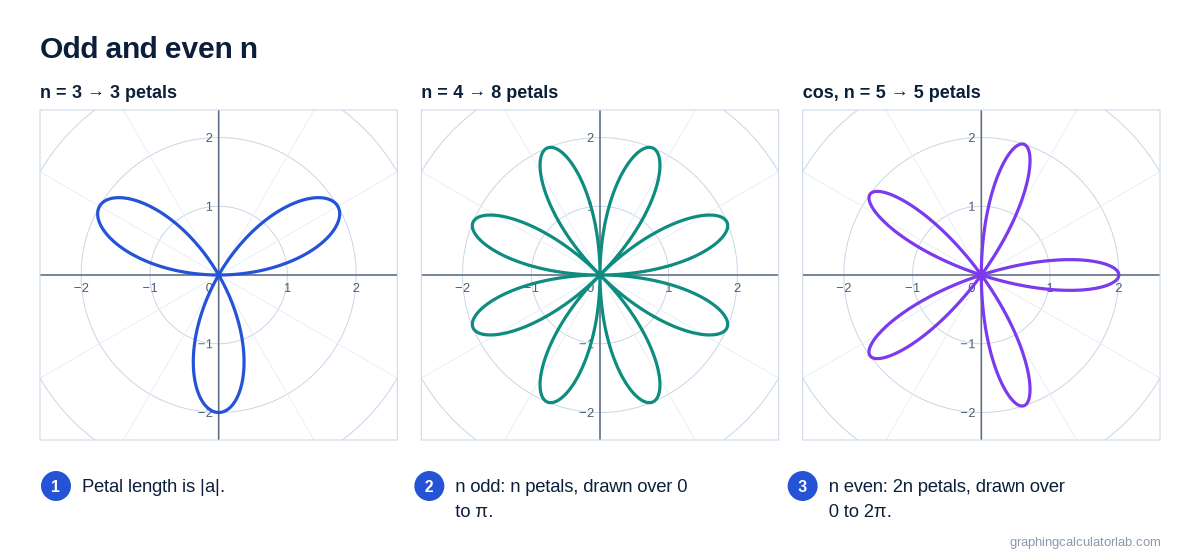
Text description of this figure
Three panels: r = 2 sin(3θ) with 3 petals, r = 2 sin(4θ) with 8 petals, and r = 2 cos(5θ) with 5 petals.
- Petal length is |a|.
- n odd: n petals, drawn over 0 to π.
- n even: 2n petals, drawn over 0 to 2π.
Worked example: r = 3 sin(3θ)
- Petals: n = 3 is odd → 3 petals, each 3 units long.
- Range: 0 ≤ θ ≤ π draws the full rose.
- First tip: r is largest when 3θ = π/2, so θ = π/6. Tip at (3, π/6).
- Other tips: every 2π⁄3 → at θ = π/6 + 2π/3 = 5π/6 and π/6 + 4π/3 = 3π/2.
- Zeros: r = 0 when 3θ = 0, π, 2π, … → θ = 0, π/3, 2π/3 — each petal starts and ends at the pole.
Between θ = π/3 and 2π/3, r is negative, which is why the second petal is drawn pointing down at 3π/2 rather than up at π/2.
- 3-petal rose r = 3 sin(3θ) — opens the Polar Graphing Calculator
Worked example: r = 3 cos(2θ)
- n = 2 is even → 4 petals, length 3.
- cos version → a petal tip on the positive x-axis: (3, 0).
- Tips every π/2: along the x- and y-axes.
- Draw over 0 ≤ θ ≤ 2π.
- 4-petal rose r = 3 cos(2θ) — opens the Polar Graphing Calculator
Sine vs cosine roses
Both make the same shape; they are rotated relative to each other. r = a cos(nθ) has a petal on the polar axis. r = a sin(nθ) is the cosine rose rotated by π⁄(2n).
Why the counts work
The petal tips occur where |sin(nθ)| = 1. As θ runs from 0 to 2π, nθ runs through n full cycles, giving 2n tips. When n is odd, the tips with negative r coincide with tips that have positive r, so only n distinct petals appear. When n is even they all differ, so all 2n are visible.
- 8-petal rose r = 2 sin(4θ) — opens the Polar Graphing Calculator
Common mistakes
- Counting 2n petals for odd n (or n for even n).
- Graphing an odd rose over 0 to 2π and thinking it has extra petals — it is drawn twice.
- Using a for the number of petals. a is the length; n controls the count.
- Forgetting negative r when sketching by hand.
Questions
Why do even values of n give twice as many petals?
For odd n, the negative values of r redraw petals that already exist. For even n, they land in new directions, doubling the count.
Where does the first petal point?
For r = a cos(nθ), a petal tip lies on the positive x-axis (θ = 0). For r = a sin(nθ), the first tip is at θ = π/(2n).
What happens if n is not an integer?
The curve no longer closes neatly into petals in one turn; for rational n it eventually closes after several turns, giving more intricate patterns.
Graph your own example with the Polar Graphing Calculator — free, in your browser.
Try it nowSources and further reading
- OpenStax, Precalculus 2e — 8.4 Polar Coordinates: Graphs
- OpenStax, Calculus Volume 2 — 7.3 Polar Coordinates
Worked examples and figures were produced and checked with the Graphing Calculator Lab engine. See the editorial policy.