The Discriminant: What b² − 4ac Tells You About a Graph
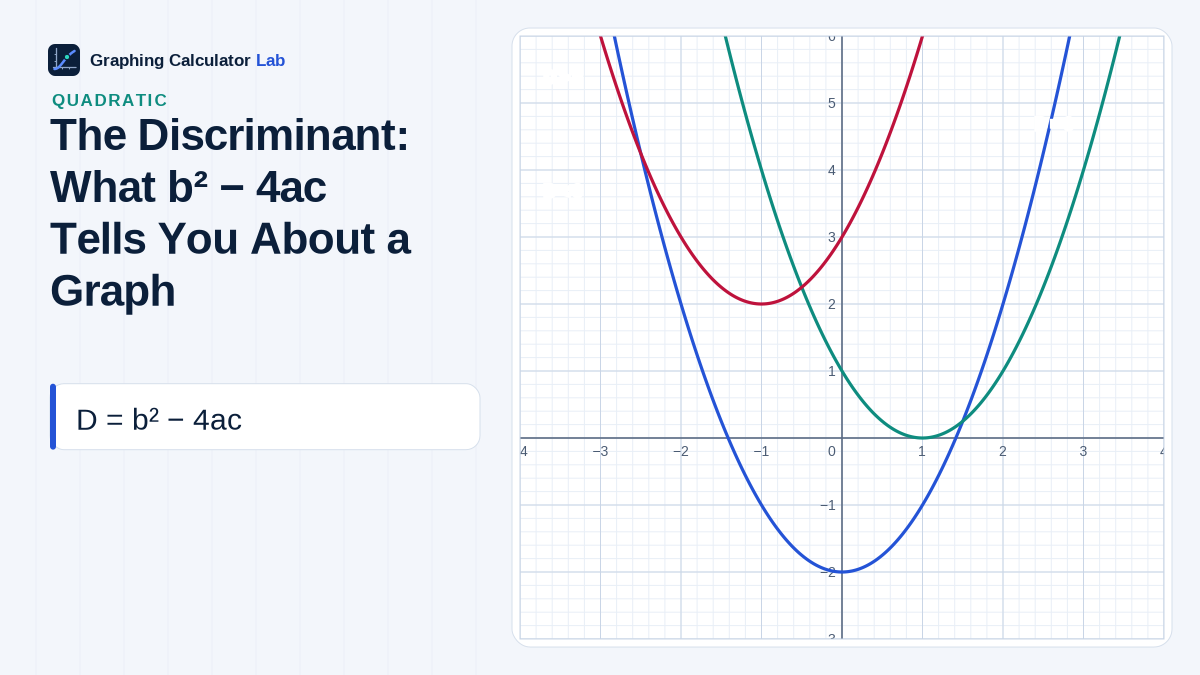
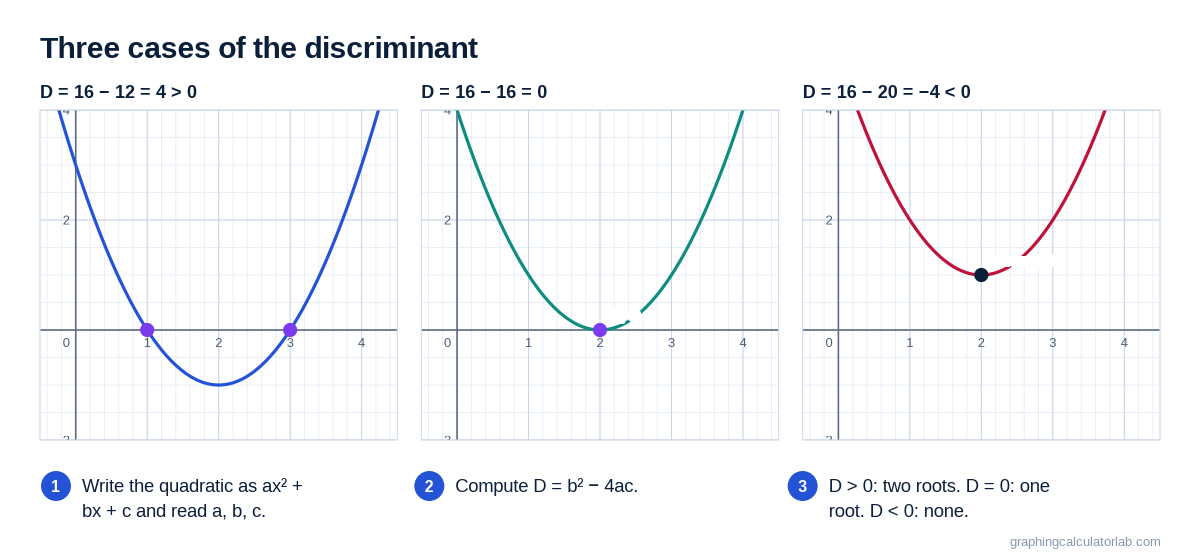
The discriminant of ax² + bx + c is D = b² − 4ac. If D > 0 the quadratic has two real roots and its parabola crosses the x-axis twice; if D = 0 it has one repeated root and the vertex touches the axis; if D < 0 there are no real roots and the graph never meets the x-axis.
Check it yourself: every example here can be loaded into the Vertex Form Calculator.
Open the Vertex Form CalculatorThe formula
For a quadratic equation ax² + bx + c = 0 with a ≠ 0, the discriminant is
It is the part of the quadratic formula that sits under the square root:
So D decides what happens to the “±” part. If D is positive, √D is a positive real number and the ± gives two different answers. If D is zero, the ± adds and subtracts nothing, leaving one answer. If D is negative, √D is not a real number and there are no real answers.
What each case looks like on a graph
| Discriminant | Real roots | Graph of y = ax² + bx + c |
|---|---|---|
| D > 0 | Two distinct | Crosses the x-axis at two points |
| D = 0 | One (repeated) | Vertex sits exactly on the x-axis |
| D < 0 | None | Never touches the x-axis |
Text description of this figure
Three panels. Left: y = x² − 4x + 3, D = 4, two roots at 1 and 3. Middle: y = x² − 4x + 4, D = 0, one root at 2. Right: y = x² − 4x + 5, D = −4, no real roots.
- Write the quadratic as ax² + bx + c and read a, b, c.
- Compute D = b² − 4ac.
- D > 0: two roots. D = 0: one root. D < 0: none.
Worked examples
Example 1: 2x² + 3x − 5. a = 2, b = 3, c = −5. D = 3² − 4(2)(−5) = 9 + 40 = 49. Since 49 > 0 there are two real roots — and because 49 is a perfect square they are rational: x = (−3 ± 7) ⁄ 4, giving x = 1 and x = −5⁄2.
Example 2: 9x² − 12x + 4. D = (−12)² − 4(9)(4) = 144 − 144 = 0. One repeated root: x = 12 ⁄ 18 = 2⁄3. The parabola touches the x-axis at (2⁄3, 0) and turns back.
Example 3: x² + 2x + 5. D = 4 − 20 = −16 < 0. No real roots; the parabola stays above the x-axis (its vertex is (−1, 4)).
- x² − 4x + 3 (D = 4) — opens the Vertex Form Calculator
- x² − 4x + 4 (D = 0) — opens the Vertex Form Calculator
- x² − 4x + 5 (D = −4) — opens the Vertex Form Calculator
How to find the discriminant step by step
- Get the equation into the form ax² + bx + c = 0. Move every term to one side. For 3x² = 5x − 1, rewrite it as 3x² − 5x + 1 = 0.
- Read a, b and c with their signs. Here a = 3, b = −5, c = 1.
- Square b first. (−5)² = 25 — the square of a negative number is positive.
- Subtract 4ac. 4 · 3 · 1 = 12, so D = 25 − 12 = 13.
- Interpret. 13 > 0, so there are two real roots. 13 is not a perfect square, so they are irrational: x = (5 ± √13) ⁄ 6.
The discriminant and the vertex
There is a neat link between D and the vertex height. In vertex form the vertex is at k = c − b² ⁄ (4a) = −D ⁄ (4a). So for an upward parabola (a > 0):
- D > 0 makes k negative — the vertex is below the axis, so the curve must cross it twice.
- D = 0 makes k = 0 — the vertex is on the axis.
- D < 0 makes k positive — the vertex is above the axis and the curve never comes down to it.
That is the same story told by the graph.
Common mistakes
- Forgetting to move everything to one side. The discriminant of 3x² = 5x − 1 uses b = −5 and c = 1, not b = 5.
- Writing −b² instead of b². For b = −5, b² = 25, not −25.
- Concluding “no solution” when D < 0. There are no real solutions. In complex numbers there are two.
- Mixing up D and the roots. D tells you how many roots there are, not what they are.
To see the cases change smoothly, graph y = x² − 4x + c with a slider for c in the graphing calculator: the curve lifts off the axis exactly when c passes 4.
Questions
Where does the discriminant come from?
It is the expression under the square root in the quadratic formula x = (−b ± √(b² − 4ac)) ⁄ (2a). A negative number has no real square root, which is why D < 0 means no real roots.
Does a perfect-square discriminant mean anything?
Yes. If a, b and c are integers and D is a perfect square (0, 1, 4, 9 …), the roots are rational and the quadratic factors over the integers or simple fractions.
What does a negative discriminant mean in real life?
The quantity modelled by the quadratic never reaches zero. For example, a thrown object whose height equation has D < 0 for a given height never reaches that height.
Graph your own example with the Vertex Form Calculator — free, in your browser.
Try it nowSources and further reading
- OpenStax, College Algebra 2e — 2.5 Quadratic Equations
- OpenStax, Intermediate Algebra 2e — 9.3 Solve Quadratic Equations Using the Quadratic Formula
Worked examples and figures were produced and checked with the Graphing Calculator Lab engine. See the editorial policy.