Factored Form of a Quadratic (Intercept Form) Explained
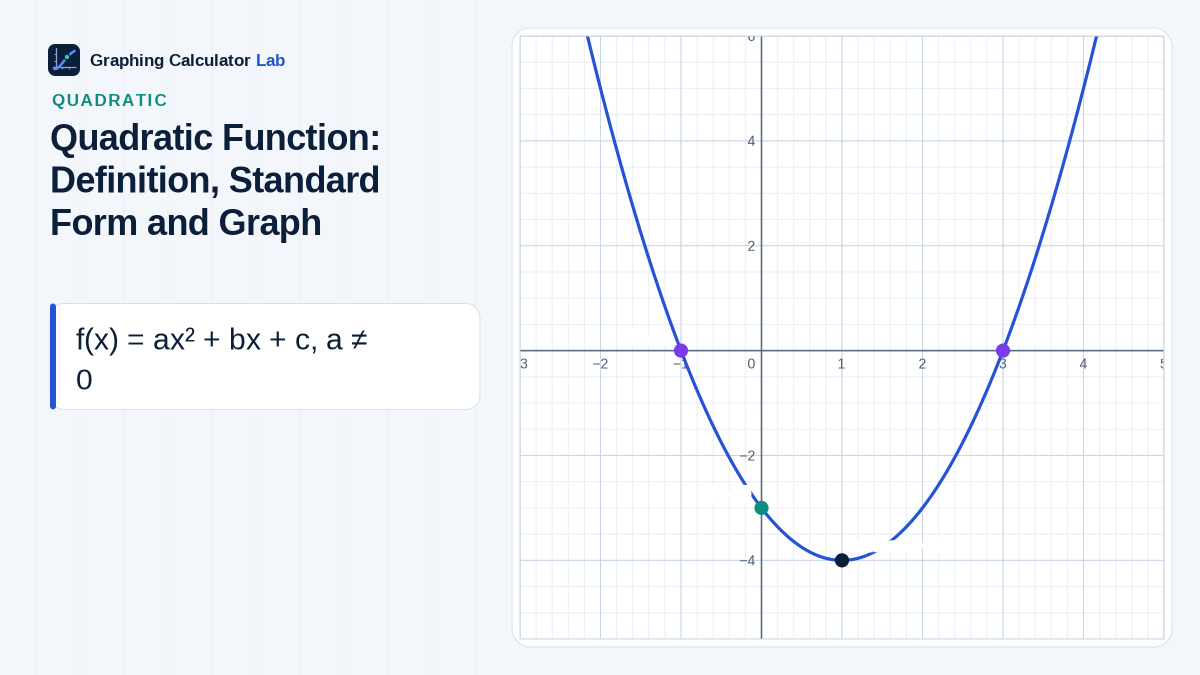
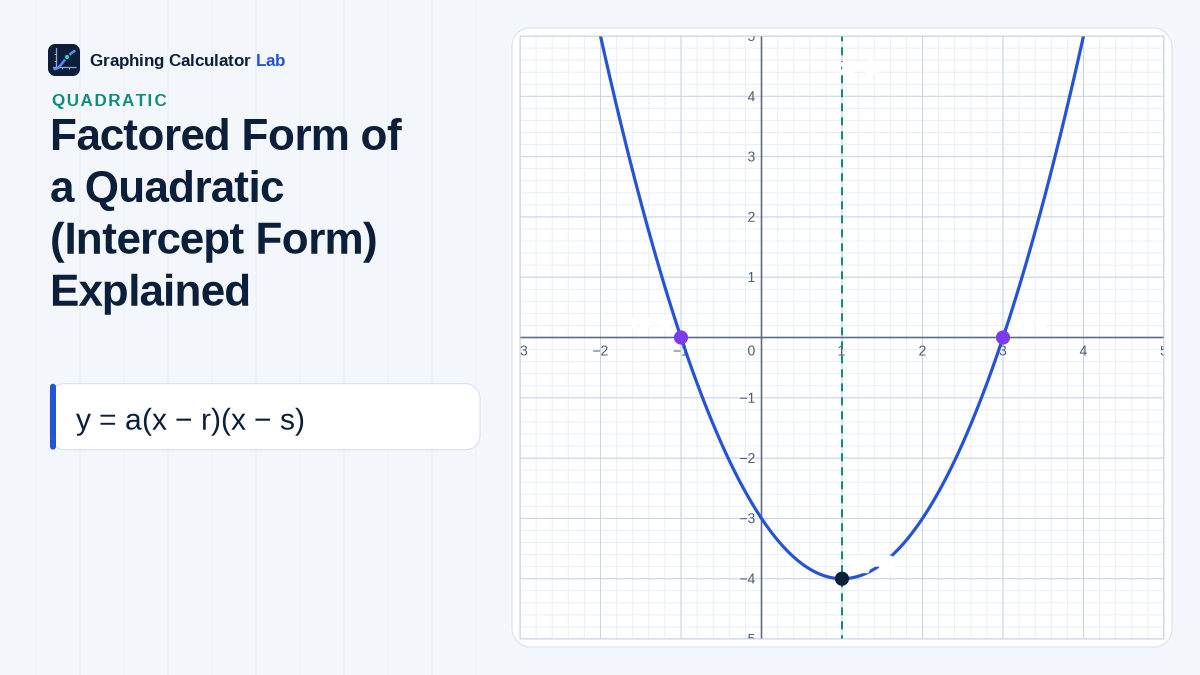
Factored form writes a quadratic as y = a(x − r)(x − s), where r and s are its roots. It is also called intercept form because the parabola crosses the x-axis at (r, 0) and (s, 0). The vertex lies halfway between them, at x = (r + s) ⁄ 2.
Check it yourself: every example here can be loaded into the Vertex Form Calculator.
Open the Vertex Form CalculatorReading factored form
A quadratic in factored form looks like
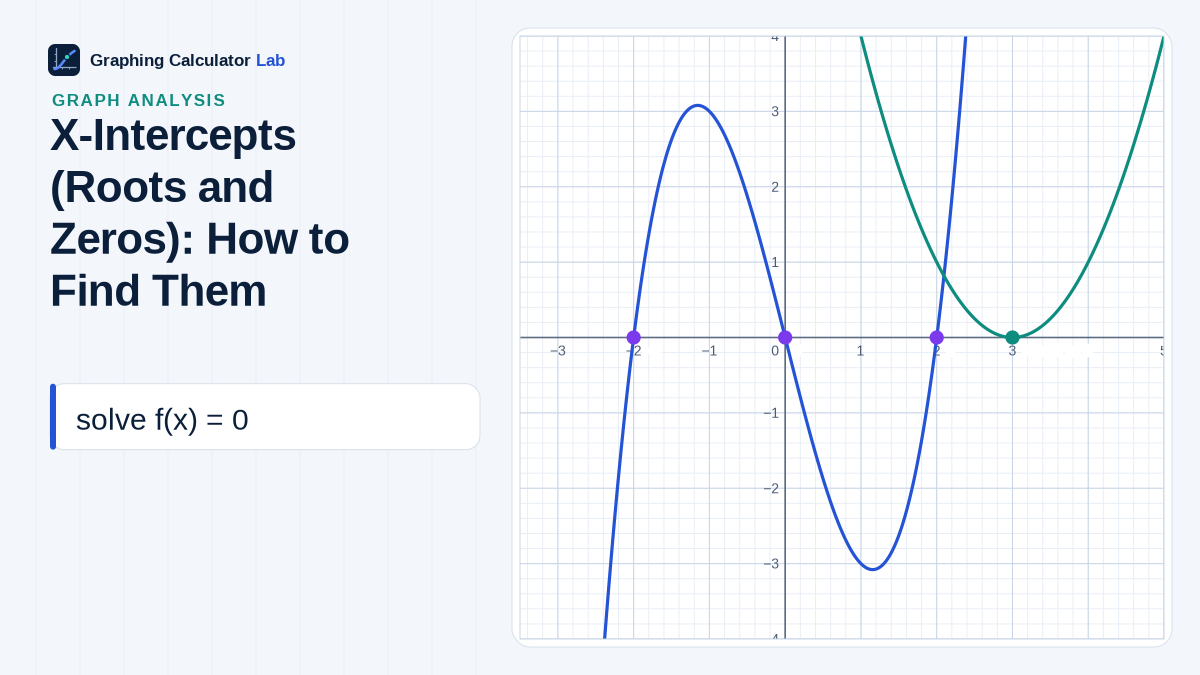
A product is zero exactly when one of its factors is zero. So y = 0 when x − r = 0 or x − s = 0 — that is, at x = r and x = s. These are the roots, also called zeros or x-intercepts. Because the intercepts are on display, factored form is also known as intercept form.
| Part | Meaning | For y = (x + 1)(x − 3) |
|---|---|---|
| r, s | x-intercepts (watch the signs) | −1 and 3 |
| (r + s) ⁄ 2 | Axis of symmetry and x of the vertex | 1 |
| a | Direction and stretch, same as in standard form | 1, opens up |
The bracket (x + 1) is (x − (−1)), so its root is −1. The sign flips, exactly as with h in vertex form.
How to graph from factored form
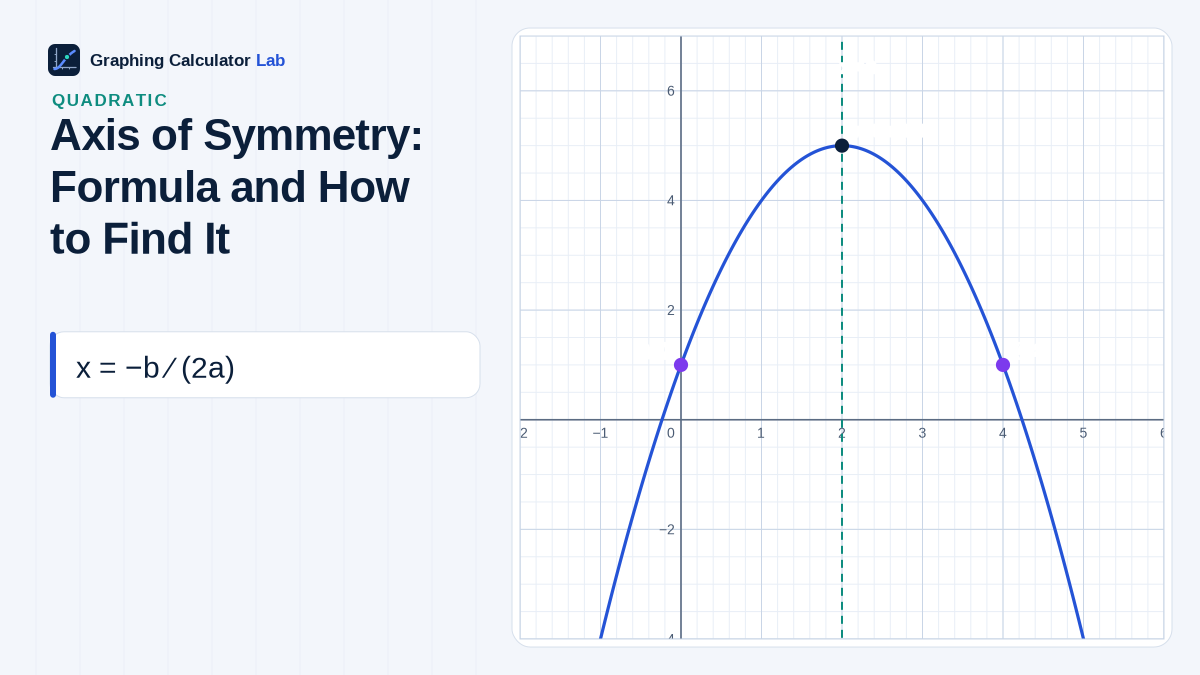
Text description of this figure
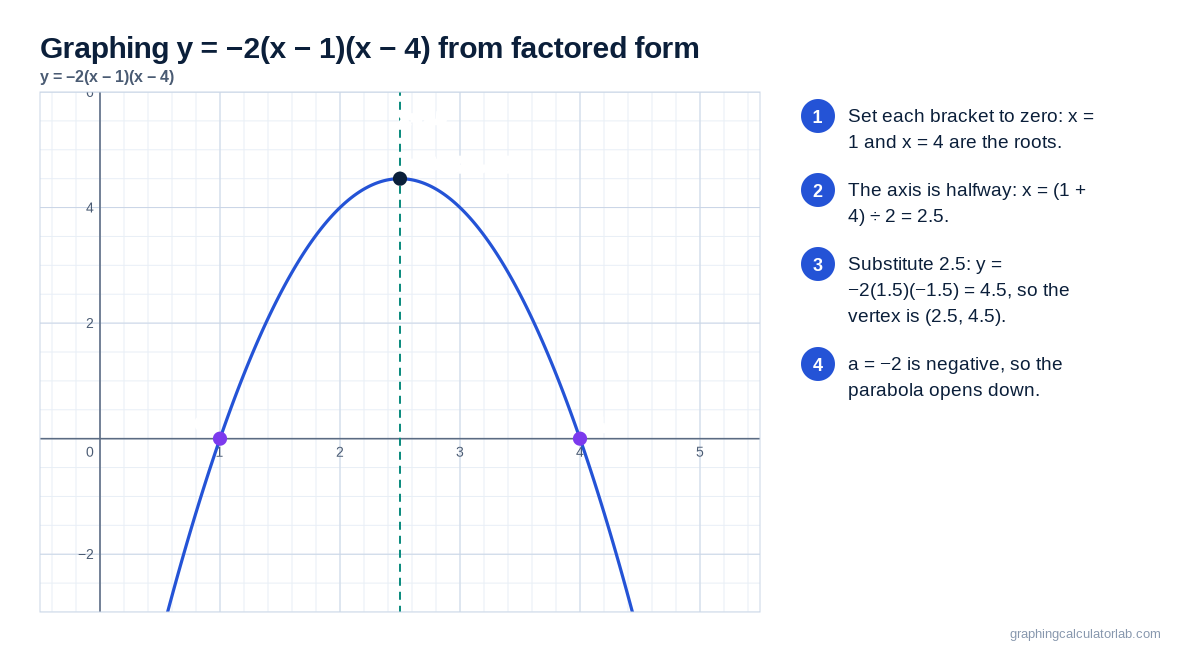
Downward parabola y = −2(x − 1)(x − 4) with roots 1 and 4, axis x = 2.5 and vertex (2.5, 4.5).
- Set each bracket to zero: x = 1 and x = 4 are the roots.
- The axis is halfway: x = (1 + 4) ÷ 2 = 2.5.
- Substitute 2.5: y = −2(1.5)(−1.5) = 4.5, so the vertex is (2.5, 4.5).
- a = −2 is negative, so the parabola opens down.
- Mark the roots. Set each factor to zero.
- Draw the axis halfway between them.
- Find the vertex by substituting the axis value into the equation.
- Check the direction with the sign of a, then sketch a symmetric U through the three points.
- Graph y = −2(x − 1)(x − 4) — opens the Graphing Calculator
Converting between forms
Factored → standard: multiply out the brackets.
(x + 1)(x − 3) = x² − 3x + x − 3 = x² − 2x − 3.
Standard → factored: factor the trinomial. For x² − 2x − 3 you need two numbers that multiply to −3 and add to −2: they are −3 and +1, so x² − 2x − 3 = (x − 3)(x + 1). When the leading coefficient is not 1, factor it out first or use the roots from the quadratic formula: if the roots are r and s, then ax² + bx + c = a(x − r)(x − s).
Factored → vertex: find the vertex as shown above. For y = (x + 1)(x − 3), the axis is x = 1 and y(1) = (2)(−2) = −4, so the vertex form is y = (x − 1)² − 4.
- Expand to standard form: x² − 2x − 3 — opens the Vertex Form Calculator
Worked example from a graph
A parabola crosses the x-axis at −2 and 4 and passes through (0, −4). Find its equation.
- Roots −2 and 4 give y = a(x + 2)(x − 4).
- Use (0, −4): −4 = a(2)(−4) = −8a, so a = 1⁄2.
- The equation is y = ½(x + 2)(x − 4), which expands to y = ½x² − x − 4.
This is the main strength of factored form: two intercepts and one more point are enough to pin down the whole parabola.
Common mistakes
- Wrong-sign roots. (x + 5) gives the root −5, not 5.
- Forgetting a. y = 3(x − 1)(x − 2) and y = (x − 1)(x − 2) have the same roots but different shapes and vertices.
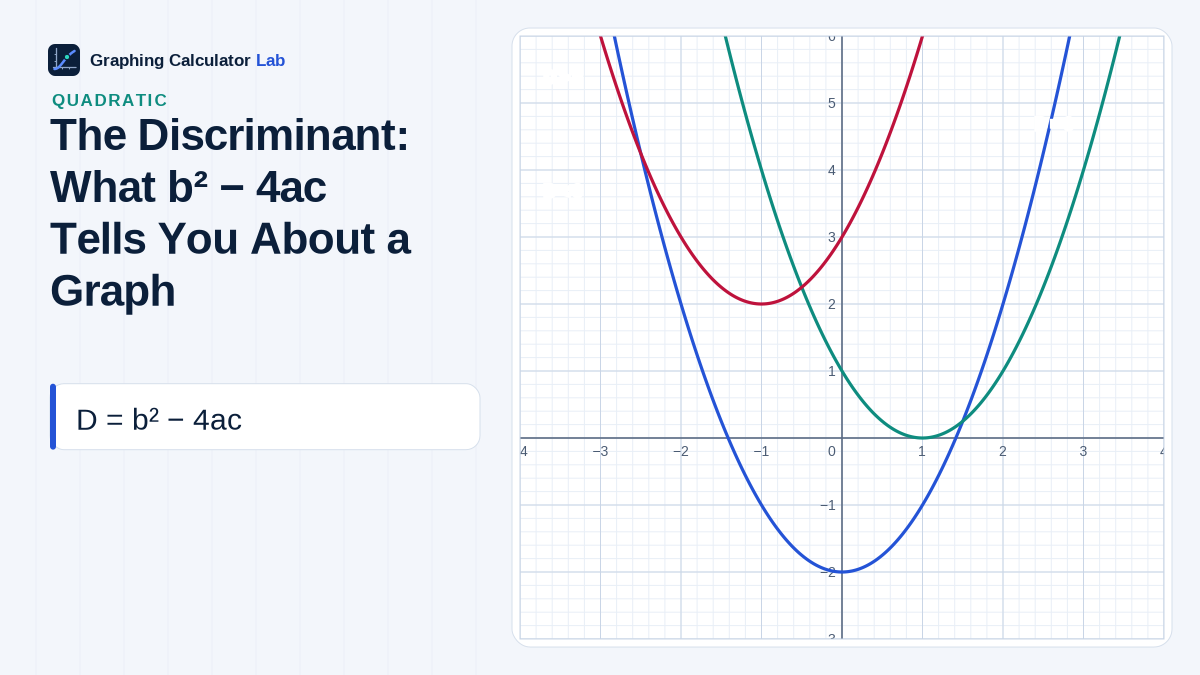
- Treating x² + 4 as factorable. It has no real roots (the discriminant is −16), so it has no real factored form.
- Mixing up factors and roots. (x − 3) is a factor; x = 3 is the root.
Questions
Is factored form the same as intercept form?
Yes. Some courses call y = a(x − p)(x − q) intercept form because p and q are the x-intercepts. The name differs; the form is the same.
Can every quadratic be put in factored form?
Only those with real roots. If the discriminant is negative, such as for x² + 1, there are no real x-intercepts and no real factored form.
What does a repeated factor mean?
y = a(x − r)² has a double root at r: the parabola touches the x-axis at (r, 0) without crossing it, and that point is also the vertex.
Graph your own example with the Vertex Form Calculator — free, in your browser.
Try it nowSources and further reading
- OpenStax, College Algebra 2e — 5.1 Quadratic Functions
- OpenStax, Elementary Algebra 2e — 7.3 Factor Trinomials
Worked examples and figures were produced and checked with the Graphing Calculator Lab engine. See the editorial policy.