X-Intercepts (Roots and Zeros): How to Find Them
An x-intercept is a point where a graph meets the x-axis, so its y-coordinate is 0. To find x-intercepts, set y = 0 (or f(x) = 0) and solve for x. The solutions are also called the roots or zeros of the function. A graph can have no x-intercepts, one, or many, and it may cross the axis or just touch it.
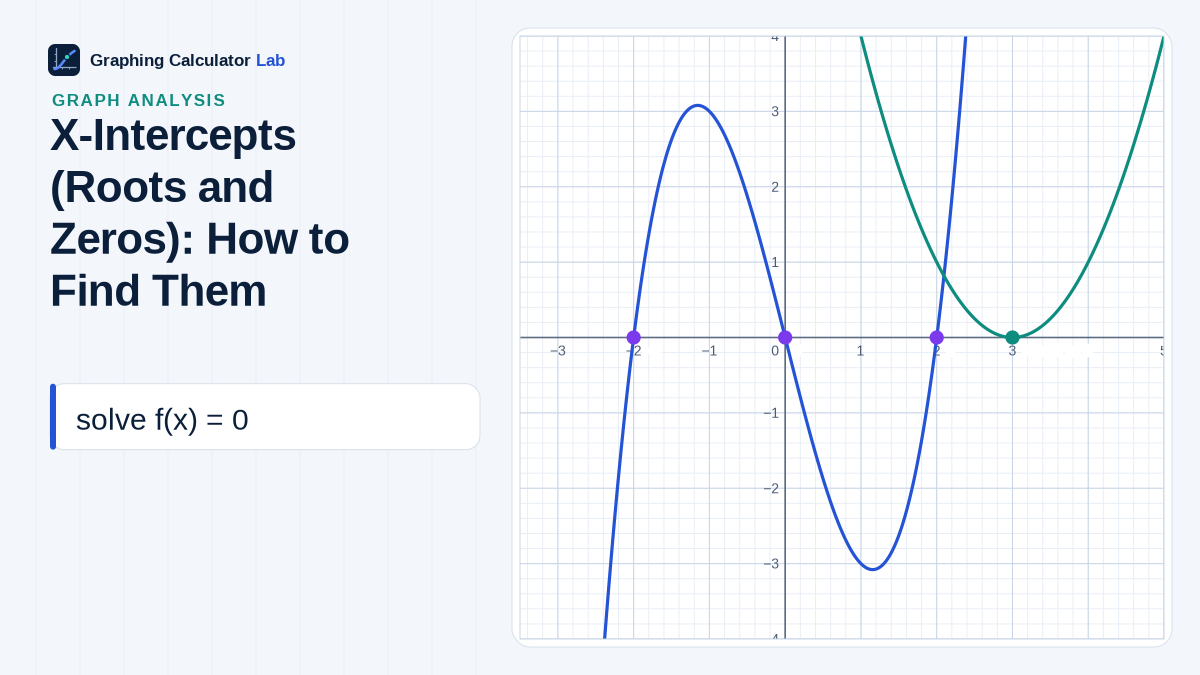
Check it yourself: every example here can be loaded into the Graphing Calculator.
Open the Graphing CalculatorDefinition
Every point on the x-axis has y = 0. So an x-intercept is a point (r, 0) on the graph, and the number r solves
That is why x-intercepts are also called roots, zeros or solutions of the equation f(x) = 0.
For lines
Set y = 0 in the equation:
- y = 3x − 6 → 0 = 3x − 6 → x = 2. Intercept (2, 0).
- 2x + 5y = 10 → 2x = 10 → x = 5. Intercept (5, 0).
- y = 4 (horizontal) → no x-intercept.
For quadratics
Solve ax² + bx + c = 0 by factoring, completing the square or the quadratic formula.
- x² − x − 6 = (x − 3)(x + 2) → x = 3, x = −2.
- x² − 6x + 9 = (x − 3)² → x = 3 only; the graph touches the axis.
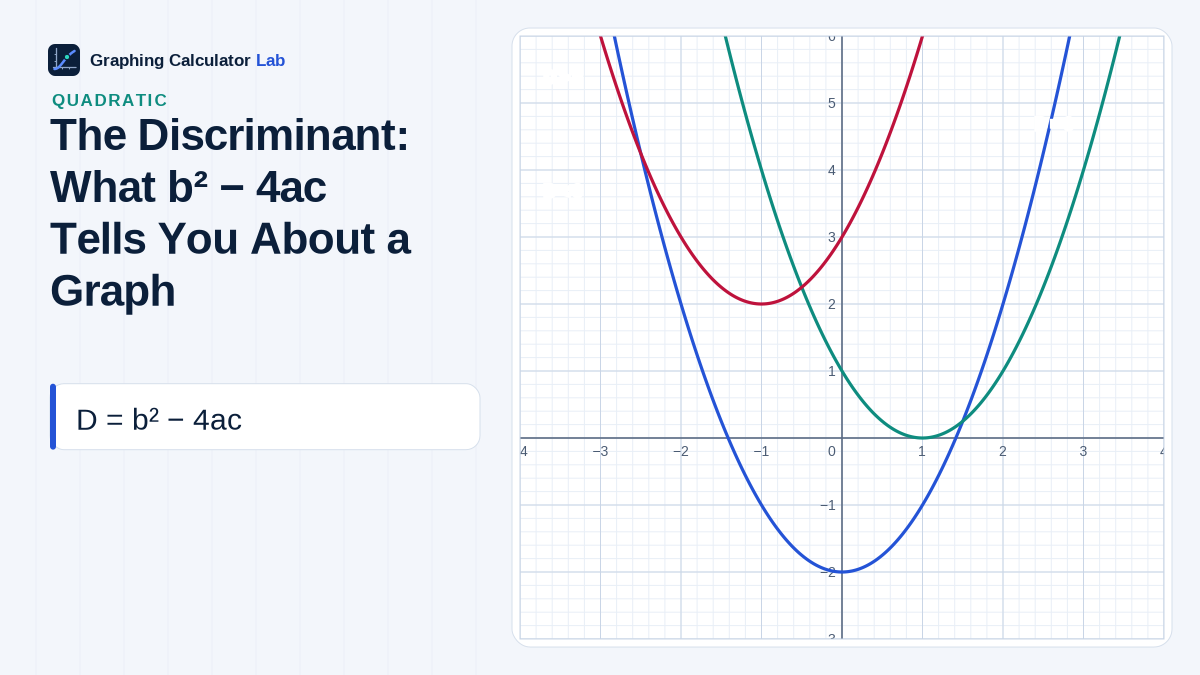
- x² + 2x + 5: the discriminant is −16, so there are no x-intercepts.
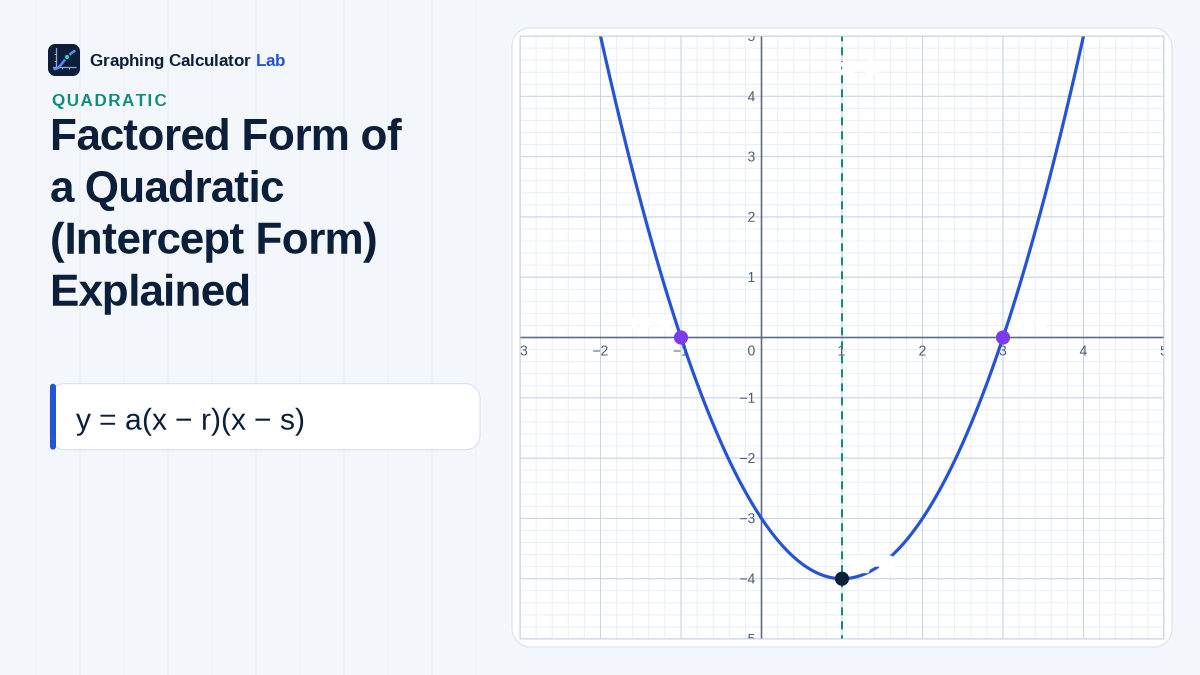
The factored form of a quadratic shows its x-intercepts directly.
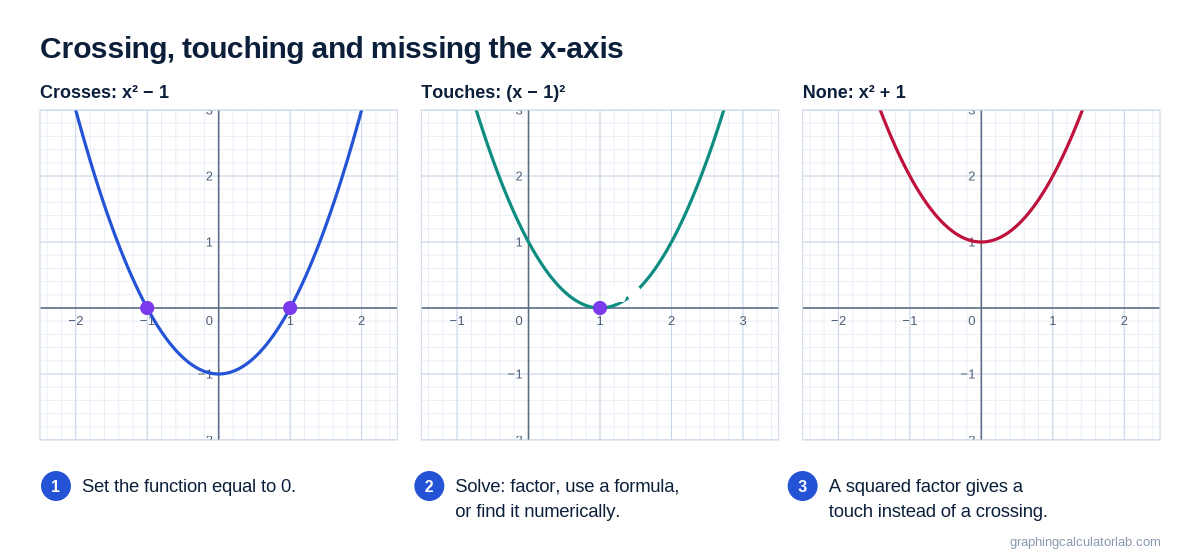
Text description of this figure
Three panels: y = x² − 1 crosses the x-axis at −1 and 1; y = (x − 1)² touches it at 1; y = x² + 1 never meets it.
- Set the function equal to 0.
- Solve: factor, use a formula, or find it numerically.
- A squared factor gives a touch instead of a crossing.
For other functions
| Function | Set to 0 | x-intercepts |
|---|---|---|
| x³ − 4x | x(x − 2)(x + 2) = 0 | −2, 0, 2 |
| √(x − 1) − 2 | √(x − 1) = 2 | 5 |
| ln(x) | ln x = 0 | 1 |
| 2ˣ − 8 | 2ˣ = 8 | 3 |
| (x − 1)⁄(x + 2) | numerator = 0 | 1 (if the denominator ≠ 0 there) |
| eˣ − 3 | eˣ = 3 | ln 3 ≈ 1.0986 |
For a fraction, only the numerator matters — but check that the denominator is not also zero, which would make a hole instead (see holes and asymptotes).
- x-intercepts of x³ − 4x and (x − 3)² — opens the Graphing Calculator
Crossing vs touching
If a factor appears an odd number of times — (x − 2) or (x − 2)³ — the graph crosses the axis there. If it appears an even number of times — (x − 3)² — the graph touches and turns back. The graphing calculator labels touching roots “(touches)”.
Finding x-intercepts numerically
Some equations, like x = cos x or eˣ = x + 2, cannot be solved with algebra. A graphing calculator finds the zeros by searching for sign changes and narrowing in on them by repeated halving (the bisection method). It confirms the function is continuous across the sign change, so the jump of 1⁄x at x = 0 is never reported as a root.
- Zeros of e^x − 3 (numerical) — opens the Graphing Calculator
Common mistakes
- Setting x = 0. That gives the y-intercept.
- Counting a hole as a root. For (x² − 1)⁄(x − 1), x = 1 is excluded, so only x = −1 is an intercept.
- Assuming none exist because none are visible — check a wider window.
- Writing the intercept as (0, r). It is (r, 0).
Questions
Are roots, zeros and x-intercepts the same thing?
Nearly. Roots and zeros are the x-values that make f(x) = 0; x-intercepts are the points (x, 0) on the graph. Complex roots are roots but not x-intercepts.
How many x-intercepts can a polynomial have?
At most its degree. A cubic has up to three, a quadratic up to two.
How accurate are the calculator’s x-intercepts?
They are found numerically within the visible window, to about five significant figures. Zoom out to search further.
Graph your own example with the Graphing Calculator — free, in your browser.
Try it nowSources and further reading
- OpenStax, Elementary Algebra 2e — 4.3 Graph with Intercepts
- OpenStax, College Algebra 2e — 5.3 Graphs of Polynomial Functions
Worked examples and figures were produced and checked with the Graphing Calculator Lab engine. See the editorial policy.