Parabola: Equation, Focus, Directrix and Graph
A parabola is the set of points that are the same distance from a fixed point, the focus, and a fixed line, the directrix. A vertical parabola has equation y = a(x − h)² + k with vertex (h, k); its focus is (h, k + 1⁄(4a)) and its directrix is the line y = k − 1⁄(4a).
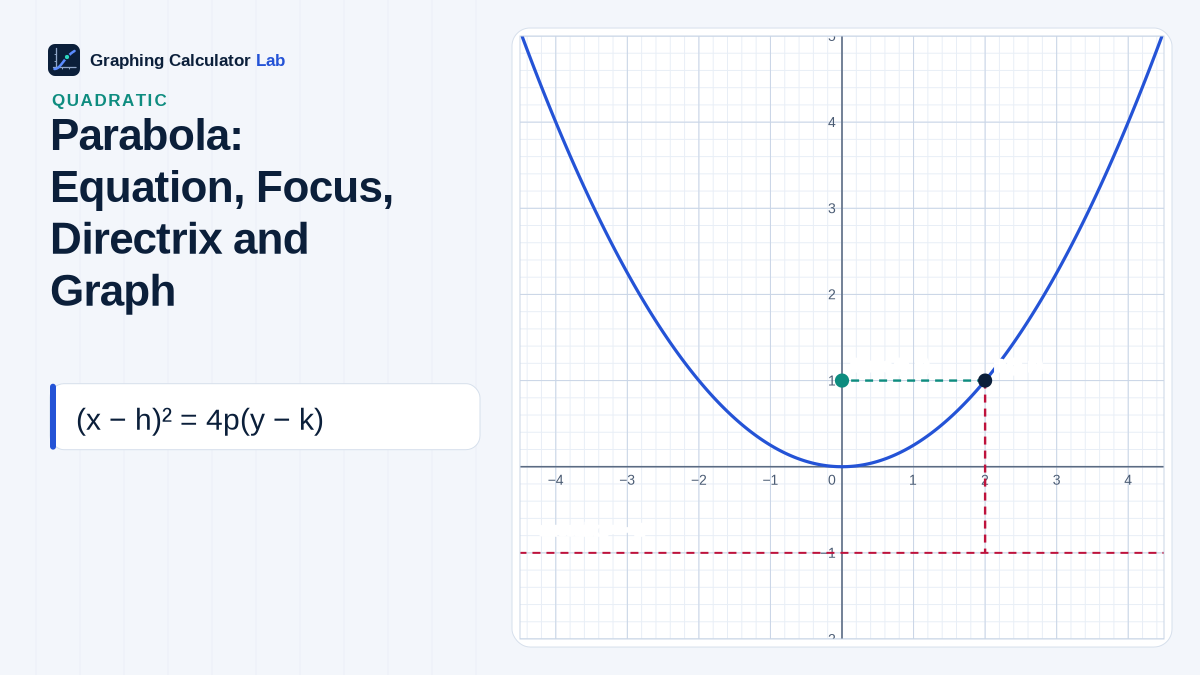
Check it yourself: every example here can be loaded into the Graphing Calculator.
Open the Graphing CalculatorTwo ways to describe a parabola
In algebra a parabola is the graph of a quadratic function. In geometry it has a precise definition:
A parabola is the set of all points that are the same distance from a fixed point (the focus) and a fixed line (the directrix).
The point of the parabola halfway between the focus and the directrix is the vertex, and the line through the focus perpendicular to the directrix is the axis of symmetry.
The parabola equation
For a parabola that opens up or down with vertex (h, k), the geometric form is
where p is the signed distance from the vertex to the focus. Solving for y gives the familiar vertex form:
| Feature | Formula | For y = ¼x² |
|---|---|---|
| Vertex | (h, k) | (0, 0) |
| p | 1 ⁄ (4a) | 1 |
| Focus | (h, k + p) | (0, 1) |
| Directrix | y = k − p | y = −1 |
| Opens | up if p > 0, down if p < 0 | up |
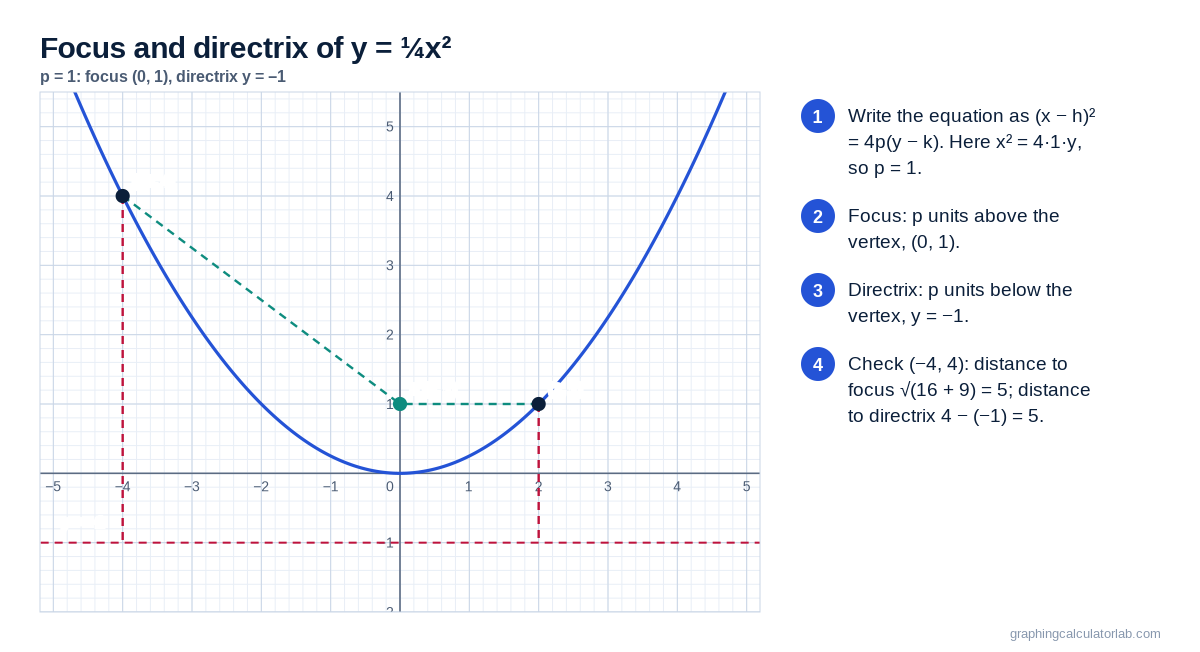
Text description of this figure
Parabola y = x²/4 with the focus at (0, 1) and directrix y = −1; for the points (2, 1) and (−4, 4) the distances to the focus and to the directrix are equal: 2 and 2, then 5 and 5.
- Write the equation as (x − h)² = 4p(y − k). Here x² = 4·1·y, so p = 1.
- Focus: p units above the vertex, (0, 1).
- Directrix: p units below the vertex, y = −1.
- Check (−4, 4): distance to focus √(16 + 9) = 5; distance to directrix 4 − (−1) = 5.
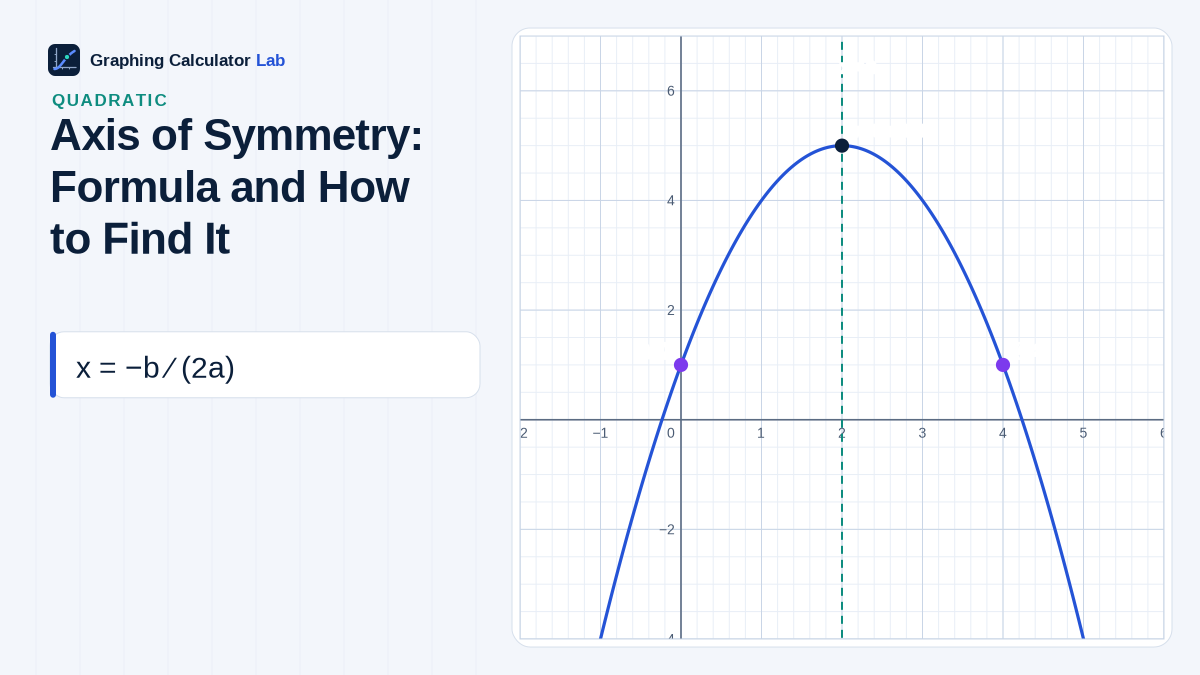
Worked example: y = −½(x − 2)² + 3
- Vertex: (h, k) = (2, 3).
- a and p: a = −½, so p = 1 ⁄ (4a) = 1 ⁄ (−2) = −½. Negative p means the parabola opens down.
- Focus: (h, k + p) = (2, 2.5) — inside the curve, below the vertex.
- Directrix: y = k − p = 3 + ½ = 3.5 — above the vertex, outside the curve.
- Check a point: x = 4 gives y = −½(4) + 3 = 1. The distance from (4, 1) to the focus (2, 2.5) is √(4 + 2.25) = 2.5, and the distance to the line y = 3.5 is 3.5 − 1 = 2.5. ✓
- Graph y = −½(x − 2)² + 3 — opens the Graphing Calculator
Why the definition gives a quadratic
Take the focus (0, p) and directrix y = −p. A point (x, y) is equally far from both when
√(x² + (y − p)²) = y + p.
Squaring both sides: x² + y² − 2py + p² = y² + 2py + p², which simplifies to x² = 4py. That is exactly y = x² ⁄ (4p), a quadratic. So the geometric and algebraic descriptions are the same curve.
Sideways parabolas
Swapping x and y gives a parabola that opens left or right: (y − k)² = 4p(x − h). These are not functions of x — a vertical line can cross them twice — so the graphing calculator shows them as two branches, y = k ± √(4p(x − h)).
- Sideways parabola x = y² as two branches — opens the Graphing Calculator
Parabolas in the real world
- Projectiles. Ignoring air resistance, a thrown ball follows a parabolic path.
- Reflectors. Car headlights and satellite dishes use the focus property.
- Bridges and arches. Many suspension-bridge cables hang close to parabolas when the deck load is even.
Common mistakes
- Using a as the focal distance. p = 1 ⁄ (4a), not a. For y = 2x², the focus is only 1⁄8 above the vertex.
- Putting the directrix on the wrong side. The focus is inside the curve; the directrix is outside it.
- Forgetting p is signed. A downward parabola has p < 0, so the focus is below the vertex.
To practise, graph a parabola together with its directrix line and focus point in the graphing calculator and trace a few points to check the equal-distance property.
Questions
Is every parabola the graph of a quadratic function?
Parabolas that open up or down are graphs of y = ax² + bx + c. Parabolas that open sideways, such as x = y², are not functions of x, but they are still parabolas.
Why are satellite dishes parabolic?
A parabola reflects every incoming ray that is parallel to its axis through the focus. Putting the receiver at the focus collects the whole signal there.
What is the latus rectum?
The chord through the focus parallel to the directrix. Its length is |4p|, which tells you how wide the parabola is at the focus.
Graph your own example with the Graphing Calculator — free, in your browser.
Try it nowSources and further reading
Worked examples and figures were produced and checked with the Graphing Calculator Lab engine. See the editorial policy.