Axis of Symmetry: Formula and How to Find It
The axis of symmetry of a parabola is the vertical line that divides it into two mirror-image halves. For y = ax² + bx + c its equation is x = −b ⁄ (2a). It always passes through the vertex, and it sits exactly halfway between the two roots when the parabola has them.
Check it yourself: every example here can be loaded into the Vertex Form Calculator.
Open the Vertex Form CalculatorWhat the axis of symmetry is
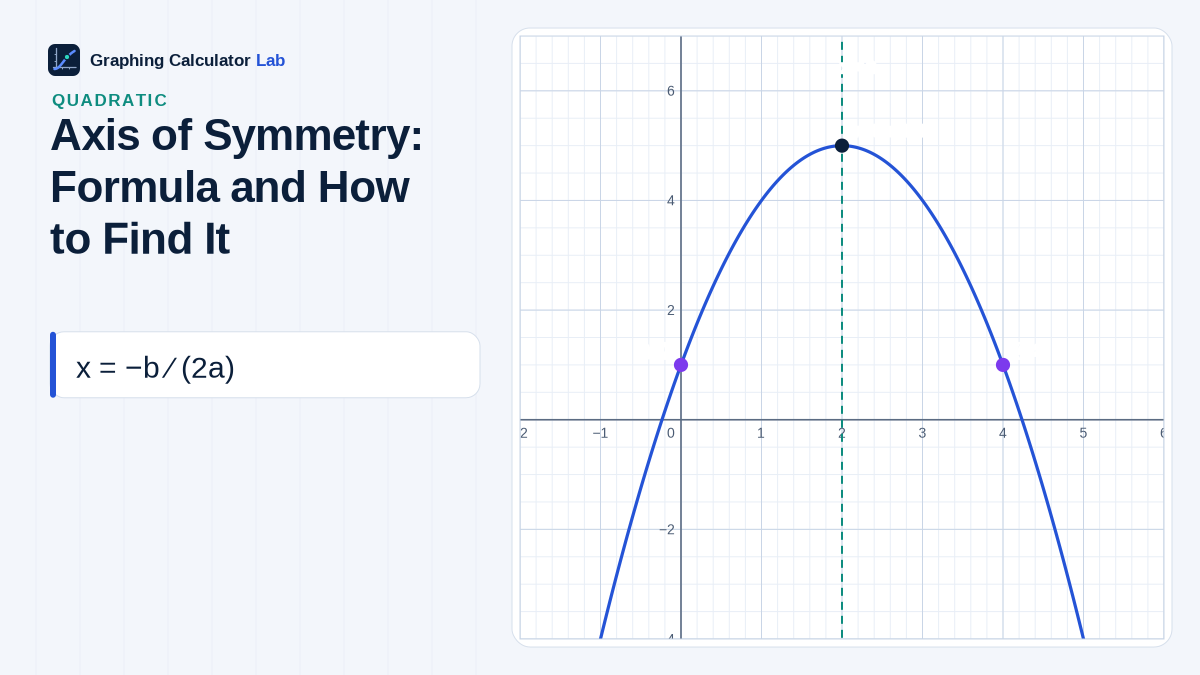
Fold a parabola along the right vertical line and the two halves land exactly on top of each other. That fold line is the axis of symmetry. Every point on one side has a partner at the same height on the other side, the same distance from the line.
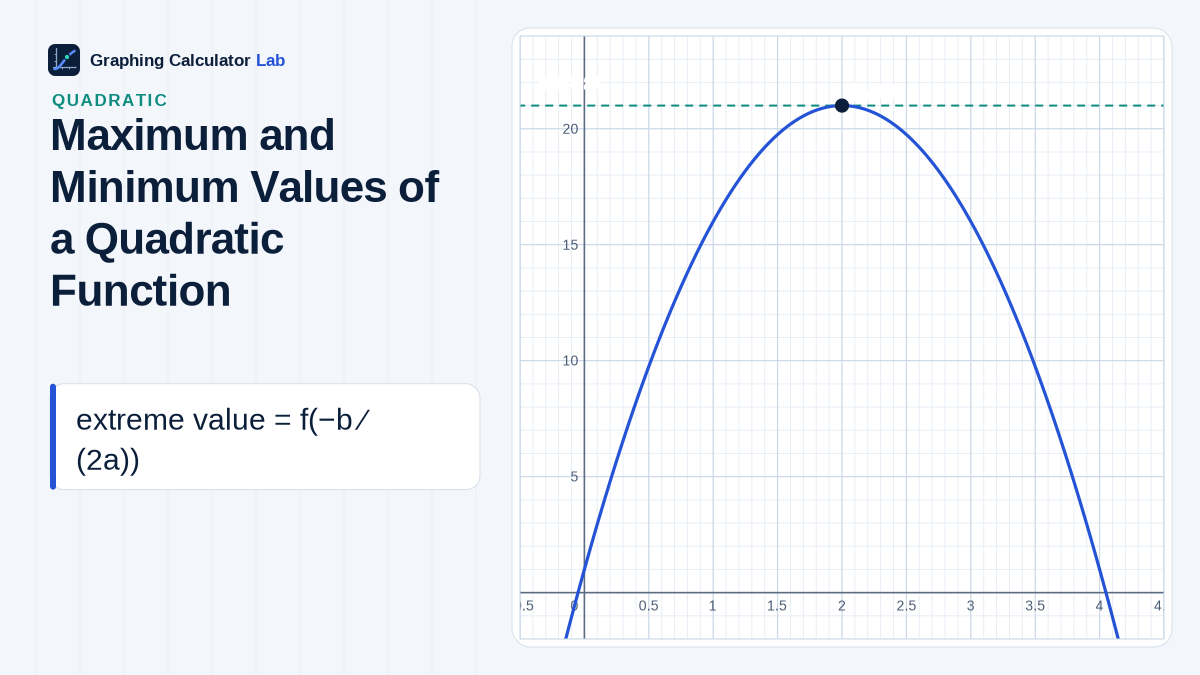
For the parabola in the picture above, y = −x² + 4x + 1, the axis is x = 2. The points (0, 1) and (4, 1) are both 2 units from the line and have the same y-value — a pair of mirror points.
The formula and where it comes from
For a quadratic in standard form,
It comes from completing the square. Rewriting ax² + bx + c as a(x + b⁄(2a))² + (c − b²⁄(4a)) puts the quadratic in vertex form, where the vertex — and therefore the axis — is at x = −b⁄(2a).
Text description of this figure
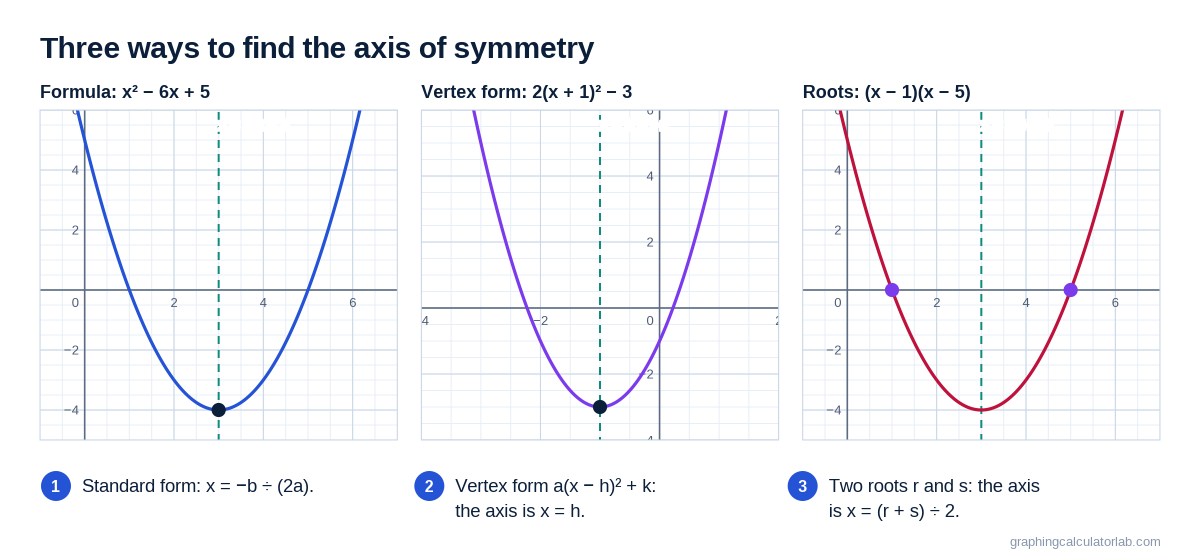
Three panels. Left: y = x² − 6x + 5 with x = −b/(2a) = 3. Middle: y = 2(x + 1)² − 3 with the axis read from vertex form, x = −1. Right: y = (x − 1)(x − 5) with the axis halfway between roots 1 and 5, at x = 3.
- Standard form: x = −b ÷ (2a).
- Vertex form a(x − h)² + k: the axis is x = h.
- Two roots r and s: the axis is x = (r + s) ÷ 2.
Method 1: from standard form
Find the axis of y = −x² + 4x + 1.
- Identify a = −1 and b = 4.
- Substitute: x = −4 ⁄ (2 · (−1)) = −4 ⁄ (−2) = 2.
- The axis of symmetry is x = 2.
- Optional: the vertex is at x = 2, so y = −4 + 8 + 1 = 5. Vertex (2, 5).
- Axis of symmetry of −x² + 4x + 1 — opens the Vertex Form Calculator
Method 2: from vertex form
In y = a(x − h)² + k the axis is simply x = h. For y = 2(x + 1)² − 3, rewrite the bracket as (x − (−1)), so h = −1 and the axis is x = −1. No calculation is needed — just watch the sign.
- Graph y = 2(x + 1)² − 3 — opens the Graphing Calculator
Method 3: from the roots
If a parabola crosses the x-axis at x = r and x = s, the axis lies halfway between them:
For y = (x − 1)(x − 5), the roots are 1 and 5, so the axis is x = (1 + 5) ⁄ 2 = 3. This is fast when the quadratic is already factored, and it works with any two points at the same height, not only roots.
Method 4: from a graph or table
On a graph, find two points with the same y-value and take the midpoint of their x-values. In a table, look for repeated y-values:
| x | 0 | 1 | 2 | 3 | 4 | 5 | 6 |
|---|---|---|---|---|---|---|---|
| y = x² − 6x + 5 | 5 | 0 | −3 | −4 | −3 | 0 | 5 |
The values mirror around x = 3, so the axis is x = 3 (and the vertex is (3, −4)).
- Axis of symmetry of x² − 6x + 5 — opens the Vertex Form Calculator
Why it is useful
- Plotting faster. Once you know the axis, each point you calculate gives you a second point for free.
- Finding the maximum or minimum. The highest or lowest point of the parabola is on the axis. See quadratic maximum and minimum.
- Checking roots. If your two roots are not equally spaced around the axis, one of them is wrong.
Common mistakes
- Dropping the minus sign. x = −b ⁄ (2a), not b ⁄ (2a). For x² − 6x + 5, b = −6 and the axis is +3.
- Forgetting the 2. x = −b ⁄ a gives twice the correct value.
- Writing the answer as a number instead of a line. The axis is the line “x = 3”, not just “3”.
- Using y = … for the axis. For an upward or downward parabola it is always x = constant.
Questions
Is the axis of symmetry always vertical?
For a function y = ax² + bx + c, yes — it is always a vertical line x = constant. Sideways parabolas such as x = y² have a horizontal axis, but they are not functions of x.
What if b = 0?
Then x = −0/(2a) = 0, so the axis is the y-axis. For example y = 3x² − 7 is symmetric about x = 0.
Does a parabola with no real roots have an axis of symmetry?
Yes. Every parabola has one. You just cannot find it by averaging roots, so use x = −b ⁄ (2a) instead.
Graph your own example with the Vertex Form Calculator — free, in your browser.
Try it nowSources and further reading
- OpenStax, College Algebra 2e — 5.1 Quadratic Functions
- OpenStax, Intermediate Algebra 2e — 9.6 Graph Quadratic Functions Using Properties
Worked examples and figures were produced and checked with the Graphing Calculator Lab engine. See the editorial policy.