Standard Form of a Line: Ax + By = C and the Intercept Method
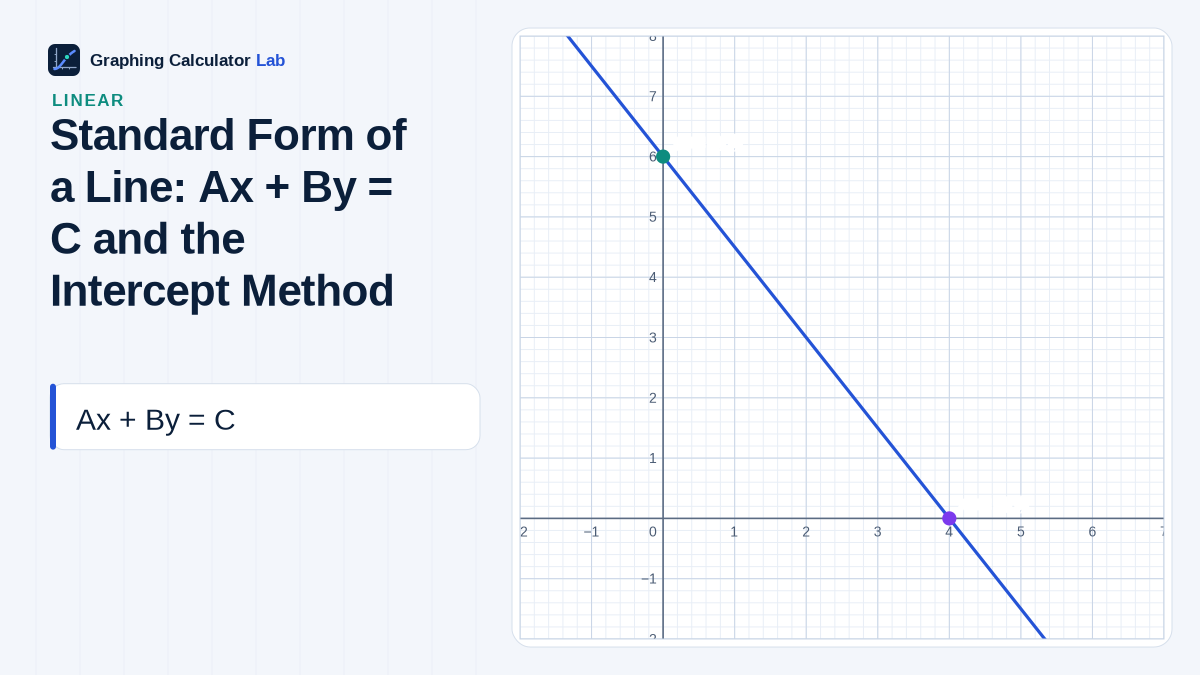
The standard form of a linear equation is Ax + By = C, usually with integers A, B, C and A ≥ 0. Its x-intercept is (C ⁄ A, 0), its y-intercept is (0, C ⁄ B), and its slope is −A ⁄ B. The fastest way to graph it is to plot both intercepts and draw the line through them.
Check it yourself: every example here can be loaded into the Slope Intercept Form Calculator.
Open the Slope Intercept Form CalculatorWhat standard form looks like
The x- and y-terms are on the left and the constant on the right. By convention:
- A, B and C are integers (no fractions or decimals),
- A is not negative, and
- A, B and C have no common factor.
So 4x + 6y = −8 is usually written 2x + 3y = −4, and −x + 2y = 5 becomes x − 2y = −5.
The key features at a glance
| Feature | Formula | For 3x + 2y = 12 |
|---|---|---|
| x-intercept | (C ⁄ A, 0) | (4, 0) |
| y-intercept | (0, C ⁄ B) | (0, 6) |
| Slope | −A ⁄ B | −3⁄2 |
Graphing with the intercept method
This is the fastest way to graph a line in standard form, because each intercept needs only one division.
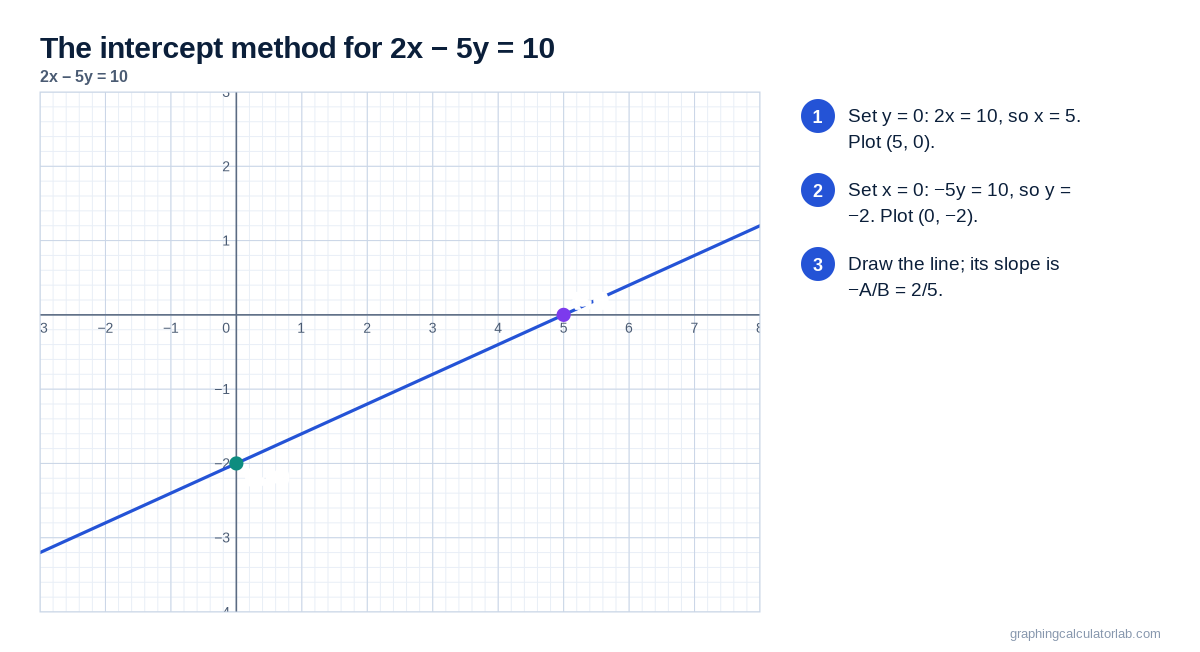
Text description of this figure
Line 2x − 5y = 10 with the x-intercept (5, 0) found by setting y = 0 and the y-intercept (0, −2) found by setting x = 0.
- Set y = 0: 2x = 10, so x = 5. Plot (5, 0).
- Set x = 0: −5y = 10, so y = −2. Plot (0, −2).
- Draw the line; its slope is −A/B = 2/5.
For 3x + 2y = 12:
- x-intercept: set y = 0. 3x = 12, so x = 4 → (4, 0).
- y-intercept: set x = 0. 2y = 12, so y = 6 → (0, 6).
- Draw the line through the two points. A third point is a useful check: x = 2 gives 6 + 2y = 12, y = 3, and (2, 3) lies on the line.
- Graph 3x + 2y = 12 — opens the Slope Intercept Form Calculator
Converting standard form to slope-intercept form
Solve for y:
2x − 5y = 10 → −5y = −2x + 10 → y = (2⁄5)x − 2.
The slope 2⁄5 matches −A ⁄ B = −2 ⁄ (−5), and the y-intercept −2 matches C ⁄ B = 10 ⁄ (−5).
- Graph 2x − 5y = 10 — opens the Slope Intercept Form Calculator
Converting slope-intercept form to standard form
Write y = (2⁄3)x − 4 in standard form.
- Multiply every term by 3 to clear the fraction: 3y = 2x − 12.
- Move the x-term to the left: −2x + 3y = −12.
- Make A positive by multiplying by −1: 2x − 3y = 12.
- Write y = (2/3)x − 4 in standard form — opens the Slope Intercept Form Calculator
Special cases
- B = 0: Ax = C is a vertical line x = C ⁄ A. Slope-intercept form cannot express it, but standard form can.
- A = 0: By = C is a horizontal line y = C ⁄ B with slope 0.
- C = 0: the line passes through the origin.
Common mistakes
- Getting the slope sign wrong. The slope is −A ⁄ B, not A ⁄ B. For 3x + 2y = 12 the line falls.
- Leaving fractions in the equation. Multiply through by the common denominator.
- Dividing only some terms. When solving for y, divide every term by B.
- Using intercepts when both are (0, 0). You need a second, different point.
Standard form is the starting point for solving a system of equations by elimination, and the intercepts are covered in detail in x-intercepts and y-intercepts.
Questions
Why use standard form at all?
It keeps integer coefficients, handles vertical lines (B = 0) and makes both intercepts easy to find. It is also the natural form for systems of equations solved by elimination.
Is there only one standard form for a line?
Any non-zero multiple describes the same line, so convention picks integers with no common factor and A ≥ 0. 2x + 4y = 6 is usually simplified to x + 2y = 3.
What if C = 0?
Then the line passes through the origin and both intercepts are (0, 0). Plot a second point by choosing another x-value.
Graph your own example with the Slope Intercept Form Calculator — free, in your browser.
Try it nowSources and further reading
- OpenStax, Elementary Algebra 2e — 4.3 Graph with Intercepts
- OpenStax, Elementary Algebra 2e — 4.6 Find the Equation of a Line
Worked examples and figures were produced and checked with the Graphing Calculator Lab engine. See the editorial policy.