Maximum and Minimum Values of a Quadratic Function
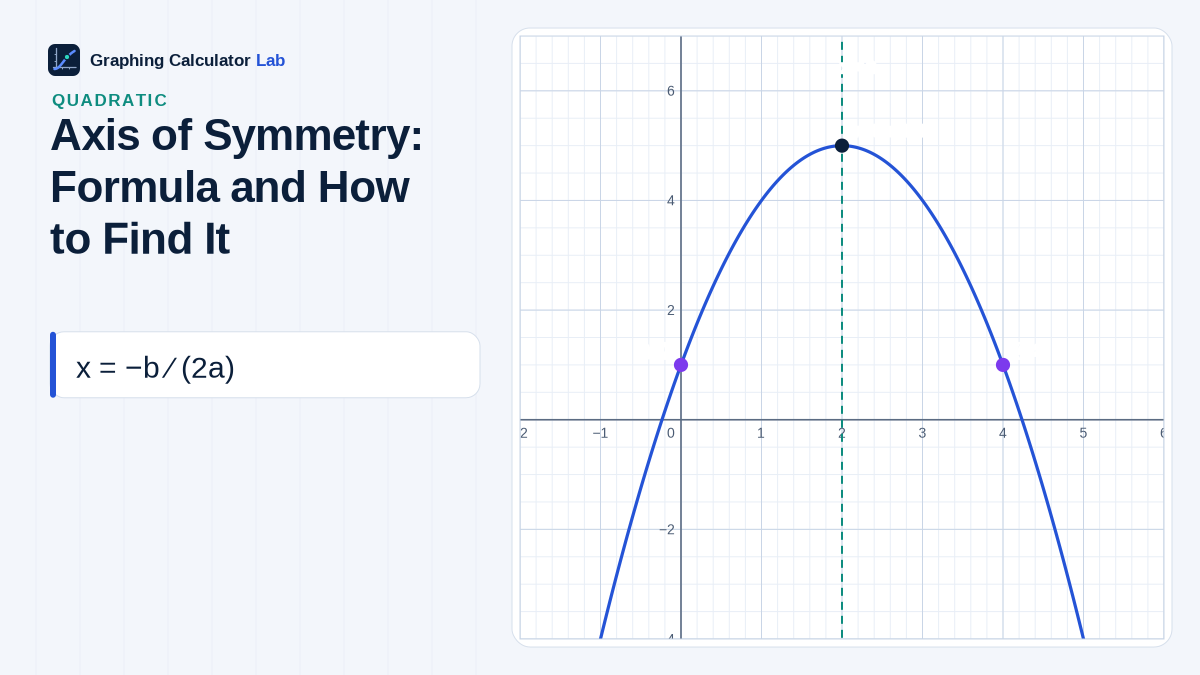
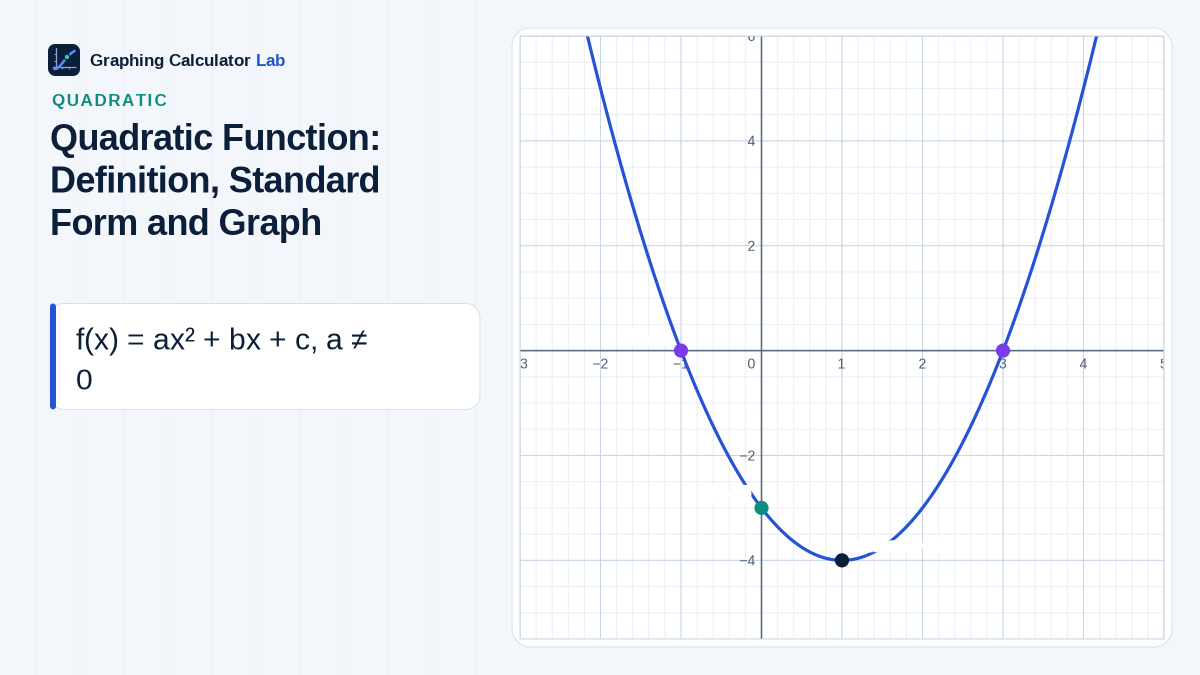
A quadratic f(x) = ax² + bx + c has its only maximum or minimum at the vertex, x = −b ⁄ (2a). If a > 0 the vertex value f(−b ⁄ (2a)) is the minimum; if a < 0 it is the maximum. On a closed interval [p, q], compare the values at p, at q, and at the vertex if it lies inside the interval.
Check it yourself: every example here can be loaded into the Vertex Form Calculator.
Open the Vertex Form CalculatorWhere the extreme value is
A parabola turns around exactly once, at its vertex. So a quadratic f(x) = ax² + bx + c has exactly one extreme value over the real numbers:
| Sign of a | Shape | Vertex is the | Range |
|---|---|---|---|
| a > 0 | opens up | minimum | y ≥ f(h) |
| a < 0 | opens down | maximum | y ≤ f(h) |
Here h = −b ⁄ (2a). The extreme value is f(h), the y-coordinate of the vertex.
Worked example: a thrown ball
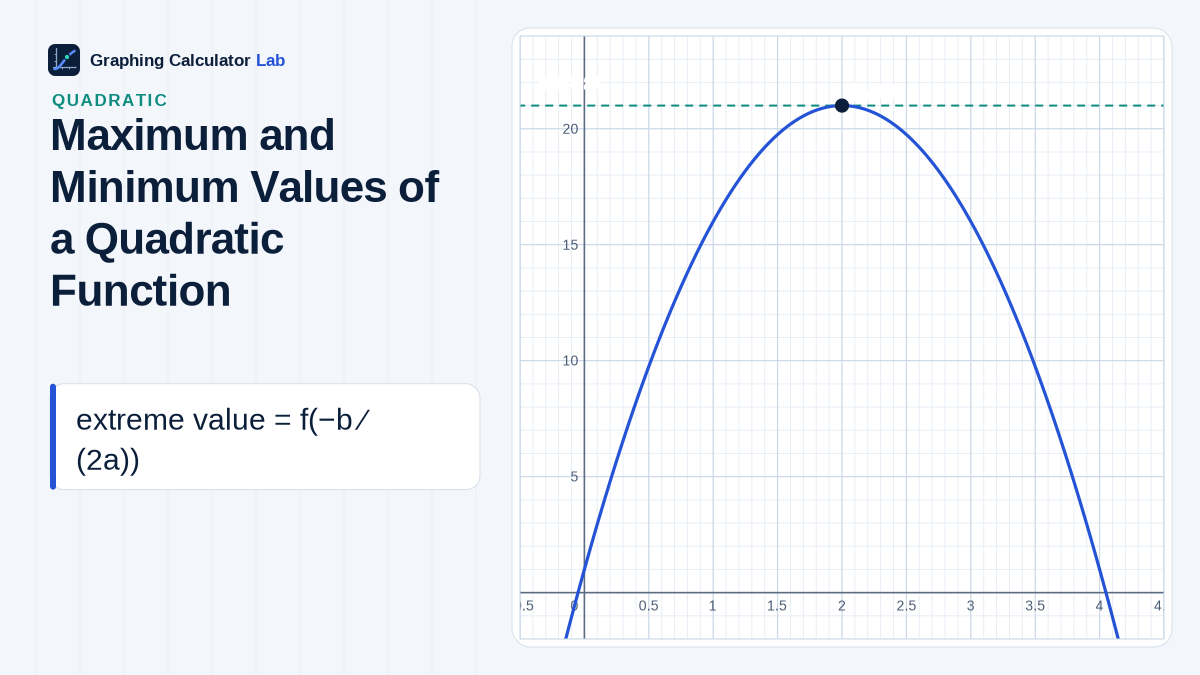
A ball’s height in metres after t seconds is h(t) = −5t² + 20t + 1. When is it highest, and how high does it go?
- a = −5 < 0, so the vertex is a maximum.
- t = −b ⁄ (2a) = −20 ⁄ (−10) = 2 seconds.
- h(2) = −5(4) + 40 + 1 = 21 metres.
So the ball reaches its greatest height of 21 m two seconds after it is thrown. The featured graph above shows the same result.
- Maximum of −5t² + 20t + 1 — opens the Vertex Form Calculator
Using vertex form
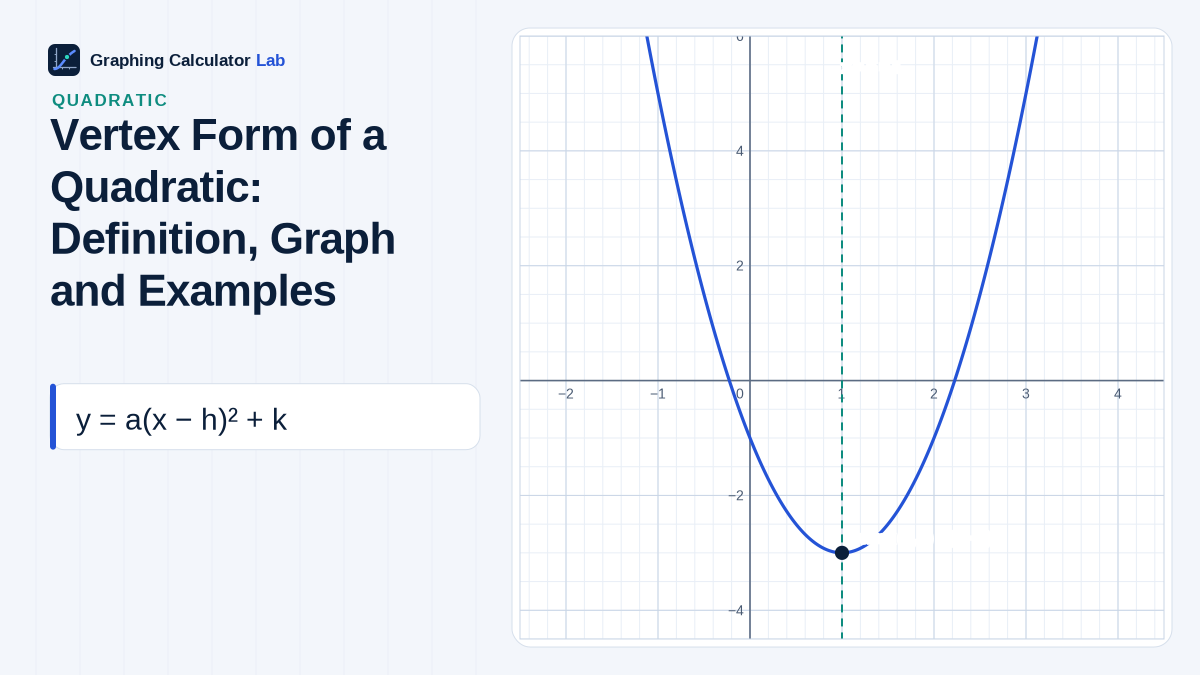
If the function is already in vertex form, y = a(x − h)² + k, you can read the answer directly: the extreme value is k, reached at x = h. For y = 3(x + 4)² − 7 the minimum value is −7 at x = −4. For y = −2(x − 1)² + 9 the maximum value is 9 at x = 1.
Maximum and minimum on a closed interval
Real problems often restrict x — time cannot be negative, a fence cannot be longer than the wire you have. On a closed interval [p, q] the quadratic has both a maximum and a minimum. Use this three-step check:
- Find the vertex x-value h = −b ⁄ (2a).
- Make a list of candidates: f(p), f(q), and f(h) only if p ≤ h ≤ q.
- The largest candidate is the maximum; the smallest is the minimum.
Text description of this figure
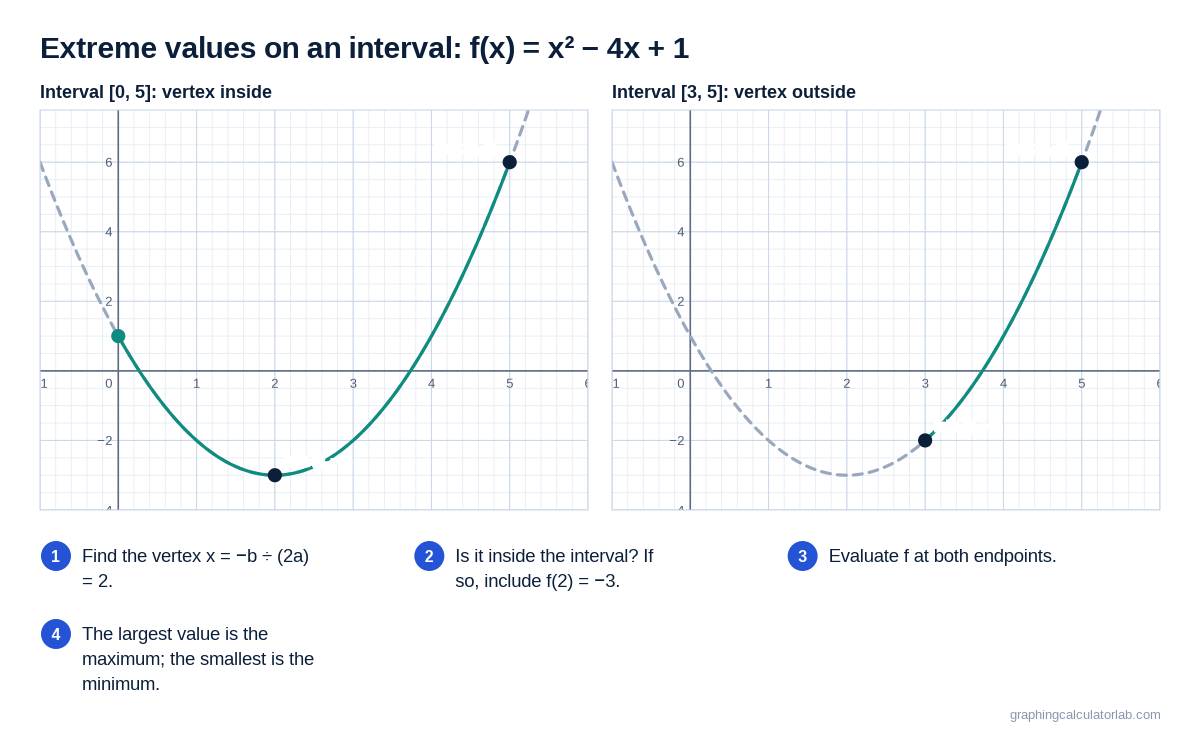
Two panels for f(x) = x² − 4x + 1. Left: on [0, 5] the vertex (2, −3) is inside, so the minimum is −3 and the maximum is f(5) = 6. Right: on [3, 5] the vertex is outside, so the minimum is f(3) = −2 and the maximum is f(5) = 6.
- Find the vertex x = −b ÷ (2a) = 2.
- Is it inside the interval? If so, include f(2) = −3.
- Evaluate f at both endpoints.
- The largest value is the maximum; the smallest is the minimum.
For f(x) = x² − 4x + 1 the vertex is at x = 2 with f(2) = −3.
- On [0, 5]: candidates f(0) = 1, f(5) = 6 and f(2) = −3. Minimum −3 at x = 2, maximum 6 at x = 5.
- On [3, 5]: the vertex is outside, so the candidates are f(3) = −2 and f(5) = 6. Minimum −2 at x = 3, maximum 6 at x = 5.
- x² − 4x + 1 on the interval [0, 5] — opens the Vertex Form Calculator
An optimisation problem
You have 40 m of fence to make a rectangular pen against a wall, so only three sides need fencing. What dimensions give the largest area?
- Let x be the length of each side perpendicular to the wall. The side parallel to the wall is 40 − 2x.
- Area A(x) = x(40 − 2x) = −2x² + 40x.
- a = −2 < 0, so there is a maximum at x = −40 ⁄ (−4) = 10.
- A(10) = 10 · 20 = 200 m². The pen should be 10 m by 20 m.
The domain matters: x must be between 0 and 20 for both sides to be positive, and the vertex x = 10 lies inside it.
Common mistakes
- Giving the x-value as the answer. “The maximum is 2” usually means the maximum value is 21 at t = 2. Read the question carefully.
- Using the vertex when it is outside the interval.
- Calling a > 0 a maximum. An upward parabola has a lowest point, not a highest one.
- Arithmetic with negative a. −b ⁄ (2a) with a = −5 and b = 20 is +2, not −2.
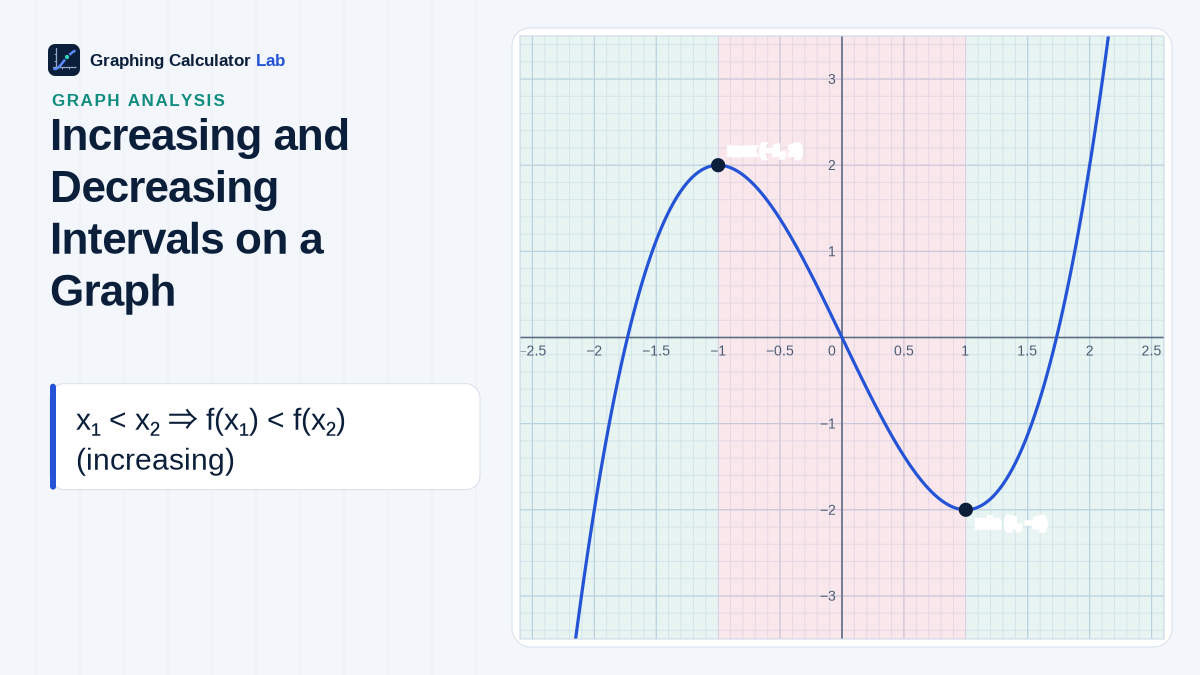
The idea of turning points extends to every function: see increasing and decreasing intervals.
Questions
Can a quadratic have both a maximum and a minimum?
Not over all real numbers: an upward parabola has only a minimum and a downward one only a maximum. On a closed interval it has both, because the endpoints limit how far it can rise or fall.
What is the difference between the maximum value and the maximum point?
The maximum value is the y-value, such as 21. The maximum point is the coordinate pair where it happens, such as (2, 21).
Does the vertex always give the answer on an interval?
Only if the vertex lies inside the interval. Otherwise the function is increasing or decreasing across the whole interval and the extremes are at the endpoints.
Graph your own example with the Vertex Form Calculator — free, in your browser.
Try it nowSources and further reading
- OpenStax, College Algebra 2e — 5.1 Quadratic Functions (maximum and minimum)
- OpenStax, Calculus Volume 1 — 4.3 Maxima and Minima
Worked examples and figures were produced and checked with the Graphing Calculator Lab engine. See the editorial policy.