Convert Between Polar and Rectangular Coordinates
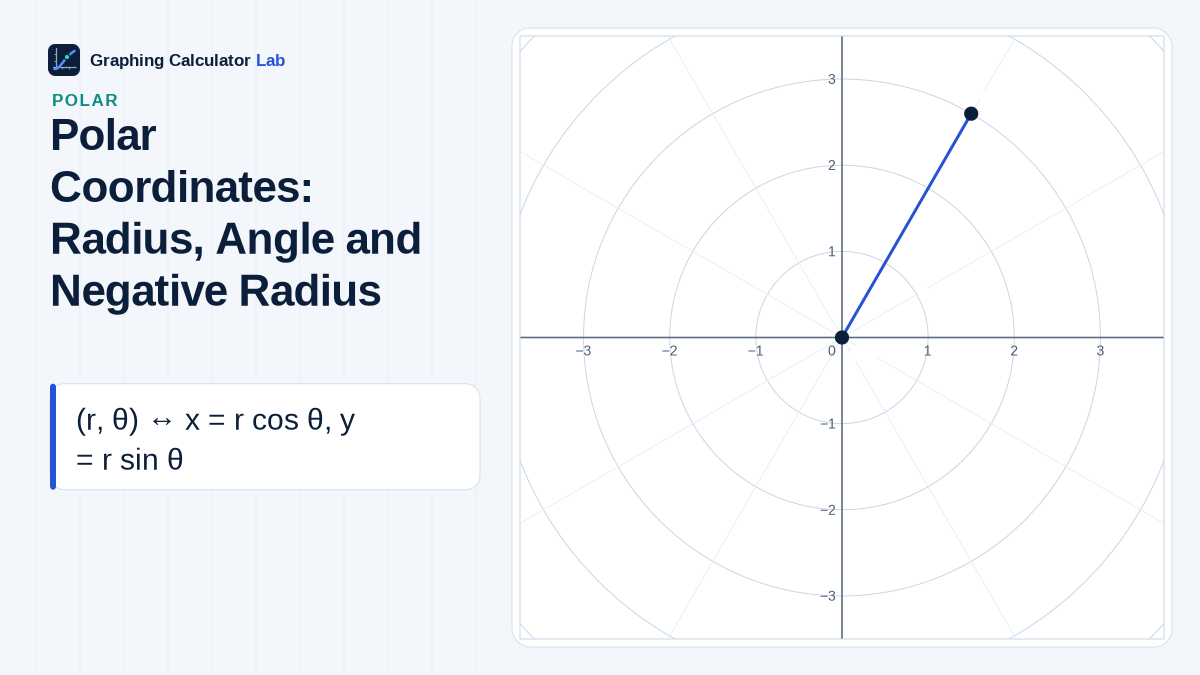
To convert polar (r, θ) to rectangular, use x = r cos θ and y = r sin θ. To convert rectangular (x, y) to polar, use r = √(x² + y²) and θ = atan2(y, x) — or tan θ = y⁄x and then adjust θ by π if the point is in quadrant II or III. Equations convert by substituting the same formulas.
Check it yourself: every example here can be loaded into the Polar Graphing Calculator.
Open the Polar Graphing CalculatorThe formulas
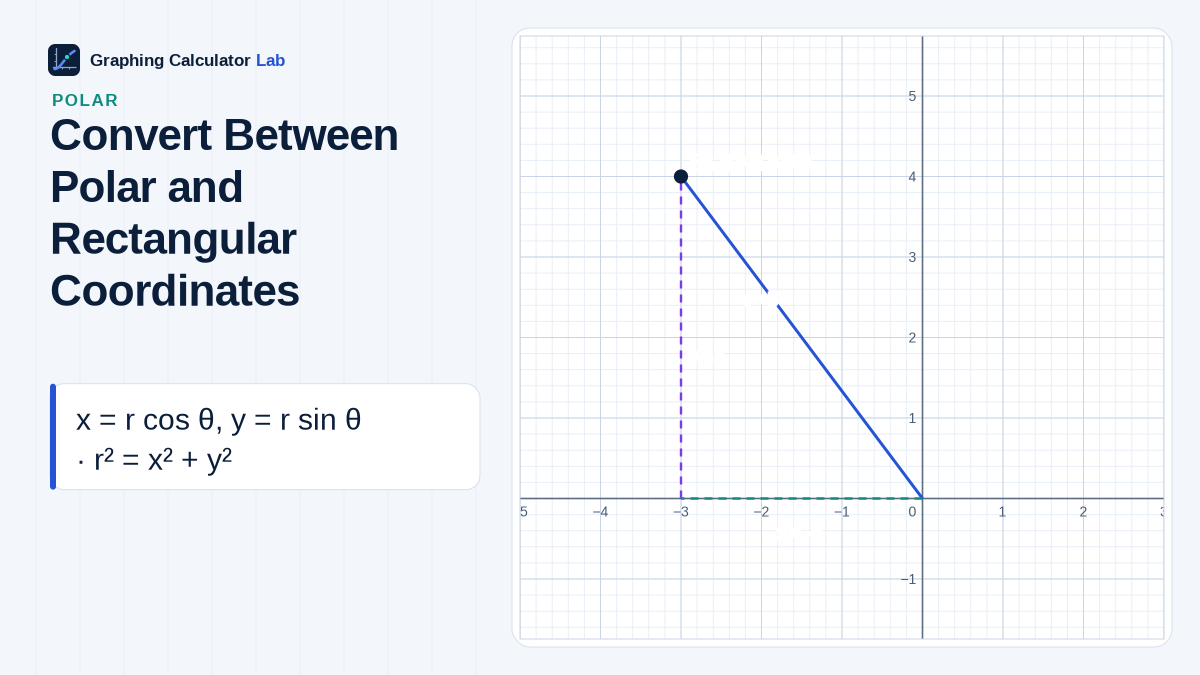
Picture a right triangle from the origin to the point: the hypotenuse is r, the horizontal leg is x and the vertical leg is y.
| Direction | Formulas |
|---|---|
| Polar → rectangular | x = r cos θ, y = r sin θ |
| Rectangular → polar | r = √(x² + y²), θ = atan2(y, x) |
| Useful identities | r² = x² + y², tan θ = y⁄x |
Polar to rectangular
Convert (4, 5π/6):
- x = 4 cos(5π/6) = 4 · (−√3⁄2) = −2√3 ≈ −3.464
- y = 4 sin(5π/6) = 4 · ½ = 2
Result: (−2√3, 2) — in quadrant II, as expected for an angle of 150°.
Rectangular to polar
Convert (−3, 4):
- r = √(9 + 16) = 5.
- tan⁻¹(4⁄−3) = tan⁻¹(−4⁄3) ≈ −0.927 — this points into quadrant IV, which is wrong.
- The point is in quadrant II, so add π: θ ≈ −0.927 + π ≈ 2.214 (about 126.9°).
atan2(4, −3) returns 2.214 directly. Result: (5, 2.214).
Text description of this figure
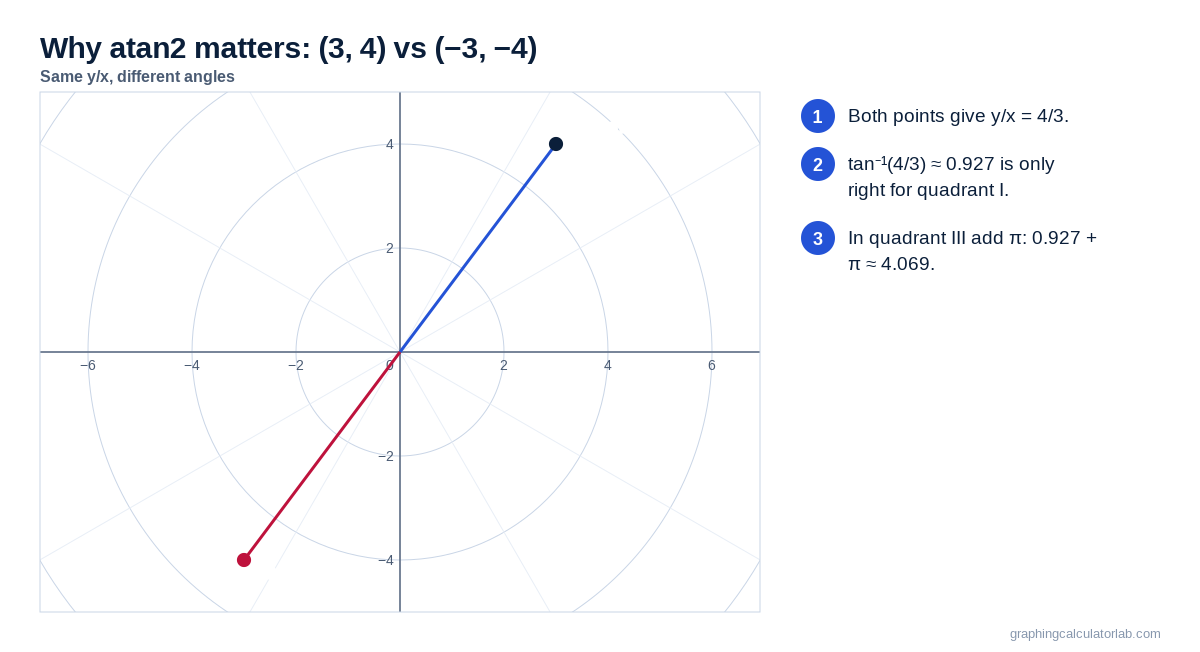
Two points (3, 4) and (−3, −4) with the same ratio y/x = 4/3; tan⁻¹ gives 0.927 for both, but the second point’s angle is 0.927 + π ≈ 4.069.
- Both points give y/x = 4/3.
- tan⁻¹(4/3) ≈ 0.927 is only right for quadrant I.
- In quadrant III add π: 0.927 + π ≈ 4.069.
Quadrant correction rule
If you use θ = tan⁻¹(y⁄x):
| Quadrant | Correction |
|---|---|
| I (x > 0, y > 0) | none |
| II (x < 0, y > 0) | add π |
| III (x < 0, y < 0) | add π |
| IV (x > 0, y < 0) | add 2π (or keep the negative angle) |
On an axis: x = 0, y > 0 gives θ = π/2; x = 0, y < 0 gives 3π/2. The origin has r = 0 and any θ.
- Open the polar calculator’s conversion panel — opens the Polar Graphing Calculator
Converting equations
Use the same substitutions:
- x² + y² = 16 → r² = 16 → r = 4.
- y = x → r sin θ = r cos θ → tan θ = 1 → θ = π/4.
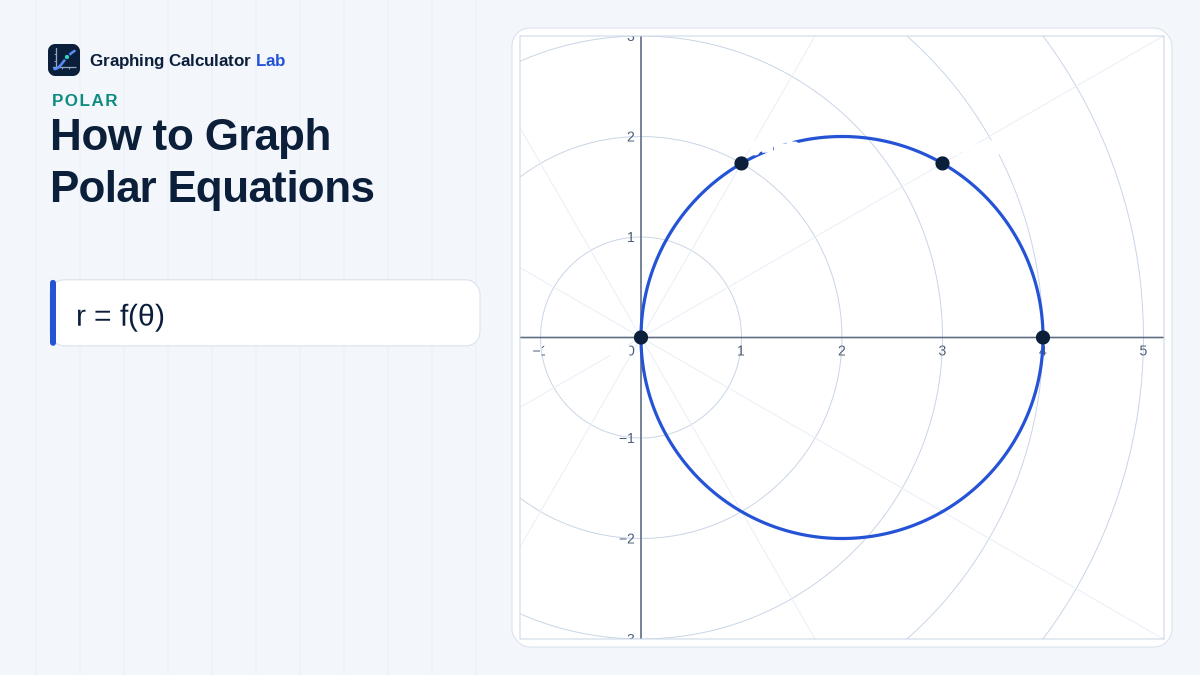
- r = 4 sin θ → multiply by r: r² = 4r sin θ → x² + y² = 4y → x² + (y − 2)² = 4, a circle centred at (0, 2) with radius 2.
- x = 2 → r cos θ = 2 → r = 2 sec θ.
- Graph r = 4 sin θ (a circle x² + (y − 2)² = 4) — opens the Polar Graphing Calculator
Common mistakes
- Using tan⁻¹ without checking the quadrant.
- Forgetting to square both coordinates in r = √(x² + y²) (signs disappear, so (−3)² = 9).
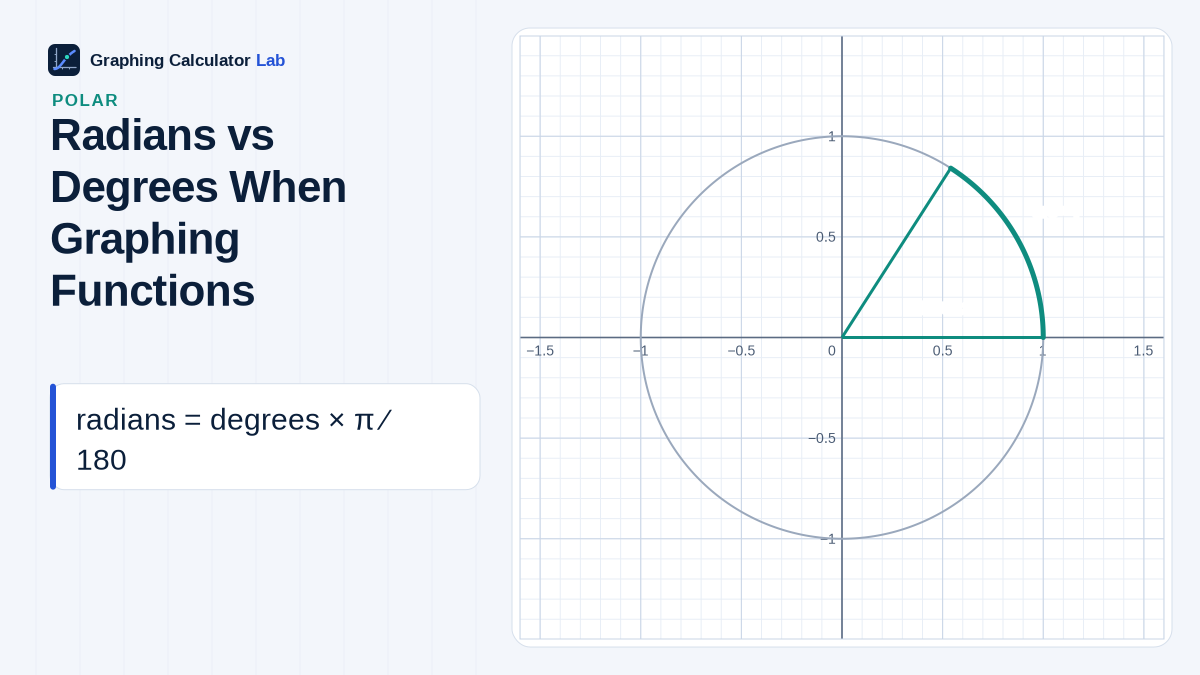
- Degree/radian mix-ups. cos(150) in radian mode is not cos 150°. See radians vs degrees.
- Dividing by r when r might be 0 while converting equations — check the pole separately.
Questions
What is atan2?
A two-argument inverse tangent that uses the signs of both x and y to return the correct angle in (−π, π]. Most programming languages and calculators provide it.
Is the polar form of a point unique?
No. (5, 2.214) can also be written (5, 2.214 + 2π) or (−5, 2.214 − π). Conversions usually give the version with r ≥ 0.
How do I convert an equation like y = 3?
Substitute y = r sin θ: r sin θ = 3, so r = 3 ⁄ sin θ = 3 csc θ.
Graph your own example with the Polar Graphing Calculator — free, in your browser.
Try it nowSources and further reading
Worked examples and figures were produced and checked with the Graphing Calculator Lab engine. See the editorial policy.