The Coordinate Plane: Axes, Points and Quadrants
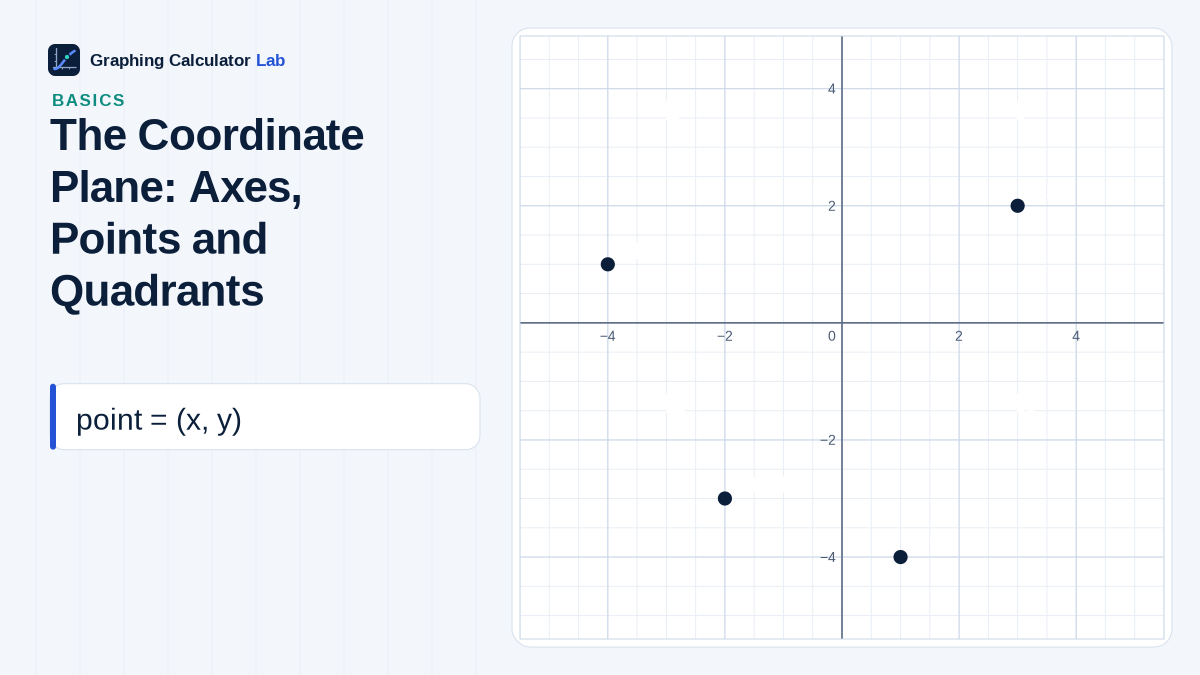
The coordinate plane is a flat grid made by two perpendicular number lines: the horizontal x-axis and the vertical y-axis, which cross at the origin (0, 0). Every point is named by an ordered pair (x, y): move x units across, then y units up or down. The axes divide the plane into four quadrants, numbered I to IV counterclockwise.
Check it yourself: every example here can be loaded into the Graphing Calculator.
Open the Graphing CalculatorThe parts of the plane
- x-axis: the horizontal number line. Right is positive, left is negative.
- y-axis: the vertical number line. Up is positive, down is negative.
- Origin: the point (0, 0) where the axes cross.
- Ordered pair (x, y): the address of a point. The first number is the horizontal position, the second the vertical position.
- Quadrants: the four regions the axes create, numbered counterclockwise starting from the top right.
| Quadrant | Sign of x | Sign of y | Example |
|---|---|---|---|
| I | + | + | (3, 2) |
| II | − | + | (−4, 1) |
| III | − | − | (−2, −3) |
| IV | + | − | (1, −4) |
How to plot a point
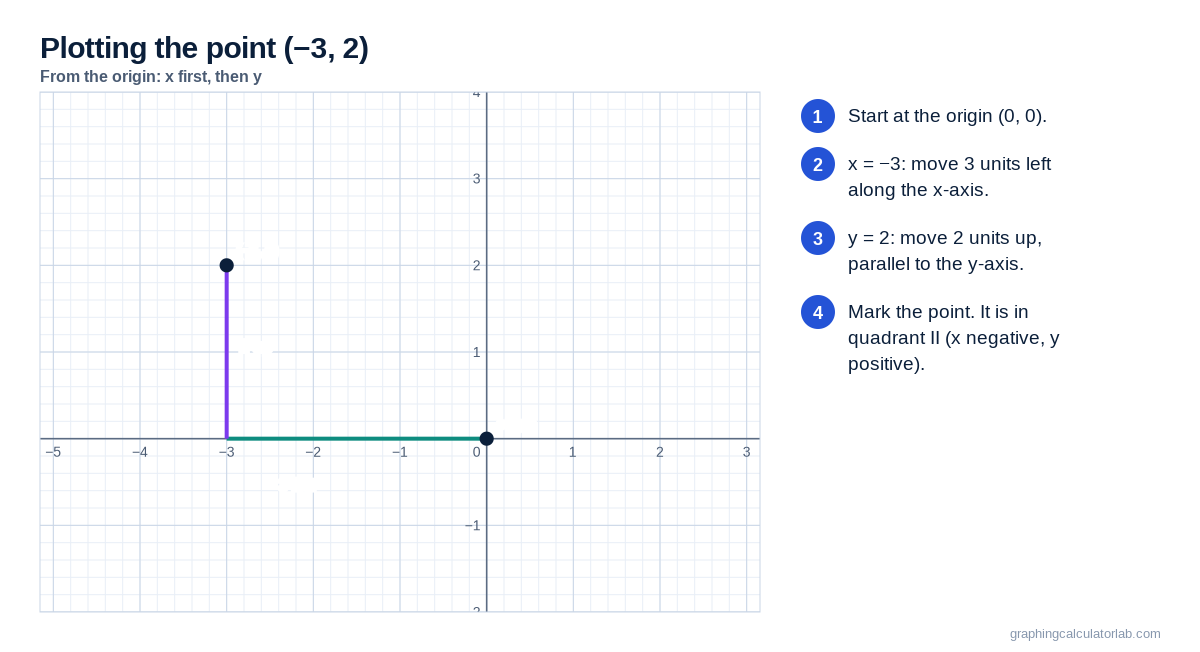
Text description of this figure
Coordinate plane showing a path from the origin 3 units left along the x-axis and then 2 units up to the point (−3, 2) in quadrant II.
- Start at the origin (0, 0).
- x = −3: move 3 units left along the x-axis.
- y = 2: move 2 units up, parallel to the y-axis.
- Mark the point. It is in quadrant II (x negative, y positive).
A helpful phrase is “run, then jump”: run along the x-axis, then jump up or down. For (−3, 2), run 3 left and jump 2 up. Mixing the order — 2 across and 3 up — lands on (2, 3), a different point.
- Plot four points in the four quadrants — opens the Graphing Calculator
How to read a point from a graph
- From the point, look straight down (or up) to the x-axis and read x.
- From the point, look straight across to the y-axis and read y.
- Write them in order: (x, y).
On the graphing calculator, hovering over a point or curve shows its coordinates, which removes guesswork.
Points on the axes
- On the x-axis, y = 0: points look like (4, 0) or (−1.5, 0). These are where graphs have x-intercepts.
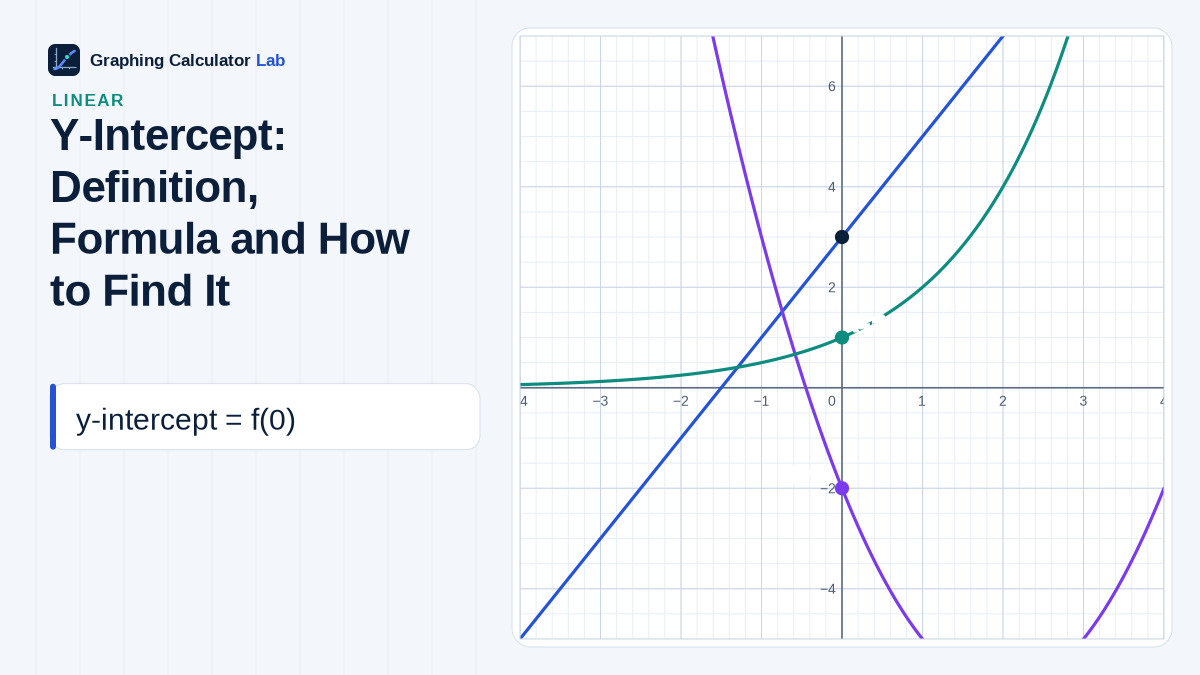
- On the y-axis, x = 0: points look like (0, 3). That is where a graph has its y-intercept.
Distance and midpoint
Two useful formulas for points (x₁, y₁) and (x₂, y₂):
- Distance: d = √((x₂ − x₁)² + (y₂ − y₁)²). From (−2, −3) to (3, 2): √(25 + 25) = √50 ≈ 7.07.
- Midpoint: ((x₁ + x₂) ⁄ 2, (y₁ + y₂) ⁄ 2). For the same points: (0.5, −0.5).
From points to graphs
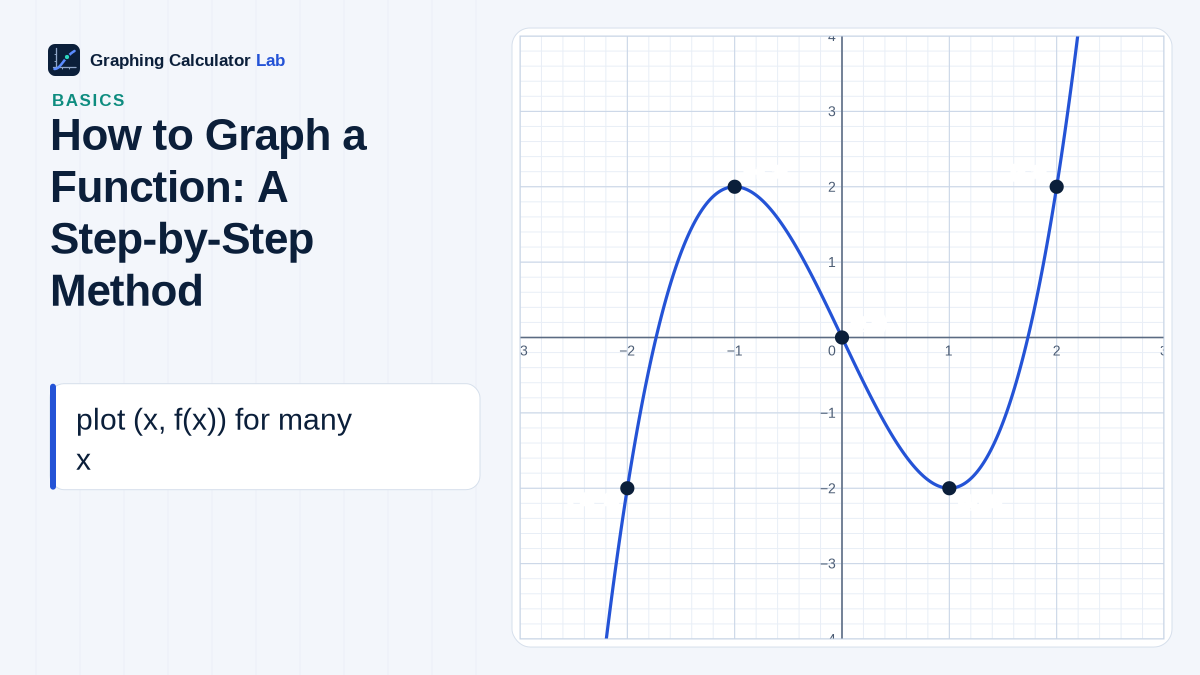
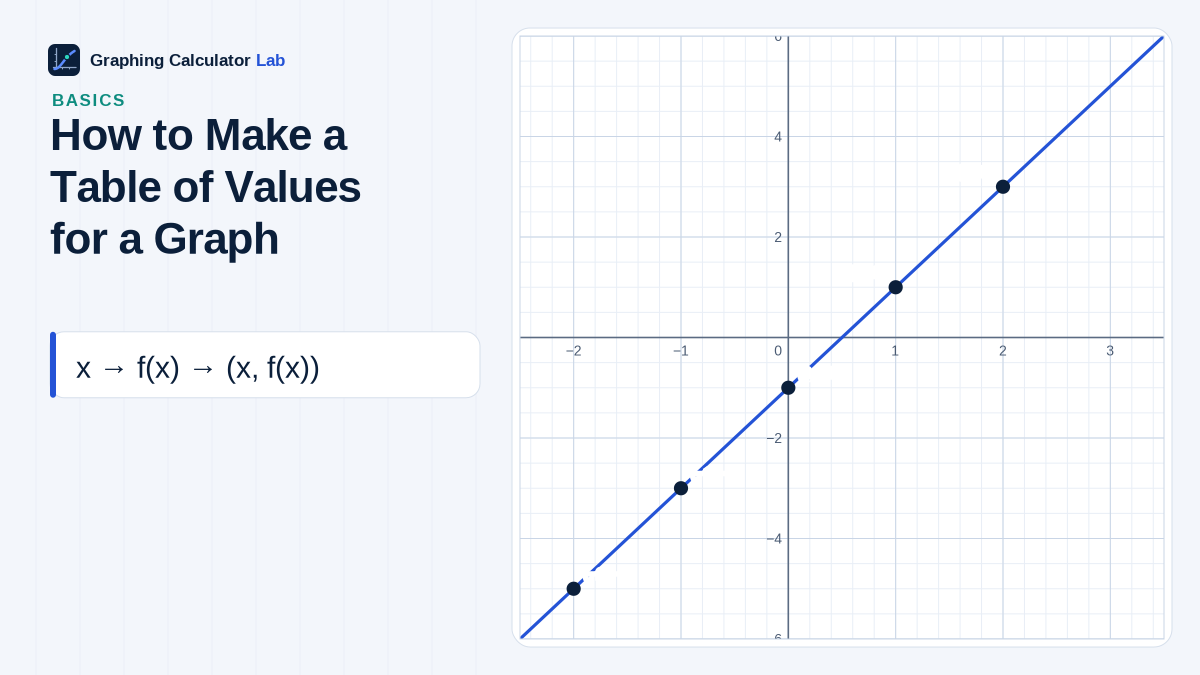
A graph is just a set of points. The graph of y = 2x + 1 is every point (x, y) where y equals 2x + 1, such as (0, 1), (1, 3) and (−2, −3). Plotting a few of them and joining them is the idea behind every graph — see how to graph a function and table of values.
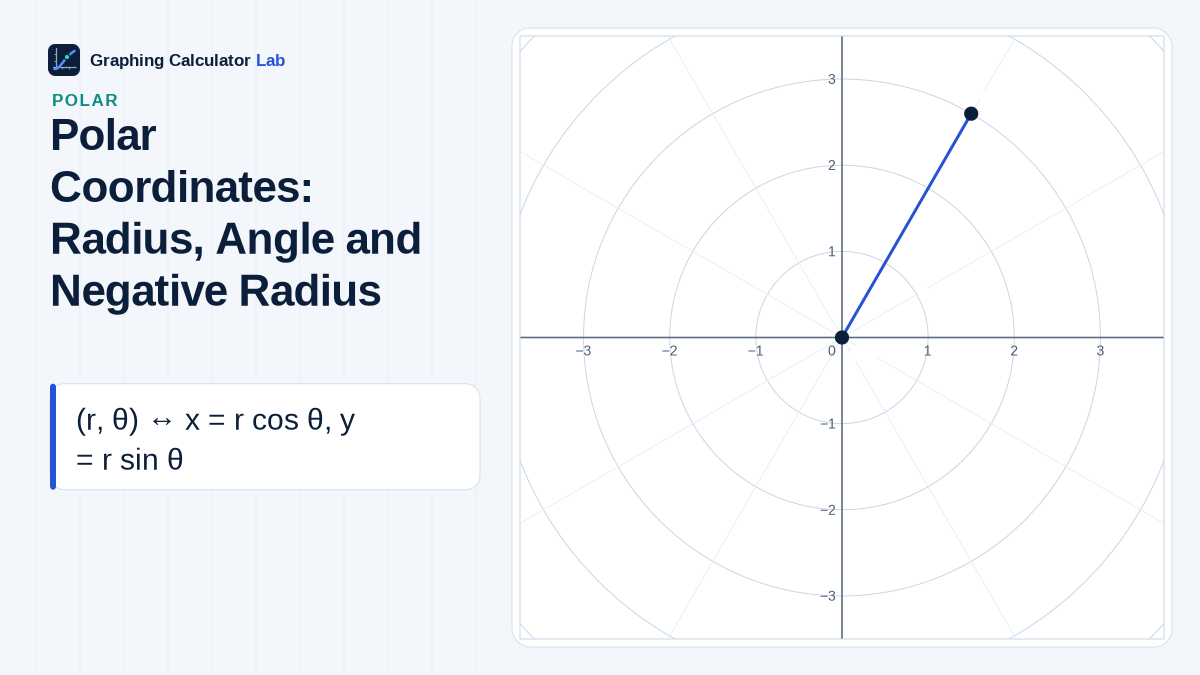
Rectangular coordinates are not the only system. In polar coordinates a point is described by a distance and an angle instead.
Common mistakes
- Swapping x and y. (x, y) is always across first, then up/down.
- Counting from 1 instead of 0. Start counting at the origin.
- Misnumbering quadrants. They go counterclockwise: I top right, II top left, III bottom left, IV bottom right.
- Ignoring the scale. If each grid square is 2 units, three squares is 6, not 3.
Questions
Why is it called Cartesian?
It is named after René Descartes, who used coordinates to connect algebra and geometry in the 17th century.
Which quadrant is a point on an axis in?
None. Points on an axis, such as (0, 5) or (−2, 0), lie between quadrants.
Does the order in (x, y) matter?
Yes. (2, 5) and (5, 2) are different points, which is why it is called an ordered pair.
Graph your own example with the Graphing Calculator — free, in your browser.
Try it nowSources and further reading
- OpenStax, College Algebra 2e — 2.1 The Rectangular Coordinate Systems and Graphs
- OpenStax, Elementary Algebra 2e — 4.1 Use the Rectangular Coordinate System
Worked examples and figures were produced and checked with the Graphing Calculator Lab engine. See the editorial policy.