Y-Intercept: Definition, Formula and How to Find It
The y-intercept is the point where a graph crosses the y-axis. Every point on the y-axis has x = 0, so you find the y-intercept by substituting x = 0 into the equation and solving for y. For a line y = mx + b the y-intercept is (0, b). A function has at most one y-intercept.
Check it yourself: every example here can be loaded into the Slope Intercept Form Calculator.
Open the Slope Intercept Form CalculatorDefinition
The y-intercept of a graph is the point where it meets the y-axis. Because the y-axis is the line x = 0, the y-intercept always has an x-coordinate of 0:
In words: put 0 in for x and see what comes out.
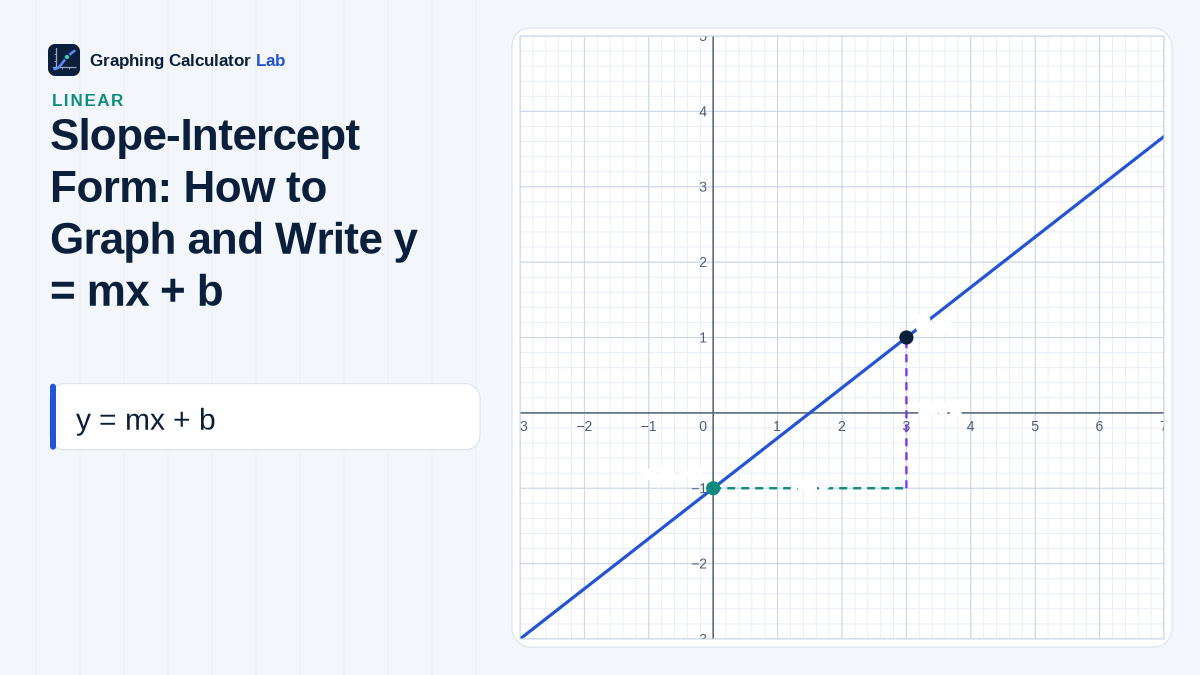
For a line in slope-intercept form
In y = mx + b, setting x = 0 leaves y = b. That is why b is called the y-intercept:
| Equation | y-intercept |
|---|---|
| y = 2x + 3 | (0, 3) |
| y = −x − 7 | (0, −7) |
| y = 5x | (0, 0) |
| y = 4 | (0, 4) |
For a line in standard form
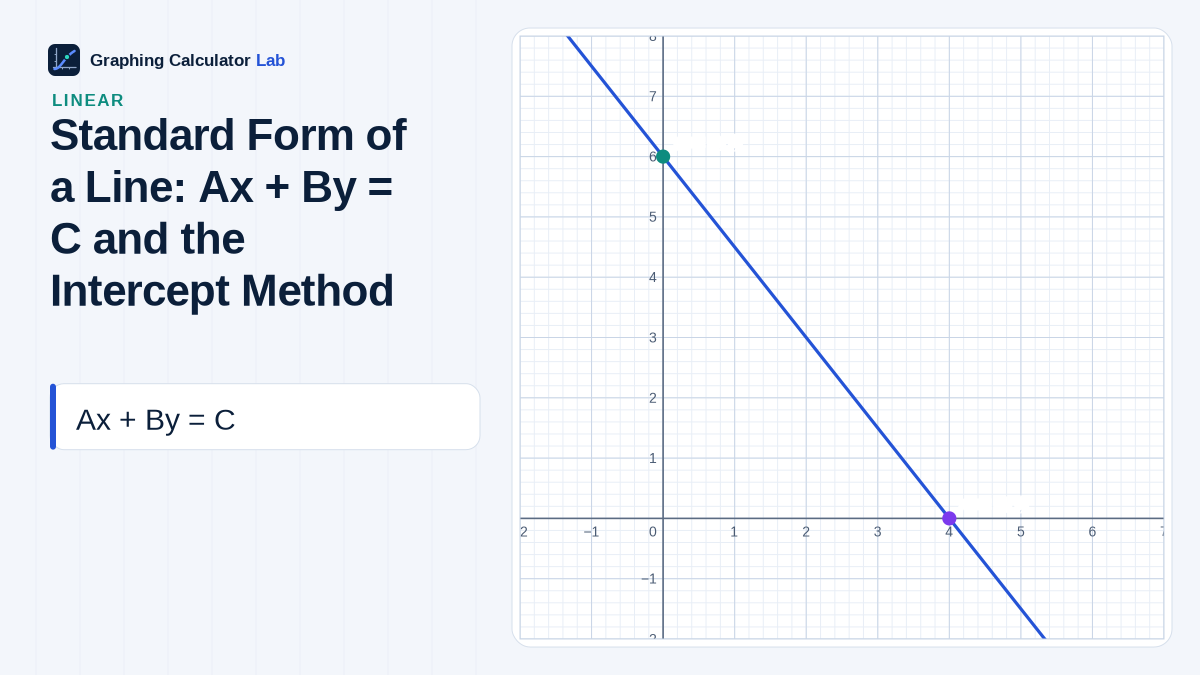
Set x = 0 in Ax + By = C and solve: By = C, so y = C ⁄ B.
For 4x − 2y = 8: −2y = 8, so y = −4. The y-intercept is (0, −4).
- y-intercept of 4x − 2y = 8 — opens the Slope Intercept Form Calculator
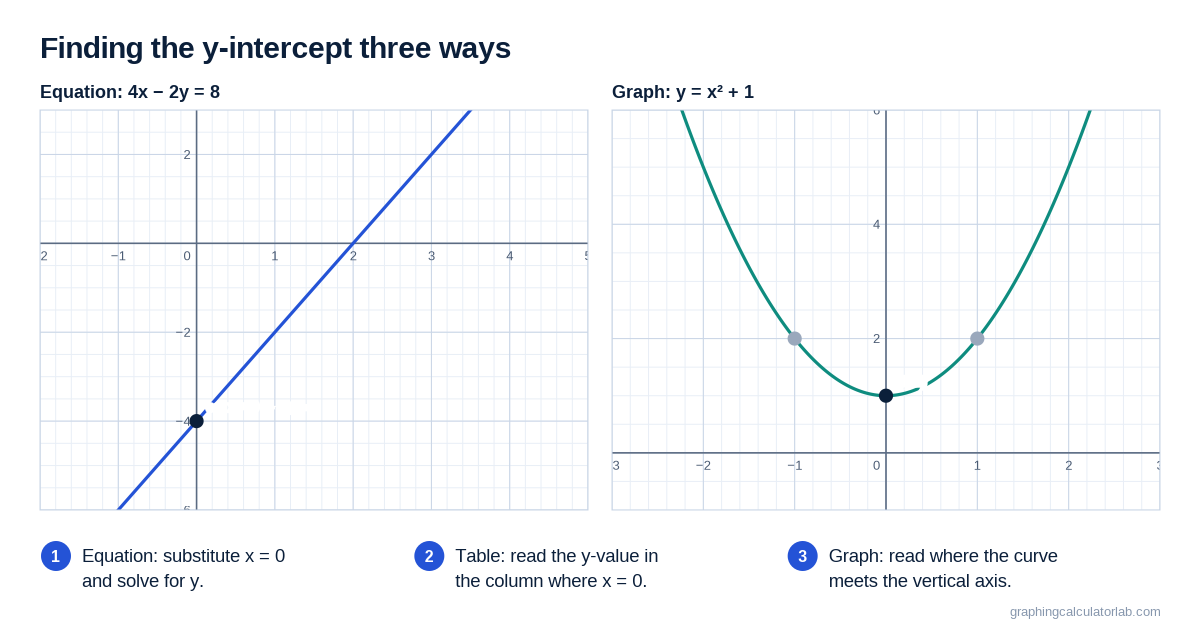
Text description of this figure
Two panels. Left: the line 4x − 2y = 8 crossing the y-axis at (0, −4). Right: a table of values with the y-value at x = 0 highlighted and the matching point on the graph of y = x² + 1.
- Equation: substitute x = 0 and solve for y.
- Table: read the y-value in the column where x = 0.
- Graph: read where the curve meets the vertical axis.
For other functions
The rule never changes: substitute x = 0.
- Quadratic y = x² − 4x − 2: y = 0 − 0 − 2 = −2 → (0, −2). In standard form ax² + bx + c the y-intercept is always c.
- Exponential y = 2ˣ: y = 2⁰ = 1 → (0, 1). Every basic exponential bˣ crosses at 1.
- Rational y = (x + 6) ⁄ (x − 3): y = 6 ⁄ (−3) = −2 → (0, −2).
- Square root y = √(x + 9): y = √9 = 3 → (0, 3).
- Logarithm y = ln(x): ln(0) is undefined, so there is no y-intercept.
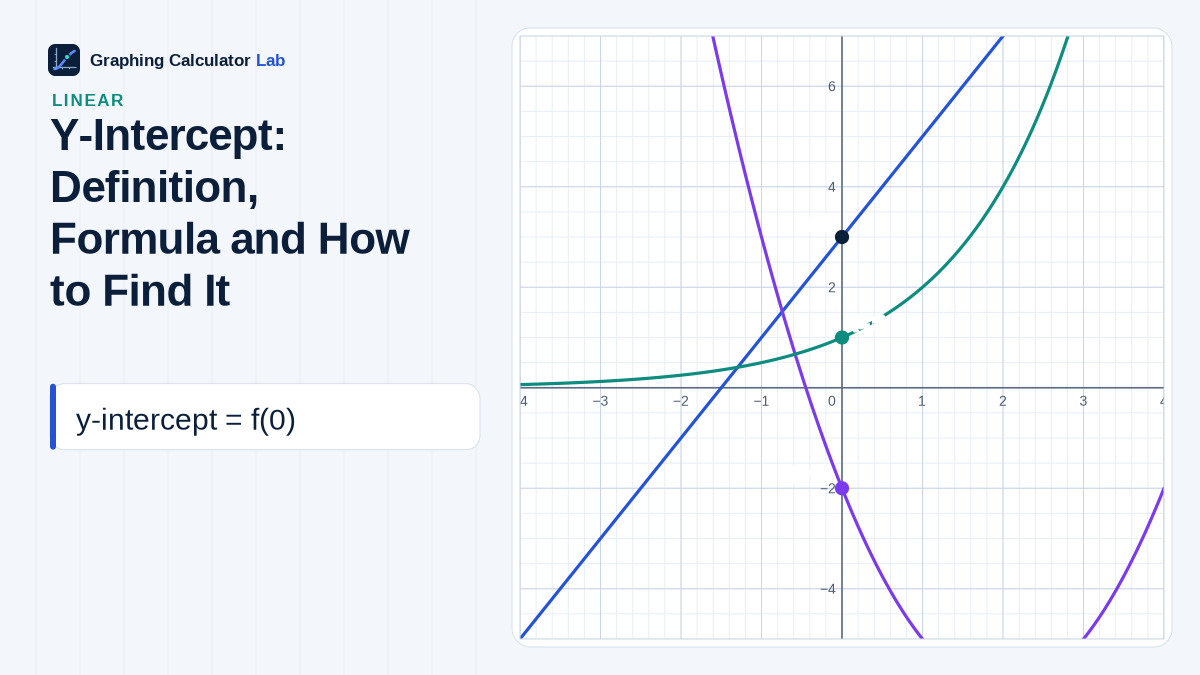
- y-intercepts of three different functions — opens the Graphing Calculator
Reading it from a table or graph
In a table of values, look for the row or column where x = 0. On a graph, look where the curve touches the vertical axis; if it falls between grid lines, estimate and confirm with the equation.
| x | −2 | −1 | 0 | 1 | 2 |
|---|---|---|---|---|---|
| y | 10 | 7 | 4 | 1 | −2 |
Here the y-intercept is (0, 4), and the constant change of −3 shows the line y = −3x + 4.
What it means in context
The y-intercept is usually a starting value — the amount when the input is zero:
- A gym membership costing y = 25x + 50 has a $50 joining fee (x = months).
- A candle whose height is h = −0.8t + 20 starts at 20 cm (t = hours).
- A population P = 1200(1.03)ᵗ starts at 1200.
Common mistakes
- Setting y = 0 instead of x = 0. That gives the x-intercept.
- Reading b from an unsolved equation. In 2y = 6x + 8, b is 4, not 8 — divide by 2 first.
- Writing the point the wrong way round. It is (0, b), not (b, 0).
- Assuming every graph has one. Check whether x = 0 is in the domain.
Questions
Can a graph have more than one y-intercept?
A function cannot, because each x (including 0) has only one output. A non-function such as a circle can cross the y-axis twice.
Can a graph have no y-intercept?
Yes, if x = 0 is not in its domain. y = 1/x and y = ln(x) never touch the y-axis, and neither does a vertical line such as x = 3.
Should I write the y-intercept as a number or a point?
Both are common. The point form (0, b) is clearer, but many textbooks say 'the y-intercept is b'. Follow your course’s convention.
Graph your own example with the Slope Intercept Form Calculator — free, in your browser.
Try it nowSources and further reading
- OpenStax, Elementary Algebra 2e — 4.3 Graph with Intercepts
- OpenStax, College Algebra 2e — 4.1 Linear Functions
Worked examples and figures were produced and checked with the Graphing Calculator Lab engine. See the editorial policy.